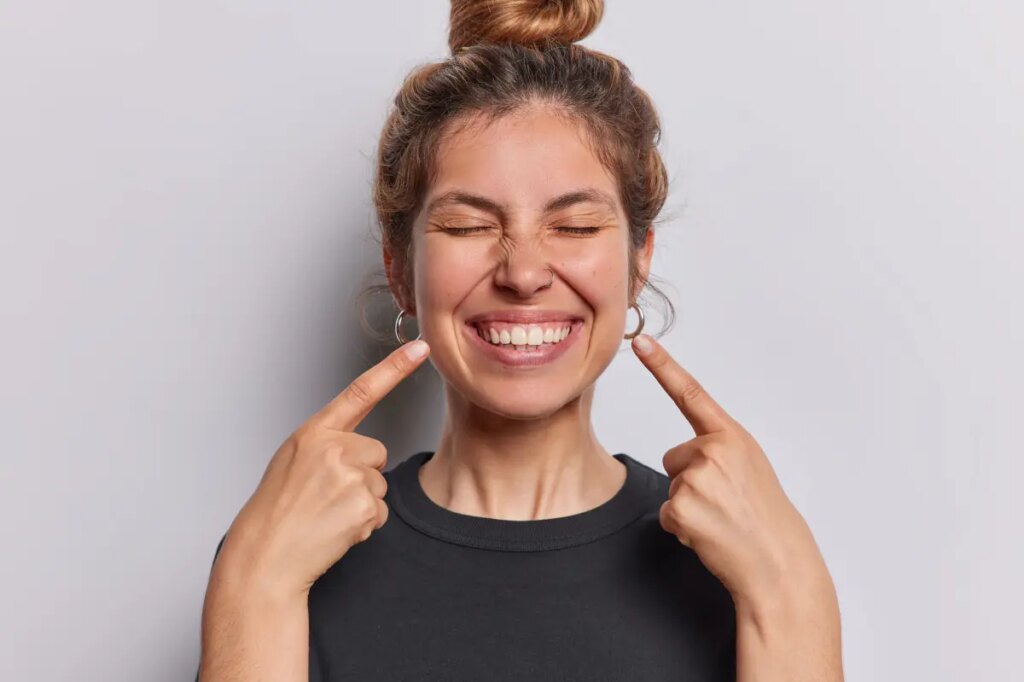
Reminding yourself to smile often can not only make more friendships but it can also make you feel better.
And rather than wait for a reason to smile, just making the physical change of literally turning that frown upside down could impact emotions, according to experts.
Research backs up the fact that smiling goes a long way.
Some older research has focused on this “facial feedback hypothesis,” according to Jeanne Tsai, a longtime psychology professor at Stanford University who runs the Culture and Emotion Lab.
In one classic study in the late 1980s, researchers would have subjects put a pencil between their lips and adopt a smile or a frown while viewing a positive movie clip like a cartoon. Some subjects who smiled would feel the sensation of the smile more and be more amused.
“When we’ve done that demonstration in classes, it works,” Tsai said. “When you’re doing it in a room by yourself, you’re not doing it in a social interaction, maybe it’s making you remember, or it’s an effect of remembering some good thing that happened and that would put you in a better mood.”
At the Orange County Academy of Sciences and Arts in Southern California, the power of a smile is taken very seriously. An entire section on the charter school group’s website is dedicated to its philosophy that a smile can make a difference.
“Smiling creates a supportive classroom culture that makes students relaxed, active, and motivated,” according to the website. “It increases emotional well-being, lowers stress, and gives students confidence.”
How smiling can benefit health
Dr. Judy Ho, a Los Angeles clinical and forensic neuropsychologist who also teaches at Pepperdine University, discusses smiling as a coping strategy with some patients suffering depression or anxiety.
“I’m not suggesting that that’s the only way they can fix things,” Ho said. “It’s just like another thing that you can add to your toolbox.”

Smiling can affect one’s level of cortisol, a hormone the body releases partly to help regulate stress and mood, according to Ho. Smiling can affect brain chemicals that are associated with positive feelings including endorphins, dopamine and serotonin.
“People who smile during stressful tasks generally demonstrated lower heart rates during recovery than those maintaining neutral expressions,” Ho said. “Smiling also reduced aspects of the body’s physiological stress response.”
The hope is if you smile enough, you will start feeling it emotionally.
“In some ways it’s like a mediating effect,” she added.
The value of a smile varies culture to culture
How smiling and even the openness of a smile are perceived are not universal. Tsai, the Stanford professor, has conducted research on how emotion in American culture puts value on trying to always feel positive and minimizing negativity and sadness. In East Asian cultures, emotion is more about balance.
“It’s like the positive and the negative emotions are braided together, and so you don’t want to feel too positive or too negative,” Tsai said. “You want more of a balance between the two.”

Her past studies also examined how European Americans and East Asians — including Taiwanese, South Koreans, Japanese and Hong Kong Chinese — look at a “neutral or a calm” smile versus a full-on grin.
Subjects rated the differing facial expressions on warmth and trustworthiness. While some Americans saw the excited smiles as friendlier, some East Asians characterized those facial expressions as “emotionally unstable” or “unreliable.”
“What kind of smile matters — whether it’s a calm, closed mouth smile more like the Dalai Lama or a big toothy excited smile like Julia Roberts,” Tsai said. “We’ve done some series of studies in Taiwan and other East Asian contexts. They don’t like the big, toothy, excited smile unless it’s really situationally appropriate.”
In Thailand — known as “The Land of Smiles” — smiling is embedded in the culture. There are nearly 30 Thai words for “smile.”
Many teach-abroad programs where people can teach English as a foreign language in Thailand cite that smiling often with children and colleagues is key to showing respect, good manners and calmness.
At the OCASA charter schools, smiling is part of an effort to make children feel seen.
“I’ve always believed in wanting school to be a happy place for kids,” said RaNae Posey, principal of OCASA Capistrano Elementary School. “To actually help them form habits of looking at the bright side of things.”
Mandating smiles may lead to more frowns
Women in recent years have smacked down the idea that they have to smile in the workplace while men do not. Smiling can feel like a Catch-22 for some women and sometimes for people of color who may be stereotyped as unapproachable or cold if they don’t smile enough.
Last year, retailer Target was ridiculed across social media for instituting a smiling policy. Workers had to smile and make eye contact if a customer was within 10 feet (3 meters) and personally greet them if they were within 4 feet (1.2 meters).
People do not like feeling like they have no “emotional autonomy,” according to Nicholas Coles, an assistant professor who runs the Social Science Collaboratory at the University of Florida in Gainesville.
“In those scenarios, what we find is that it’s more that you’re smiling your way to misery,” Coles said. “It’s only when it feels authentic and voluntary that I think it’ll have any real effect.”
With the holidays approaching, more people may have to muster smiles with family if sensitive topics like politics and religion come up. Those could be good times to see if smiling helps.
“If we were able to just smile and be like ’Look, this is somebody that historically cares about you and loves you,’ maybe that would change the way that we respond to them even in a moment of tough conversation,” Ho said.
The post Cracking a smile regularly may be good not just for your mood but for your health appeared first on New York Post.