The push for a new nuclear age to power the AI boom with next-generation reactors remains feasible, but it’s the U.S. military and NASA that are stepping in to expedite the development of even smaller nuclear—so-called microreactors—to power remote bases, revolutionize combat, and fuel deep-space exploration.
As the data center boom slows a bit and the nuclear hype wanes—stock valuations are down and planned IPOs are canceled—the federal government is stepping up funding to support the implementation of microreactors on domestic military bases by 2028. The tentative plans are to eventually extend their reach to remote bases in harsh weather conditions—potentially near combat zones—and eventually to lunar bases and the outer reaches of the solar system.
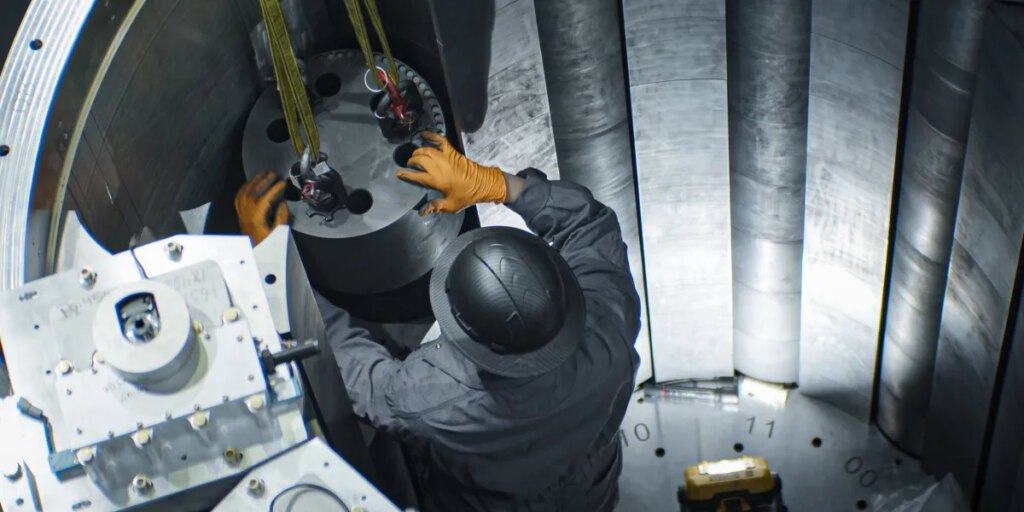
In June, nuclear startup Antares successfully flipped the switch on its Mark-0 microreactor, first to the finish line in the Trump administration’s pilot program race for the next generation of reactors to achieve criticality.
Next, Antares aims to install its 1-megwatt R1 reactor at the U.S. Army’s Fort Bragg in North Carolina by September 2028. Even more ambitious, founder and CEO Jordan Bramble aims to install an R1-S (the S is for “space”) on the moon as soon as 2030. In September, the Department of Defense awarded Antares $161 million to develop an R1-S reactor integrated with spacecraft for flight certification. Solar power and radioisotopes are seen as the shorter-term power solution on the moon with nuclear microreactors considered the permanent fix.
“We’ll need fission power on the dark side of the moon,” Bramble told Fortune. “Fission is going to be our best path to doing very high-powered things in orbit. If we’re going to send landers to Europa and Enceladus and Triton (moons of Jupiter, Saturn, and Neptune) and try to find microbial life under the ice, we’re probably going to need fission power to do that.”
The idea is to provide nimble and reliable baseload power that’s clean, meltdown-proof, and relatively agile for limited power uses. Of course, the technology still needs to be proven in the field commercially and not just in testing labs. Historically, the only comparable uses are within the Navy—for decades—for nuclear-powered submarines and aircraft carriers to avoid constant refueling. “We’ve always believed since the beginning the [Department of Defense] would be the first adopter of advanced nuclear power,” Bramble said. “That’s obvious at this point.”
In the near term, the U.S. Army is working with Antares, Radiant, General Atomics, and more to install microreactors on its biggest Lower 48 bases to prove their reliability and to protect critical defense infrastructure from any grid failures. This is Project Janus, which announced $2.2 billion in awards in August.
The biggest recipient of the Janus awards is microreactor startup Radiant, which specializes in a transportable, 1-megawatt reactor—enough to power about 750 homes—that only takes up the space of “three parking spaces.”
But Radiant has designs for its 1-megawatt Kaleidos system extending far beyond the Lower 48 and its first projects on Fort Benningin Georgia and Buckley Space Force Base in Colorado, said chief operating officer and president Tori Shivanandan.
“The U.S. has struggled, and not just in major conflicts, in supporting troop deployments internationally,” Shivanandan told Fortune. “If you’re moving your troops around and you want defense systems to protect those troops as they’re deployed overseas, you also need to make sure that you have the power available to defend your troops.”
This year’s war in Iran has shown that U.S. military bases throughout the Middle East—and beyond—are vulnerable to drone attacks. Fuel convoys are historically exposed as well, she said. Smaller, more mobile bases that don’t require so much diesel refueling are the potential answer, she added.
“A diesel generator needs to be refueled every one to two days. In previous conflicts in the Middle East, those were our largest targets for our adversaries because fuel convoys create repeatable paths,” Shivanandan said. “Our unit doesn’t need to be refueled for three years.”
The Army view
Jeff Waksman, the Army’s top energy official, likes to recite the popular military saying, “Amateurs talk tactics, professionals talk logistics.”
Waksman, a nuclear physicist by training, is leading Project Janus as well as the earlier Project Pele for a transportable nuclear reactor. “As we look to the future of warfare, it is becoming increasingly electrical,” he told Fortune, referencing drone warfare and much more.
“We have a lot of applications where being able to have a lot of power, not needing to refuel for a long period of time, and being able to do that in a fairly transportable way could be absolutely game changing,” he said, noting that Janus is the Roman god of new beginnings and transitions. “So, we are trying to lead the nation on these microreactors.”
The Army’s goal is to speed up microreactors into becoming commercially successful and, therefore, more economic and useful to the military. After all, no company wants to buy the first few that are economically prohibitive, so the Army is jumping in financially and then helping the economies of scale take over. Project Janus plans to fund 20 microreactors for Lower 48 bases through the early 2030s.
Afterwards, he said, “We are certainly thinking about what it would take to move reactors into more austere locations,” Waksman said, citing tactically strategic positions in the Arctic or Pacific islands to power missile-defense systems and more. But he’s not ready to push for microreactors near combat—yet. “We don’t have any plans at this time to take these into conflict zones. We want to be clear about that.
“You can see into the future potential game-changing capabilities,” he said. “But we need to see that this works safely and affordably within the Lower 48 states first.” And he cautioned against the Army—or the public—getting ahead of itself. “It’s one thing to turn a reactor on for five minutes at low power. It’s another thing to turn a reactor to full power, which nobody has done with these microreactors.”
What’s also clear is the military sees the potential of nuclear as the most reliable and steady power source for the future. The initial goal is not to power entire bases, but to focus instead on the critical operations that must stay online during grid outages, especially in this age of AI and rising cybersecurity threats. The microreactors would serve as permanent power sources, and not just backup generation.
“Most of the electricity is not what we would necessarily consider critical, operationally critical. If people can’t get lunch, that’s a problem, but that’s not national security critical,” Waksman said. “We’re focused on what the critical operations are on those installations.”
Competing approaches
While many of the next-gen nuclear leaders are startups, 71-year-old General Atomics also aims to trailblaze with a souped-up, commercial version of its training and research TRIGA reactor, which was initially developed in the late 1950s.
General Atomics’ GA-TES (Tactical Energy System) reactor, which would scale from 5 to 20 megawatts as needed, is first slated for at Fort Hood in Texas.
Christina Back, GA’s vice president for nuclear technologies and materials, essentially agrees with Antares’ Bramble that strong commercial demand for nuclear will be at the two ends of the spectrum: large, next-gen reactors, such as the Westinghouse, 1.1-gigawatt AP1000, and microreactors. The midsized, small modular reactors (SMRs) in development may struggle to find enough takers.
The GA-TES reactor is air-cooled, so it doesn’t even need to be positioned near water, such as with traditional light-water nuclear power plants.
“It’s good for places that are remote. It costs a lot of money to move the fuel up there. You don’t want to have to keep carting up coal or natural gas or whatever,” Back said, citing everywhere from Guam to Alaska and noting that the General Atomics system only needs to be refueled every four to six years.
In competition with each other, the microreactor companies aren’t afraid to criticize each other, even if they don’t cite them by name. Back said General Atomics didn’t need to bother competing in Trump’s criticality race because the TRIGA test reactors are proven for nearly 70 years.
Back also said a 1-megawatt reactor seems pointless because the Army needs more power for a base and the commercial demand is limited. Taking a microreactor into a combat zone is impractical because of the many days needed to set it up and break it down.
General Atomics is well positioned and doesn’t need to hype itself, she said. “As a company, we don’t need to worry about the next Series A startup money, so we are very careful about what we say.”
Radiant and others would of course disagree. After all, Radiant’s Kaleidos is focused on being the most transportable, while most microreactor systems are designed to stay in one place for prolonged periods of time—although they can be mobile. Shivanandan said she’s most “confused” by the microreactor companies that require digging holes at least 50 feet in the ground.
“Once you dig a hole in the ground and put a reactor in there, that is a nuclear site forever,” Shivanandan said. “You’ve limited the customer for those in-ground systems mostly to utilities. No [other] customer wants to be a nuclear cipher forever because business is changing incredibly quickly.”
What the rivals do agree on though is they’re excited about the Trump’s administration’s efforts to expedite permitting for nuclear projects, as well as the growing bipartisan support within Congress as the 2011 Fukushima nuclear disaster in Japan moves away from the forefront of people’s minds.
“We tend to be very conservative because the nuclear industry can’t afford an accident,” Back said, before adding another dig. “We’re [taking] a little bit longer than the 1-megawatt startups hurrying to show it works, because we’re building something to last.”
The post The U.S. military and NASA have power problems. Nuclear microreactors might solve both appeared first on Fortune.