In today’s edition … Hyperlocal ads … Changing your mind about politics … but first …
Time for ‘safe’ Republicans to actually campaign
Republicans in Mississippi, especially those running for Senate, aren’t supposed to face serious challenges. The Democrats’ last Senate win in Mississippi was in 1982 — before your newsletter writer was born.
But the poor national environment for Republicans, fueled by President Donald Trump’s unpopularity and the GOP-controlled Congress going along with Trump’s tariffs and war in Iran (both of which have led to higher prices), have pushed incumbent Sen. Cindy Hyde-Smith into an unexpectedly tough race against Democrat Scott Colom, forcing the Republican to do something odd: Campaign.
It hasn’t gone great.
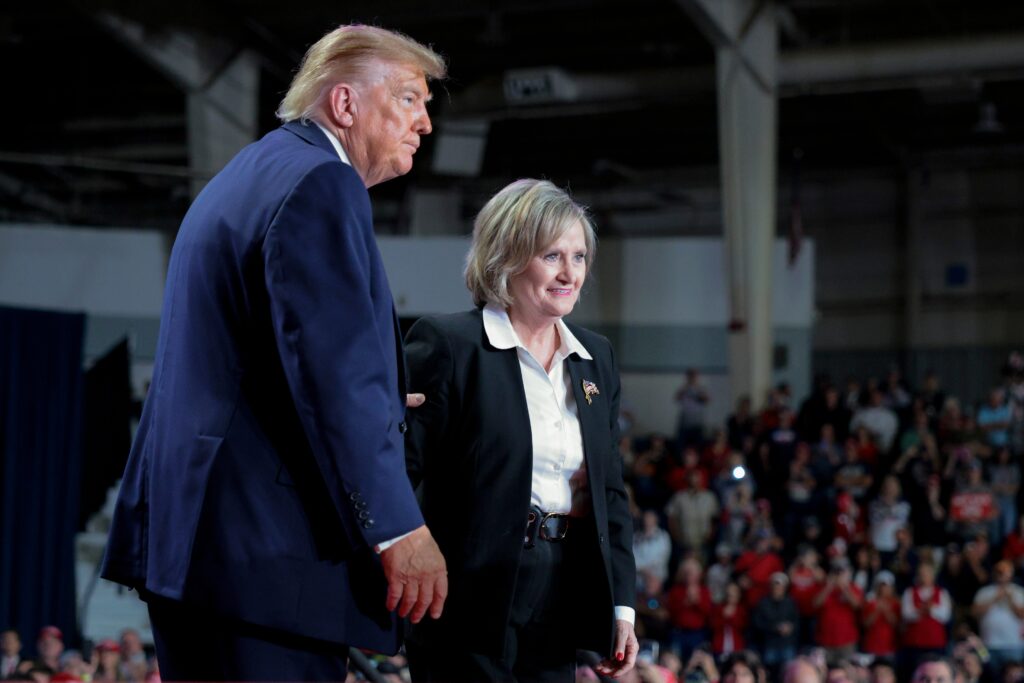
Hyde-Smith has raised a little over $6 million in her reelection bid, not insignificant, but far less than other Republican incumbents in tough races. Trump traveled to Mississippi on Monday night to stump for Hyde-Smith, and her brief speech made it clear she was relying on a president who won the state less than two years ago by 23 percentage points for help.
“Is this not the best president in our lifetime?” she exclaimed, before exiting stage left.
Hyde-Smith hasn’t exactly been using the media to her advantage, from calling security on a reporter in the Capitol to saying again in a recent interview that consumers can turn to proteins other than beef amid high prices, doubling down on a comment her opponent happily turned into a viral attack ad.
“Thank goodness when mothers want to feed their families when you go out shopping, there are proteins, you want to feed meat, there are some cheaper prices,” she said.
Hyde-Smith certainly may still win. She is the favorite. It is Mississippi, after all.
But her campaign reflects a broader trend in this year’s midterms: Republicans who haven’t had to campaign in years are being forced to do so by the national environment — and, in some cases, surprisingly strong Democratic opponents. And conditions like this can lead to a few surprises.
“Incumbents who aren’t ready for their reelection are not only caught asleep at the wheel, but they are also the ones who are most easily viewed by voters as part of the problem,” said Jesse Ferguson, a longtime Democratic operative. “In a change election, the incumbent who is unprepared is also the incumbent who owns all the baggage of the status quo.”
Republican incumbent Sen. Roger Marshall in Kansas is another example of this trend. He won his first Senate term by double digits. Before that, Marshall won his 2018 House race — a good year for Democrats — by over 36 percentage points.
Marshall, however, is in the race of his life this year, facing Democrat Adam Hamilton in a Senate race that could be the cycle’s most fascinating contest.
Marshall has raised $6.9 million this cycle — again, not an insignificant amount of money — but a pittance compared with other Republican incumbents and far less than the $16.3 million Hamilton has raised. Marshall has also been challenged on the campaign trail. The first debate between the two candidates turned into a raucous affair, with audience anger boiling over at Marshall, and the Republican has been hit over his comments dismissing high gas prices and over a story about his referral of patients with medical debt to law enforcement.
Like Hyde-Smith, Marshall could still win and is probably the favorite. A Democrat hasn’t won a Kansas Senate race since 1932. (Definitely wasn’t born then!)
Even clearer examples appear in the House race. In Colorado, Republican Rep. Lauren Boebert moved districts ahead of the 2024 elections to run in a deeper red district. Yet this cycle, Democrat Eileen Laubacher is pushing her, seizing on her position as a Democratic bogeywoman by raising a staggering $13.7 million, compared with Boebert’s $1.2 million.
In southern Minnesota’s congressional district, which Trump won by double digits in 2024, Republican incumbent Rep. Brad Finstad is in a real race against Democrat Jake Johnson, with the Democrat outraising the Republican throughout the campaign and outside Democratic groups now pouring millions into the contest.
The same has previously happened on the other side of the aisle.
Some Democrats in Massachusetts weren’t used to serious competition in 2010. And yet a bumbling special election campaign by Democrat Martha Coakley against Republican Scott Brown — who can forget Coakley dismissing complaints about her campaign style with: “As opposed to standing outside Fenway Park? In the cold? Shaking hands?” — presaged a tough environment for Democrats in the midterms. Later that year, 18-term Democratic Rep. Jim Oberstar lost his Minnesota seat to a Tea Party-backed Republican in a district the Democrat had won by 35 percentage points two years earlier.
Struggling incumbents are always more vulnerable during wave years, and though the environment isn’t good for the GOP, redistricting makes a true wave less likely. As Ferguson notes, going into 2010, 48 Democrats represented seats that GOP Sen. John McCain won in 2008, compared with just three Republicans this year in districts Vice President Kamala Harris won in 2024.
“You can have a big wave from the electorate, but it crashes up on the dunes more quickly now,” Ferguson said. “The wave can be just as big, but it is not going to result in the same sort of thing.”
That means this year’s election results will answer an interesting question: Are economic conditions and Trump’s unpopularity so bad that incumbents who should have no chance of losing are kicked out of Congress? We’ll all find out together next week.
Want this in your inbox?
Start your day with The Washington Post’s flagship political newsletter. Sign up here.
From across the newsroom
- How Trump and his allies are sowing doubt ahead of the midterms, from Laura Meckler, Chris Hacker and Patrick Marley.
- Trump’s arch would cast shadow on Arlington Cemetery, from Jarrett Ley, Aaron Steckelberg and Dan Diamond.
- Costs outpaced wages in more GOP-held battlegrounds, Post analysis shows, from Federica Cocco, Erin Cox and Amy L. Wong.
- Why these Arab Americans who voted for Trump now back Abdul El-Sayed, from Laura Beveridge.
- Justice Dept. charges James Comey, ex-FBI director, for a third time, from Perry Stein and Jeremy Roebuck.
- Bob Woodward spills his ‘Secrets’, from Craig Whitlock.
- Anthropic reveals $80 billion loss, surging revenue as it prepares to go public, from Gerrit De Vynck and Miriam Waldvogel.
What I’m watching
You are undoubtedly being inundated with campaign advertising right now — on television, on your computer, on your phone, in your mailbox.
At this point in the election, campaign ads are intentionally grabby, trying to break through the media slog and stick in your mind. But one outside group is taking a different, novel tactic: hyperlocal.
Government That Works PAC — an outside group that has spent millions on Democrats this cycle and is focused on restoring trust in government — has been airing a slate of ads that target voters with hyperlocal figures and issues, like high school football coaches or specific hospital closures, all in the hope of overcoming voters’ trust issues.
One spot features Roy Knight, a longtime football coach at Lufkin High School in East Texas, touting his support for James Talarico, the Democrat running for the Senate in Texas. “With James Talarico, you’ve got a man who works hard for other people more than he works for himself,” Knight says.
The group is targeting specific areas by airing ads featuring small-town mayors hitting Ken Paxton, Talarico’s Republican opponent.
“I voted Republican for most of my life,” says Helen Larsh, a former mayor of Silsbee, Texas, a tiny town in East Texas. “I can’t vote for somebody that I don’t believe has integrity.”
The group is also airing radio ads in Iowa that tie hospital closures to the One Big, Beautiful Bill Act, and it has created 11 versions that call out the specific impacts on local hospitals in other areas.
“The theory of the case is that with so little trust in major political parties these days, these local trusted messengers will break through and connect with critical voters,” said Lauren Hitt, a spokesperson for the group.
In your local paper
Baltimore Banner: Former president Barack Obama released an ad yesterday urging Maryland voters to back a ballot question that would make it easier to redistrict the state. Some Democrats hope they could draw out a Republican district next year.
Minnesota Reformer: If Democrat Peggy Flanagan wins her Senate race in Minnesota, she would be the first Native American woman to serve in the U.S. Senate. The same would be true for Democrat Mary Peltola in Alaska.
Virginia Mercury: Anger over license plate readers continues to grow, and a Virginia prosecutor’s decision not to charge a police officer for sharing data with federal authorities could change state law.
From you
Changing your mind is part of life, and many of your emails yesterday show how your political views have changed over the course of your life.
“My parents were Eisenhower Republicans, and so was I until my final year of college,” wrote David Olsen. “In those days, defenders of social justice could be found in the GOP. No longer.”
“I was a Republican for 48 years,” wrote Joe Wisinski. “When Trump announced for president in 2015, I looked at his website and thought, ‘I agree with that, and that. Maybe he’ll be my guy in the primaries.’ But I quickly realized, ‘This guy’s no Republican.’ In 2020 changed my registration to Democrat. To paraphrase Ronald Reagan, ‘I didn’t leave the Republican Party. It left me.’”
Tamara Myers described herself as a 65-year-old Republican who before 2020 only once voted for a Democratic presidential candidate — Jimmy Carter in 1980.
“Sadly, I didn’t even vote in 2016. That was the first time I did not vote in a presidential election. I was just too conflicted. I did not like Hillary Clinton one iota. Trump was definitely not receiving my vote. I deeply regret not voting for Hillary Clinton now,” wrote Myers. “My first vote for a Democrat was in 2020 for Joe Biden. This year, I’m voting all Democrat.”
And Ellen Weslow submitted the funniest email of the day: “I’m 81 years old. When I first voted (I’ve never missed a vote), I was a flaming liberal. Now I’m just a liberal.”
Send a reply
Almost all campaign ads that will hit the airwaves have been released — some good, some bad, some plain odd. What have been your favorites? What have been your least favorites? And what do you think makes a good campaign ad? Let me and your fellow Early Brief readers know at [email protected].
Thanks for reading. You can follow me on X at @merica.
The post A tough environment forces ‘safe’ Republicans to actually campaign appeared first on Washington Post.