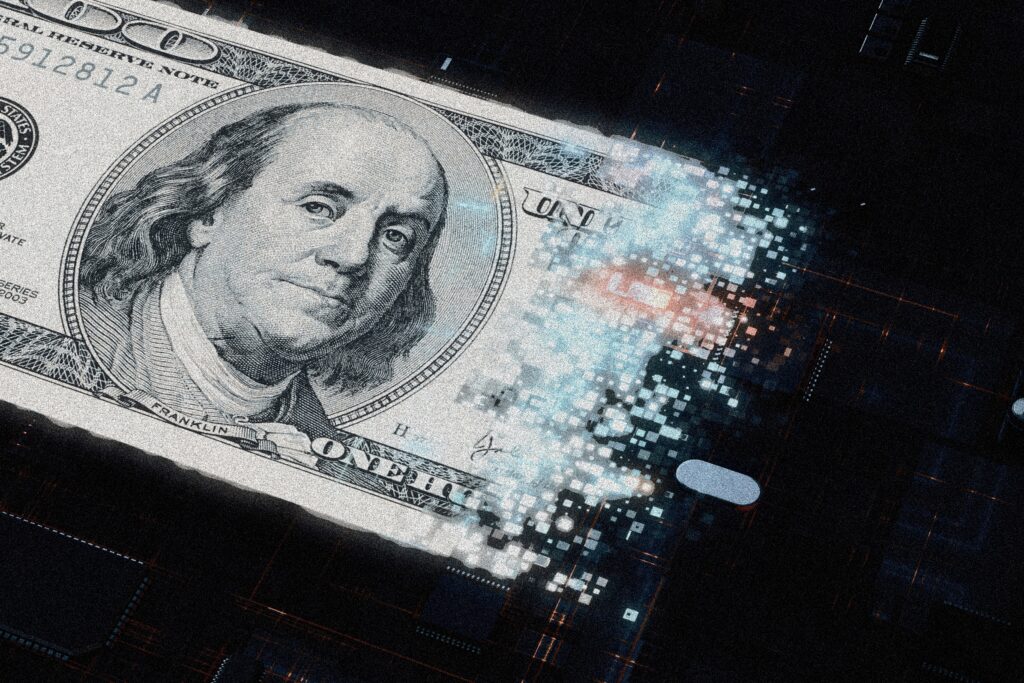
The biggest bet in the history of the United States keeps getting bigger and we’re all hanging on for the ride.
Technology companies recently launched a record scramble for cash to pay for data centers, computer chips and technology and equipment to power artificial intelligence. This boom is so expensive that even Silicon Valley giants are bleeding cash and companies are now racing one another to collect or borrow other people’s money for the estimated $10 trillion of AI-related spending in coming years.
Three eye-popping figures that emerged on Monday showed the scale of the AI cash grab.
Anthropic, maker of the Claude chatbot, started the clock on what is expected to be the largest initial public offering in history, raking in an estimated $100 billion in stock sales. But the company’s IPO paperwork warned that will just be the down payment necessary to fund the company’s AI ambitions. “We anticipate making significant and increased investments for the foreseeable future,” Anthropic said in its IPO document.
The same day, Meta said it would sell up to $95 billion in new stock after disclosing a few days ago that it was struggling to compete with other AI developers asking investors for cash. And less than five months after Elon Musk’s SpaceX held what stands as the current record largest IPO, the AI and rocket company finalized a complex deal to borrow $40 billion to pay for AI computer chips and equipment.
How to summarize the sentiment among AI firms right now? “Take it when you can,” Matt Orton, chief market strategist of investment firm Raymond James Investment Management, said about the AI companies’ cash grabs. “Everyone is going to need more.”
Not every company will be able to secure the cash needed to keep up in the AI race, Wall Street and global economic power players are now realizing. The global economy and the personal finances of just about everyone are tied to the outcome of the AI boom and its escalating costs.
In a widely cited draft research paper last month, Columbia University finance professor Stijn Van Nieuwerburgh estimated that it will cost more than $10 trillion through 2032 to build out AI including data centers and computer equipment.
Measured as a slice of U.S. economic output, the average yearly AI spending works out to more than the combined national commitments for electrifying American households in the early 20th century, building the interstate highway system and installing the backbone of the 1990s U.S. dot-com boom, he estimated.
AI companies are starting to hunt for funds in nearly every imaginable financial nook and cranny to meet those immense costs, Van Nieuwerburgh and other experts say. They’ve been borrowing hundreds of billions of dollars, selling fresh stock and cooking up more novel and potentially risky methods of financing.
Even the U.S. government is paying more to borrow money because it is going head-to-head with AI companies for investors’ cash. “It’s causing a short-term competition for capital,” Treasury Secretary Scott Bessent said in a CNBC interview in August.
Investors are starting to get picky about which AI companies they’re willing to bankroll. Stock and bond prices have been on a roller coaster in recent weeks, particularly for a class of smaller firms that earn money from renting AI data center computing power to leading AI companies. Investors have balked at IPOs for several of these young but fast-growing data center companies, dubbed neoclouds, or demanded higher interest rates to lend them money.
Like many AI companies, many neoclouds cannot fund their operations without taking on debt or other outside cash, as they outfit costly data centers today in hopes abundant data center rent checks will roll in tomorrow.
Market research firm Gartner recently noted this stark timing “imbalance” for neoclouds that spend up front for a revenue payoff later. It predicted that 80 percent of neocloud companies could fail or be forced to sell themselves in coming years.
Atsi Sheth, the chief credit officer for Moody’s, which assesses debt risks for investors, said it’s healthy that investors are becoming more discriminating about bankrolling anything that calls itself an AI company. Pickiness lowers the odds that the AI boom turns into a bubble. “If you think something is not risky and it is, that’s where you get the systemic issues,” Sheth said in a recent interview.
Some investors have spoken openly about the scary unknowns looming. Jas Khaira of Blackstone, one of the world’s largest investment firms, said it was unclear who would supply all the money that AI companies need. “We have some hypotheses, but the honest answer is we don’t know where all of it will come from,” he told the Information, a tech news publication, last month.
Even successful and highly profitable technology companies are struggling to afford the enormous costs of AI.
Microsoft’s revenue and profits are popping from selling AI software to businesses eager for its productivity-enhancing promise. Still, on Monday, Microsoft said it would offer buyouts to about 60,000 employees, or one-quarter of its global workforce, as its AI spending dwarfs the financial payoff for now.
A Microsoft spokeswoman said a fraction of those eligible are expected to take the voluntary buyout offers.
AI has also plumped Meta’s financial fortunes by increasing advertising sales on its social networks. Meta is starting to bleed cash from its AI spending, though, and last week said in a securities filing that it recognized the need to grab AI funding before investors were tapped out.
Meta’s filing said Google, SpaceX, Anthropic and ChatGPT developer OpenAI all want cash to pay for their AI bets, which has “resulted in an increasingly challenging environment for raising capital.” (The Washington Post has a content partnership with OpenAI.)
The U.S. economy and financial future of every American — whether they intended to wager on AI or not — are increasingly linked to this giant bet. Companies large and small in the AI industry, on Wall Street, and those leasing office space or selling paint are all becoming dependent on AI spending and the premise behind it: that AI will profoundly reshape work, the U.S. economy and American life in a way that delivers geysers of economic growth, corporate profits and wealth for decades to come.
Stock markets rose Monday, as Orton and some other investors said that Anthropic’s disclosures of soaring revenue from a relatively broad set of AI customers helped calm worries about an AI bubble.
Orton, who is optimistic about the ultimate financial payoff from AI, said Anthropic’s IPO is a test of who can deal with the uncertainty about when the AI boom might blossom into riches.
“There will be plenty of room for everyone to win significantly,” Orton said. “The market is questioning how quickly that will happen.”
The post AI companies are desperate for cash and don’t know where it will come from appeared first on Washington Post.