This article is part of the Fine Arts & Exhibits special section on how the world of art and museums is pushing boundaries.
On a warm afternoon in 1990, the historian Stephen E. Ambrose was enjoying a cocktail with his good friend Gordon H. “Nick” Mueller, the then vice chancellor of the University of New Orleans.
Ambrose was completing a history of the Allied landing in Normandy on June 6, 1944, and he needed a repository for hundreds of oral history interviews with American soldiers he’d conducted for the book, “D-Day.” The historian, who died in 2002, wondered if the university might sponsor a small museum and research center dedicated to D-Day.
“Stephen proposed a modest project to support the continuation of his oral history work — it seemed a feasible idea,” Mueller, now 87, recalled in an interview. “I said, ‘Let’s do it. I’m in.’”
For the next 10 years, the two men organized, lobbied and raised funds. Finally, on June 6, 2000, the National D-Day Museum opened on the site of a former warehouse in downtown New Orleans. It was an immediate success. Two hundred thousand visitors, many of them D-Day veterans, attended the inaugural ceremonies, Mueller said.
Four years later, Congress expanded the institution’s mandate by rebranding it as the National World War II Museum and appropriating funds to jump-start land acquisition and a construction program.
Today, the museum, which sprawls across seven buildings in New Orleans’ business district, hosts more than 600,000 visitors annually. The travel website TripAdvisor ranks it as the No. 1 attraction in New Orleans and one of the 10 top museums in the United States.
“We never thought it would become this behemoth,” said Mueller, the museum’s president and chief executive emeritus, in an interview. “Doing this was intimidating. How do you tell a story of a war that changed the world? It was hard to get your arms around telling it.”
Perhaps because the two men didn’t start out as museum professionals, they ended up creating something unusual and eclectic. Their idea: try anything and everything to document and memorialize America’s role in the largest and deadliest war in history.
The concept has perhaps even more resonance now as the museum seeks to engage a younger audience that is attracted more than ever by technology and has few, if any, living connections to a war that ended more than 80 years ago.
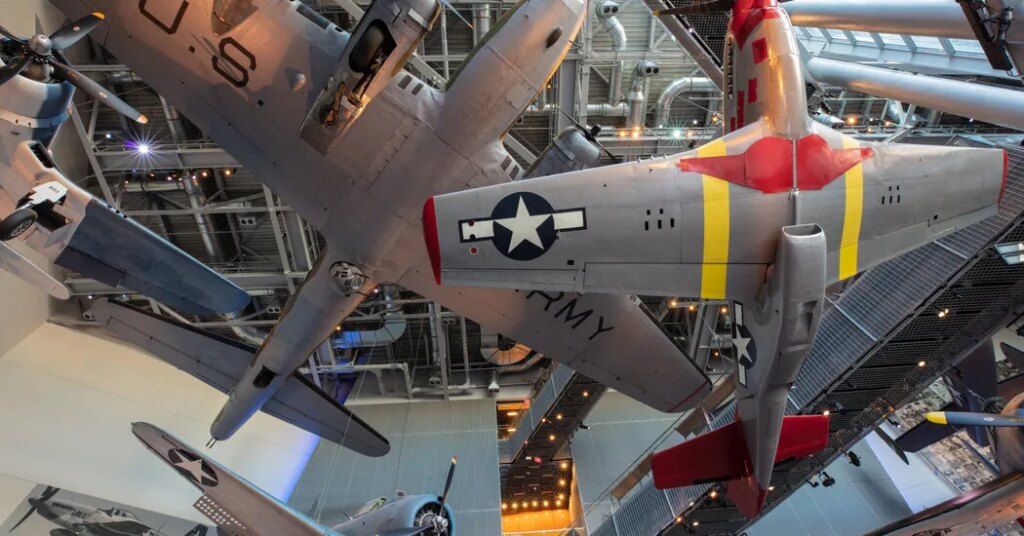
The National World War II Museum is, at once, an archive, a research facility, a multimedia production center, a traditional military history museum and a nontraditional exhibit space experimenting with new ways to tell a story. On its seven-acre campus, there are three restaurants, an auditorium, several cinemas, a nondenominational chapel and a nightclub.
Throughout the museum, visitors will find displays of the American built armaments that helped win the war, but also the oral history recollections of 12,000 American soldiers, home-front workers and Holocaust survivors.
In one building, tourists can sit inside a replica of the U.S.S. Tang, a submarine that operated in the Pacific, and participate in a simulated battle. In another — the Liberation Pavilion, visitors walk through a room that reproduces the Amsterdam attic where the young German-born Jewish girl Anne Frank and her family hid from the Nazis. One can walk on the Persian rugs the Frank family placed on the floor to muffle the sounds of their existence and see the Rosenthal china they took into hiding — a hopeful gesture aimed at keeping their lives as normal as possible.
At the heart of the National Museum of World War II is, of course, the narrative of the American part of the war — December 1942, through August 1945. To understand those years, visitors are invited to guide themselves through a series of immersive galleries. There, guests are physically brought into what the curators call “turning point moments.”
At the “Arsenal of Democracy” pavilion, which is focused on American society in the prewar years — one can watch an “America First” rally and hear the aviator Charles Lindbergh give an isolationist speech. Next, guests move onto the “Road to Tokyo,” where exhibits recreate significant battles in the Pacific campaign.
From there, the visitors travel on the “Road to Berlin,” where they find themselves in a gallery that captures a moment of the Christmas 1944, Battle of the Bulge. Ice is on the ground of a gallery decorated to look like a dark and frightening corner of the Ardennes forest. Snow covers pine trees. Explosions can be heard. And machine gun fire, too. On three screens, footage from the actual battle is projected. In a corner are oral history kiosks with headsets where Battle of the Bulge veterans speak about what they saw.
Patrick Gallagher, whose design consultancy firm, Gallagher and Associates, built the exhibits, says that museum’s leaders have chosen to feature what he calls, “immersive exhibitions” because they are the most effective means to teach about historic events.
“Our audience testing has shown that visitors learn with a higher degree of engagement in immersive environments and feel a greater sense of understanding,” Gallagher explained. “They’ll spend more time at an exhibition when they are fully immersive.”
When the museum first opened, many of the visitors were veterans and their families. Some had documents and objects that they wanted to contribute. Today, the museum preserves some 300,000 war-related artifacts, an enormous resource for exhibitions.
In the collection are the physical markers that explain the era: a wedding gown made by a war bride from parachute fabric, artworks by Japanese American prisoners in internment camps, P.O.W. diaries, Nazi flags, the flight log of the Enola Gay, the plane that dropped an atomic bomb on Hiroshima.
“Almost everything we have was donated by the public — we buy very little,” said Kimberly Guise, the director of the museum’s Curatorial Services. “Every month, we get about 300 donation offers. When a relative dies, people clean out their attics. They find things.”
And many of the museum’s original supporters have died. Of the 16 million Americans who served during the war, only about 30,000 veterans survive. Most are in their 90s. That leaves the museum’s staff with an existential problem — how do they bring in new audiences? World War II ended 81 years ago. Why would your typical Gen Zer even care?
One of the ways the curators try to address a potential generation gap is by showing, in exhibits, how the conflict was really a young people’s war. In the special exhibit on the art and career of the political cartoonist Bill Mauldin, there are photographs of a baby-faced war correspondent, age 19, trudging through the battlefields of Europe.
“This was young people’s work,” said the military historian, Col. Michael Bell, the executive director of the museum’s Institute for the Study of War and Democracy. “The infantry was drawn from young men. President George H.W. Bush, he was 19 and a lieutenant. In World War II, you could be 19 and have all this responsibility.”
Educational outreach is another path to new audiences. There are free lesson plans available for K-12 teachers. For the lay public, there are multiple distant learning courses and webinars. Last year, the staff welcomed almost 19,000 school children to in-person tours. And if students can’t get to the museum, the staff will loan their teachers “footlockers,” which are boxes filled with lesson plans and real World War II artifacts for students to analyze and discuss in their hometown classrooms.
Given all these efforts, the museum has succeeded in attracting many younger visitors. On the August day when this reporter visited, a substantial number of teens and 20-somethings were viewing the exhibits. Most were there with relatives. Many said they were history buffs.
“I really like World War II history,” said Matt Dale, 27, of Columbia, Tenn. “I watch the History Channel and ‘Band of Brothers.’”
“I’ve been interested in history since I was a little kid,” said Morgan Niven, 24, of Troy, Mo. “My grandfather has all the Ken Burns movies. We’ve been to Normandy.”
For Henry Schofield, 15, a 10th-grader from Rye Brook, N.Y., the museum taught him serious life lessons.
“I learned that freedom is essential for all human beings and that humanity is willing to fight to preserve it,” he said, after visiting the Liberation Pavilion, which explores the last year of the war, particularly what the G.I.s saw when they liberated the concentration camps. “World War II gave me a safe world to grow up in.”
Schofield’s insights may well be part of what the museum’s originators were hoping for when they first proposed building it.
“Steve Ambrose and I helped develop a museum that remembers the dead, honors their courage and tells their story to future generations,” said Mueller. “The rest is up to those generations to understand. The museum now is way more than anything we could have imagined. I’m pleased and proud.”
The post A World War II Museum Brings the Lessons of War to a Younger Audience appeared first on New York Times.