SÃO PAULO — When the results showed that he’d lost in the first round of the country’s presidential election earlier this month, President Luiz Inácio Lula da Silva appeared to be in disbelief. The leftist incumbent had gone into the evening expecting to net more than 50 percent of the vote and squarely defeat right-wing challenger Flávio Bolsonaro. Instead, he had lost, and it looked as though he would lose in the second round, too.
In a fury, Lula stormed out of the viewing room at the Renaissance Hotel in São Paulo.
The incumbent had 21 days before the deciding second-round vote. Three weeks to figure out how to achieve what had not been done in the history of modern Brazilian presidential politics: Lose in the first round, but win in the second.
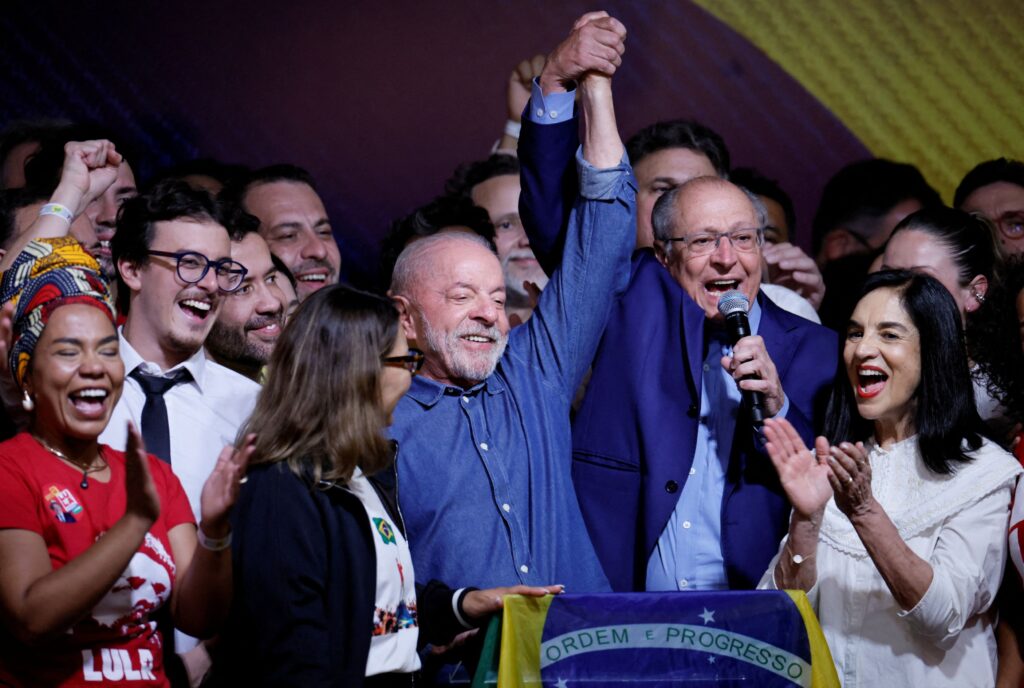
Lula on Sunday pulled off that unlikely comeback. In the end, he bested Bolsonaro by roughly 4 million votes and 4 percentage points, bringing a halt to the wave of MAGA alignment that had been washing across Latin America.
To meet the moment, Lula made major changes in his approach, according to seven of his closest political advisers, who had direct knowledge of the campaign’s internal deliberations. They spoke on the condition of anonymity to discuss the internal dynamics of the campaign.
Analysts say those changes were a key factor in driving a mass mobilization that turned the electoral tide.
The diagnosis and treatment plan, the advisers said, were clear from the moment of the initial loss.
The first round of the election had seemed like an overwhelming victory for Bolsonaro, who had defeated Lula by 47 percent to 45 percent. But the result didn’t reflect the total potential electorate. Voting is mandatory in Brazil, but more than 33 million eligible voters — 20 percent of the total — had abstained nonetheless.
Among people 21 to 24, the rate was even higher: More than 25 percent had stayed home.
Lula, who turns 81 Tuesday, had to find a way reverse that trend: He needed to try to harness the digital power of Generation Z, whose political activism in recent months has driven political ruptures in countries including Bulgaria, France and Madagascar.
His advisers said the old-school organizer and union activist who’d risen from poverty to win the presidency after several failed runs, then emerged from prison to reclaim it, would now have to author yet another metamorphosis. He needed to get a smartphone — a technology he’s long eschewed — go on social media and learn the technology on the fly to mobilize his base.
What was less clear was whether Lula would actually do it.
Joining Lula’s army
Brazil is an intensely online country, with nearly three-fourths of its 215 million people on Instagram alone. But its president has long been a reluctant adopter.
Lula had an Instagram account, but its contents consisted of polished packages and speeches, and lacked the rawness and immediacy that often helped posts to go viral. When campaigning, he shied away from speaking directly into the phone.
“He would say he preferred ‘looking people in the eye’ rather than ‘talking to a cellphone,’ and didn’t think he needed to do it,” an adviser said. “‘How many votes am I going to get from this video?,’” he would ask.
Then he lost in the first round.
Like his father, former Brazilian president Jair Bolsonaro, Flávio had a knack for social media. During the campaign, he filmed frequent selfies videos, took trips to the supermarket to blame Lula for the expense of food, and even played futevôlei, a Brazilian beach game that combines volleyball and soccer.
The day after his first-round loss to Flávio, two 40-something political allies, Congressman André Janones and Rafael Fonteles, the governor-elect of Piauí state, approached Lula in the presidential palace with a phone.
“Let’s get to the streets!” Lula bellowed into it. “Now’s the time!”
The video was short, extemporaneous — and went extremely viral, racking up 9 million views in a few hours, ultimately surpassing 23 million. That was the moment when it clicked for Lula, advisers said. With the phone, he could reach far more people than he’d otherwise be able to — particularly the young.
His campaign called the videos “little rockets.” Early each morning of the pivotal few weeks, Lula would record three short selfie videos that were designed to go viral and launch the campaign’s social media push of the day.
“Fonteles told him, ‘Look at this number: 9 million people watched this,’ ” one adviser said. “Lula couldn’t even find the number on the screen, but he finally understood that the videos were reaching a huge audience.”
Lula deputized Janones to lead what would become known in Brazil as “Lula’s Army.” With a militaristic aesthetic, Janones barked out “missions” each day on social media to Lula supporters whom he called his “soldiers.” The tasks included sharing pro-Lula social media content, promoting hashtags, pushing out AI-generated memes or taking part in planned social media actions, like taking selfies while flashing the Lula “L.”
The goal was to steal the digital advantage that belonged to the Brazilian right, and stoke fears over the cuts to social benefits that they accused Bolsonaro of plotting. In country where tens of millions receive government support, that fear was pervasive and could be used to drive people to the polls.
“ATTENCION: Lula’s army is recruiting new soldiers!” went one typical post. “The new soldiers will be sent out on their first missions at 23:26 hours.”
Flávio’s campaign accused “Lula’s Army” of spreading fake news about Flávio’s alleged ties to Brazilian militias and claims that he planned to cut social benefits — leading to the account’s brief suspension — but every day more people were drawn to the digital army.
“Janones knew how to motivate people to act on social media,” a social media adviser said. “He created the sense that there was a leader, and people began calling him ‘the general’ — even Lula.”
On Oct. 21, Lula joined himself. The Brazilian president finally had his first phone: a Samsung Galaxy S26 Ultra. It wouldn’t leave his side for the few remaining days of the campaign.
Mass mobilization
Lula usually goes quiet on election day. He doesn’t like watching the news, and chose Sunday to remain at his residence in Alto Pinheiros in São Paulo.
Internal polling was more optimistic than outside projections, but it still didn’t look good. He was gaining on Flávio. But it was unclear whether he would surpass him.
His 21 days were up.
On his new cellphone, Lula saw remarkable images. One video showed hundreds of people streaming into buses on their way to vote. Another depicted a dozen or so Indigenous people traveling more than 7 hours down the Paraguay River to vote. One showed hundreds racing out of a boat.
“It was unbelievable,” said Mauricio Moura, founder of IDEIA Big Data, a Brazilian data analysis firm. “Everything that needed to happen did.”
The absentee rate plunged to its lowest rate in decades. The undecideds appeared to break Lula’s way. An additional 3 million voters showed up, and “Lula must have won 95 percent of those,” Moura said. Turnout, he said, rose among young and elderly voters. In all, more than 10 million people voted for Lula in the second round than in the first.
Late in the afternoon, Lula arrived to the InterContinental Hotel in São Paulo to watch the returns. His allies around him were tense. But he told them that he felt good.
When the final numbers came in, and he was projected to have won, Lula put on a pair of red star-framed glasses and rose a fist into the air. He gave a military salute to his social media “general,” then went to the podium.
“I want to thank the generosity of the Brazilian youth that got out into the streets to defend democracy,” he said.
In this next term, he promised, “digital communication will play a much bigger role.”
McCoy reported from Mexico City.
The post 21 days: Inside Lula’s race to resurrect his campaign — and go viral appeared first on Washington Post.