The French government announced on Monday that it would phase out an unpopular online university admissions platform, a significant concession to high school students who have led a protest movement that has mushroomed into weeks of nationwide unrest.
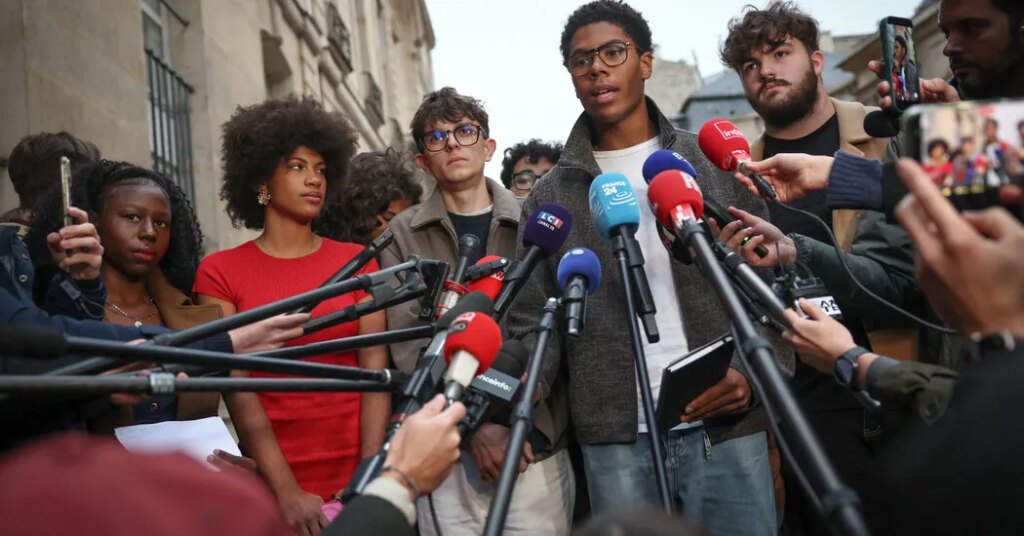
The measure, one of several announced by the education ministry, did not mollify the students. Leaders of high school and university student groups called on them to protest again on Oct. 31 and Nov. 5, even after meeting with Prime Minister Sébastien Lecornu and hearing the proposals.
Still, the concessions showed that the government was trying to respond to the complaints of students. Many of them criticize the admissions platform, known as Parcoursup, as being opaque and unfair. The government said it would revise the system in 2027 to make it more transparent, and replace it in 2028.
The government also said it would create 15,000 new higher education spaces for students, cap the size of second-year high school classes at 28 students and make available four billion euros ($4.48 billion) in low-interest loans to renovate dilapidated middle school and high school buildings.
“None of the decisions we make are empty promises,” the education minister, Édouard Geffray, said at a news conference. “Everything we say will be done and respected within specific time frames and with figures.”
The government’s capacity to respond to the students is constrained because of its dire public finances. With widening fiscal deficits, it simply does not have billions of additional euros to spend on schools. But the decision to overhaul and then replace the university admissions platform was welcomed, even if student leaders said it was not enough to end their protests.
“We are managing to achieve some gains through mobilization, but they are still crumbs,” Sabrine Kharbach, a representative of one of the groups, the Student Union, said to the news agency Agence France-Presse.
Louis Letoublon, the vice president another student group, Les Lycéens!, told reporters after the meeting with Mr. Lecornu, “We can say that we’ve gained something: first, the government’s fear.”
High school students have complained about overcrowded classrooms, a shortage of teachers, and crumbling facilities. Among their demands are major investments to upgrade facilities and enough spaces in universities so that every high school graduate is guaranteed a spot.
They erected barricades in front of schools, sometimes clashing with the police. And as their movement grew, it drew in protesters unhappy about high fuel prices and France’s slow-growing economy.
On Oct. 17, a day of mass protests devolved into widespread arson, looting and other violence, putting the government on the defensive. While there were more clashes between protesters and the police at the end of demonstrations this past Saturday, the authorities managed to avert a repeat of the lawlessness that engulfed French cities the previous week.
President Emmanuel Macron, who traveled to Marseille on Monday to meet shop owners, police officers and public officials, said he was ready to take actions that would respond to the “legitimate demands at the root of the social movement.”
The post France Makes Concessions to Students, but Not Enough to Halt Protests appeared first on New York Times.