When Mom died a few years ago things were quiet for a while. Dad was in Phase 2 of Alzheimer’s — still living alone with the help of a housekeeper and me, still driving. (I know.) Then one day a friend left a message on my phone that went something like, “Hi, Becky! I saw someone who looked like your dad hitchhiking by the mall.”
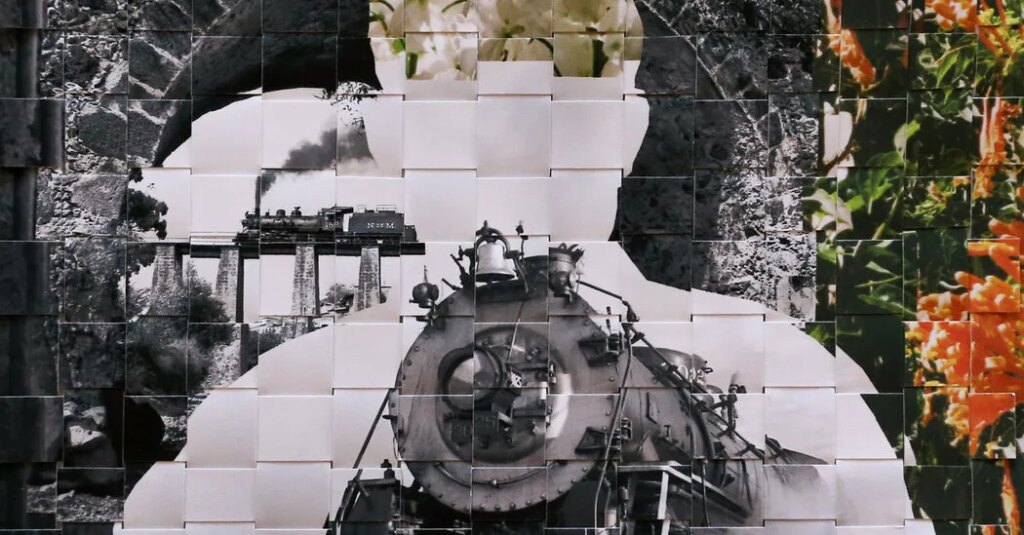
After that I decided I should be spending even more time with him, and that a good way to do that would be to work with him on his book. He had been writing it before his Alzheimer’s kicked in, a memoir of photographing steam engines in the late 1950s and 1960s called “Chasing Steam in Mexico.” Dad first lived in Tlaxcala as a conscientious objector to the Korean War, building roads and drilling wells through the American Friends Service Committee.
An avid rail fan since he was a boy, he spent his spare time hitchhiking to different railroad lines, camping out at night, riding the steam trains by day, photographing them and the people who worked on them. He loved the drama of the plumes of dark smoke, the wild landscapes they went through, the generosity of the engineers and crews who welcomed him into their engine cabs.
We started meeting several times a week, sitting at his desk, a fire in the wood stove, our favorite Mexican folk music playing on repeat. We read his manuscript out loud, editing as we went.
Studies on people with Alzheimer’s suggest that making art can relieve anxiety and improve mood, self-esteem and focus. I saw this firsthand. Sometimes when I arrived, he would be in a bad mood. His chain saw wasn’t working. (I know.) The computer had messed up all his margins. He couldn’t find his glasses. But then we’d sit down and start reading through his stories, curating the photos that went with them. After a few hours he’d cheer up, his memory a little sharper, talking about wheel arrangements or a dinner party in Yucatán in 1965 where it was so hot the unlit candles melted.
What I did not expect was the way the project affected me. Working on the book was like entering a time capsule — no news, no television, no social media. Just two people and a project. Over time I stopped seeing what was wrong — with the world, with his health — and focused on what we were creating.
This joint undertaking gave us a new way to connect. It allowed me to provide help without hovering. It gave him agency in the caretaking.
And I got to know him better. At some point I realized that the book wasn’t just about trains or travel. It was about a time in his life when he was doing what his soul loved. He went on to enjoy his work writing grant proposals for community development projects, but his true love (besides my mother) was trains. Our laundry room doubled as a darkroom, and I was used to seeing his striking black-and-white photos in books, rail magazines and museums.
Yet as I read the book with him, I heard stories I’d never heard before and found pictures I’d never seen. I saw the feats my father performed to get his photos — hiking into remote canyons, balancing on top of passenger cars, riding on the cowcatcher of a wood-burning engine. I began to see, even more than I already had, what an artist he was and how he’d inadvertently captured a way of life that no longer existed. Mostly, though, I was able to get to know my parent as the person he was before I was born.
I will never get over the gift of this time.
One weekend, after we’d been working together for about a year, Dad called. His wrist hurt. He thought he might have fallen when he was outside splitting wood (I know!!!); he couldn’t remember. It turned out that he had sepsis. He was in the hospital for three weeks. Not long after that, he stopped driving.
I knew we were in a race against the disease to get the book done. Still, had we not had a project to work on, the focus would have been on the sepsis, the hospital stay and his accelerating memory loss. As it was, the stress and sadness were a small part of a bigger story.
Now, if friends say they’re thinking about doing something like this with an aging relative, I say, do it! The project could be anything. Reading old letters or diaries, making a photo album. Listening to music. Trying out family recipes. Don’t do it because the person is leaving. Do it because you love the person and enjoy being in the same room. Do it because you are tired of having your entire relationship consist of what you are losing. Do it because the process of making something together can shift your gaze to what you still have.
Or for the pure joy of getting it made. My husband and I run a small publishing company, and so we were able to produce Dad’s book. When it arrived, we were triumphant!
Last week when I went to visit my father, he was reading one of his favorite chapters about a day he spent in a remote area of Oaxaca, standing on a cliff ledge so narrow that he had to place his feet sideways, waiting for hours for a train so he could get the right shot. “It might seem odd for me to read my own book, because I wrote it,” he said. “But! I have Alzheimer’s, which means I forget a lot of things, and this takes me back to such wonderful places.”
His hands shake sometimes and he can’t bend his arthritic fingers. When my mother’s hands turned black and blue from dialysis, I watched every single symptom, afraid of what was coming.
It must have been so annoying to be watched like that.
I’m still afraid of what is coming sometimes. Now, when I look at my father’s hands, all I think is “I love you.”
Rebecca Barry is the author of “Later, at the Bar” and “Recipes for a Beautiful Life.” “Chasing Steam in Mexico,” by her father, Frank Barry, was published this year.
Source photographs for top art by Frank Barry and Andy Wittenborn.
The Times is committed to publishing a diversity of letters to the editor. We’d like to hear what you think about this or any of our articles. Here are some tips. And here’s our email: [email protected].
Follow the New York Times Opinion section on Facebook, Instagram, TikTok, Bluesky, WhatsApp and Threads.
The post I Couldn’t Cure My Dad’s Alzheimer’s. Here’s What I Could Heal. appeared first on New York Times.