It was the gravest act of violence among the litany of atrocities that defined Russia’s long, bloody siege of Mariupol in the first months of the full-scale war in Ukraine.
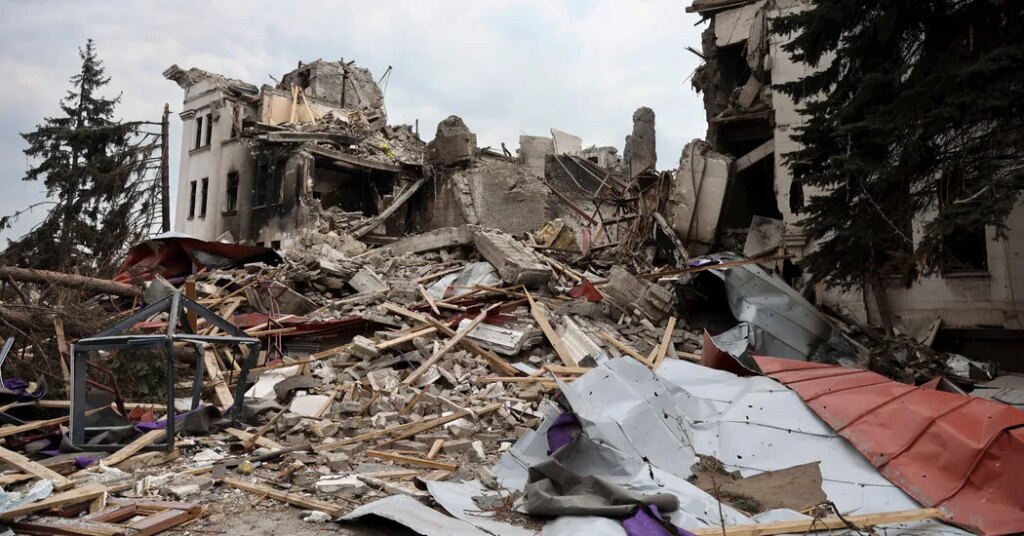
On March 16, 2022, an explosion tore through the Soviet-era Regional Academic Drama Theater, killing hundreds of civilians taking refuge there. Survivors, journalists and analysts who examined the devastation have concluded that a Russian airstrike caused the blast.
Now, a new Russian film that calls itself a documentary is trying to rewrite that history. It claims to present evidence supporting Russia’s longtime assertion that Ukraine was behind the bombing. Ukrainian officials have dismissed the film as propaganda, calling it part of a systematic Russian campaign to falsify events and deny Russian war crimes.
The movie, “Witnesses,” was filmed on the stage of the rebuilt theater in Mariupol, which has remained under Russian control. It shows Vittorio Nicola Rangeloni, an Italian journalist sympathetic to the Kremlin, interviewing several people who say they survived the bombing. They assert that the Ukrainian military destroyed the theater in a diversionary attack meant to discredit Russia.
“Except for us, unfortunately, nobody else will speak of this,” Daria V. Morozova, the human rights commissioner in the Russian-controlled part of the Donetsk region of Ukraine, says in the film. Mr. Rangeloni somberly nods along to Ms. Morozova’s assertions.
Asked about the movie’s claims, Mr. Rangeloni said in an email: “I’ve looked into the eyes of those people who were there that day. I have no reason not to believe these people.” He has narrated several other documentaries under the “Witnesses” brand.
The studio responsible for disseminating the documentary online, Bumblebee, could not be reached for comment. Its social media channels feature a stream of pro-Kremlin content, much of it focused on a revisionist history of Russia’s actions in Ukraine. “Witnesses” has received more than 600,000 views and has been promoted by Russian military bloggers.
To Ukrainians, Moscow’s monthslong siege of Mariupol in 2022 and the city’s eventual occupation are tragic symbols both of civilian resistance and of a Russian push to erase Ukrainian culture in captured territories.
The Mariupol theater seized global attention after Russian forces attacked it even though people sheltering inside had written the word “children” in white paint on the ground outside.
The yearslong rebuilding effort that has followed the theater’s destruction is part of a Russian crusade to make Mariupol a showcase of the “new territories,” the Kremlin’s term for occupied Ukraine. To supporters of the Kremlin, the theater embodies Russian supremacy restored in a city that long played host to divided loyalties because of its proximity to Russia.
With its reconstruction, Russia hopes to bury memories of its relentless bombing of the city in 2022, which killed thousands of Ukrainians.
“Behind all this simulated ‘restoration’ are hidden the atrocities of the Russian occupiers,” Mariupol’s exiled city council, based elsewhere in Ukraine, wrote in a social media post when the theater held a reopening ceremony in December 2025.
James Verini, whose new book “The Theater” meticulously reconstructs events surrounding the attack, wrote that it “may yet prove the single worst act of mass civilian killing” by Russia during the war. About 600 people were killed, according to an investigation by The Associated Press. The number of children who were victims has not been established.
In an interview, Mr. Verini, who has written about the war in Ukraine for The New York Times Magazine, said that none of the many survivors he had spoken with had seen anything to suggest subterfuge by Ukraine.
Russia, said Jade McGlynn, an expert on the country and a research fellow at King’s College London, may be trying to shift perception of the strike from “established war crime to disputed incident.”
An effort to provide cover for what happened at the theater could be useful during any reckoning that may follow the war’s conclusion, Dr. McGlynn said.
“I personally see it just as another evidence point in the Kremlin’s ongoing rewriting of the siege, the war and Mariupol’s broader history to make it fit a version that flatters Russia’s self-image and myths,” she added.
The new film is part of a sweeping effort to revise history in order to stoke national pride and suppress unseemly aspects of Russia’s past. Mr. Putin, for example, has orchestrated a systematic rehabilitation of the Soviet dictator Joseph Stalin, whose paranoid purges claimed millions of lives. That Stalin signed a disastrous pact with Nazi Germany, despite clear evidence of an impending invasion by Hitler, is now seen, at least officially, as an act of diplomatic necessity.
The cumulative effect of the revisionist campaign is an image of Russia as an ever-victimized hero, tormented by a persistently bellicose West, of which Ukraine is a mere puppet.
Among the cities that Russian forces captured after the full-scale invasion on Feb. 24, 2022, Mariupol is the largest one that Moscow still holds. Ukrainian defenders managed to hold out for 86 days, finally surrendering at a Stalin-era steelworks. By taking control of Mariupol, Russia secured a key route to the Crimean Peninsula, which it seized from Ukraine in 2014.
The 2022 siege was vividly captured by “20 Days in Mariupol,” which won an Academy Award in 2024 for best documentary feature. With harrowing detail, the documentary shows Russia indiscriminately shelling and bombing hospitals and apartment blocks. In one scene, a doctor takes the filmmakers to see the body of a newborn, placed in a basement converted into a morgue.
“I can’t show you the face,” the doctor says, unwrapping a sheet to reveal tiny legs and a discolored torso. The narrative of “20 Days in Mariupol” ends on March 15, as the filmmakers leave the city through a humanitarian route. The theater was bombed the next morning.
“Witnesses” is only the latest in a cottage industry of pro-Russian films about Mariupol, Dr. McGlynn said. These include “Mariupol, Russian City” (2022), “Mariupol: Returning Home” (2023), “At the Edge of the Abyss” (2024) and “Mariupol: Three Years of Freedom” (2025).
These works are meant to tug on Russians’ sense of patriotism. They refer to heroic World War II episodes as they depict the battle for the Azovstal Iron and Steel Works in Mariupol, which was once occupied by German invaders, and portray the West as intent on seeing Russia weakened at any cost.
“The smaller the victories, the grander the narratives,” said Nina L. Khrushcheva, a professor of international affairs at the New School in Manhattan.
Ms. Khrushcheva is the great-granddaughter of Nikita S. Khrushchev, the Soviet leader who turned Crimea over to Ukraine in 1954. His move would have unforeseen repercussions 60 years later, when Russia retook the peninsula. The United States condemned the incursion but did not oppose it militarily. Neither did Europe.
President Vladimir V. Putin of Russia made clear that he was animated by profound grievances and that retaking Crimea was only the beginning of a more grandiose project.
To justify the full invasion of Ukraine in 2022, Mr. Putin claimed that Ukraine’s military was rife with Nazi sympathizers. Those allegations focused on the Azov regiment, an ultranationalist outfit that was absorbed into the Ukrainian National Guard in 2014.
Azovtsy, as members of the regiment are known, played a significant role in the defense of Mariupol in 2022. They are blamed in “Witnesses” for the theater explosion.
Several people interviewed in the film claim that they saw Azov-affiliated soldiers placing crates of explosives under the theater’s stage.
Western researchers have debunked Russia’s claims. “There was no crater, which means the weapon used would have detonated somewhere between the roof and floor,” Gareth Collett, who served as the British Defense Ministry’s top bomb disposal expert and who conducted an extensive investigation into how the theater was destroyed, said in an email.
The damage, Dr. Collett added, was “typical of a large airdropped munition known to be used by the Russian Federation.” A report by Amnesty International concluded that the theater was most likely destroyed by two 1,100-pound bombs dropped by a Russian fighter jet.
The post Russian Film Aims to Rewrite History of Deadly Theater Bombing in Ukraine appeared first on New York Times.