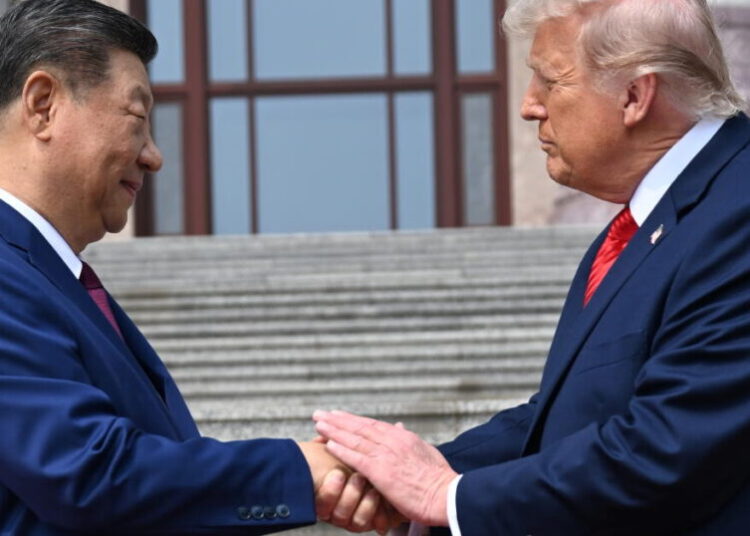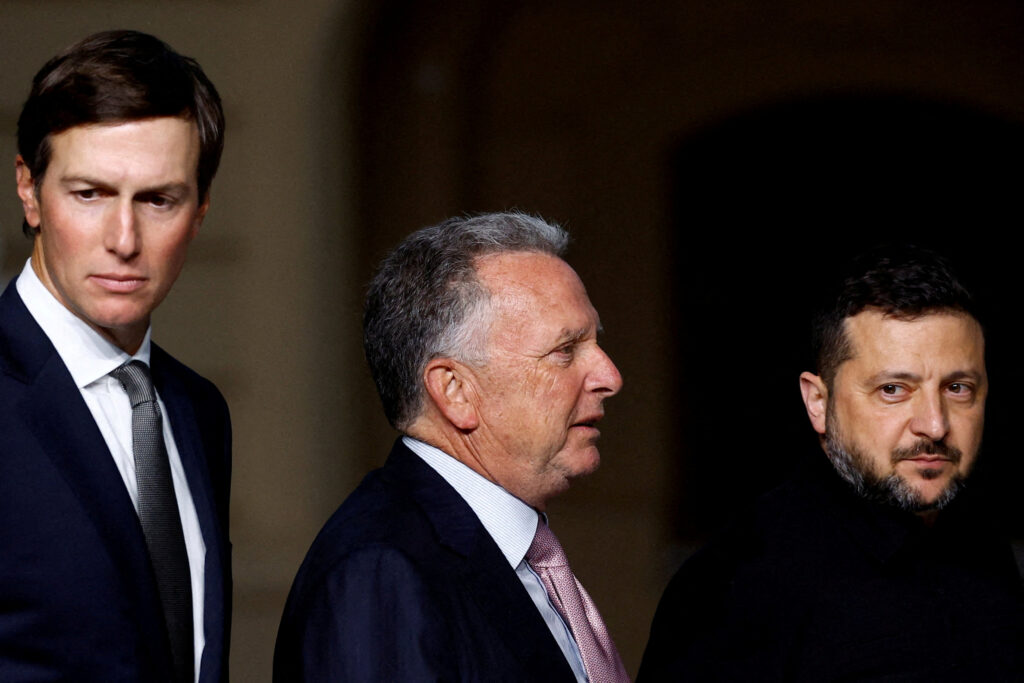
As President Donald Trump’s envoys Jared Kushner and Steve Witkoff negotiate an end to Russia’s invasion of Ukraine, they are also working with the Kremlin to sell $20 billion in international assets owned by the Russian oil company Lukoil to a group of investors that includes their own business partners.
According to the Financial Times and the New York Times, the U.S. government (via the U.S. International Development Finance Corporation) would get a 15 percent stake in the new company. Other stakeholders would include Trump donor Todd Boehly; an Emirati fund that also invested in World Liberty Financial, a cryptocurrency company co-founded by the Trump and Witkoff families (Witkoff says he has divested his interest); and two Syrian-born Qatari brothers who are partners with Kushner and his wife, Ivanka Trump, in a planned luxury resort in Albania.
While Witkoff and Kushner say they would not benefit from the Lukoil sale, the deal reeks of conflicts of interest at best and outright corruption at worst. But it is emblematic of the de facto Trump Doctrine — mixing private and public interests to an unprecedented degree.
The justification for this approach is that advancing U.S. business interests can advance U.S. national security interests. The International Development Finance Corporation, for example, said the proposed Lukoil deal “would … strengthen U.S. economic security, advance U.S. foreign policy and lower energy prices for everyday Americans.” Countries that do what Trump wants get lucrative business deals; those that don’t get higher tariffs.
Trump is pursuing his own version of “dollar diplomacy,” a term coined during the administration of an earlier pro-business Republican — William Howard Taft, who claimed more than a century ago that he would be “substituting dollars for bullets” to pursue U.S. interests. The problem is there’s little evidence that “dollar diplomacy” works.
In his first term, Trump hoped to lure North Korea’s Kim Jong Un into giving up his nuclear weapons in return for Western investment. “Kim Jong Un understands the unbelievable economic potential that country has,” the president said. “It’s located between Russia and China on one side, and South Korea on the other. And it’s all waterfront property. It’s a great location.” The White House even produced a slick propaganda film to depict the glorious future for North Korea if only Kim cooperated with Trump.
The pitch didn’t work. Kim refused to give up his nuclear weapons; today, according to Trump, he has “57 very powerful nuclear weapons.” Rather than cooperating with Washington, Kim is supporting the Russian invasion of Ukraine in return for Russian military technology. Kim has so far shown no public interest in Trump’s attempts to entice him to attend another summit this year.
Undeterred by the failure of his North Korea diplomacy, Trump offered a similar pitch to Hamas in 2025: disarm in return for beachfront condos. The White House released another video showing a future Gaza Strip full of resorts and skyscrapers, including a gold-trimmed hotel labeled “Trump Gaza.” The goal was to turn the devastated enclave into the “Riviera of the Middle East.”
Not surprisingly, Hamas isn’t interested. The fanatical terrorist group hasn’t given up its weapons. The Gaza Strip remains a bombed-out wasteland.
This June, Trump was at it again, this time with Iran. He presented a deal that would have given Iran tens of billions of dollars in sanctions relief along with a $300 billion reconstruction fund. All Iran had to do in return was open the Strait of Hormuz and negotiate the fate of its nuclear program. This was seemingly a great deal for Iran, and yet hard-liners in the Islamic Revolutionary Guard Corps sabotaged it by attacking tankers in the strait. The war drags on with no end in sight.
You would think Trump, Kushner and Witkoff would have figured out by now that dictators are not primarily interested in economic development. While Trump & co. have devoted their lives to making money, the leaders of North Korea, Hamas, Iran and Russia have devoted their lives to accumulating power. They fear that making concessions to Washington would undermine their iron grip on power. Sure, their people suffer as long as Western sanctions remain in place, but what do the dictators care? They’re doing just fine.
The irony is that while Trump is failing with his “dollar diplomacy,” other countries see him as a target for their own “ruble” or “riyal” diplomacy — and they’re also discovering the sharp limitations of that approach.
Putin obviously hopes to dangle development deals in front of Kushner and Witkoff to lift U.S. sanctions. He made some progress when Trump announced on Friday that the United States would be importing diesel fuel from Russia. But most sanctions remain in effect, and Congress recently passed legislation to strengthen them.
The Saudis and Emiratis have invested so much in business projects associated with the Trump clan in large part because they are hoping to buy influence.
Trump did agree to sell artificial intelligence chips to the United Arab Emirates and nuclear energy technology to Saudi Arabia — both projects that the Biden administration had rejected. Yet Trump also dragged the Gulf countries into a costly war with Iran that they didn’t ask for. And when the Houthis attacked Saudi Arabia, Trump refused to come to their aid because he is reluctant to be trapped in another endless war. Even for Trump, who is turning the presidency into a multibillion-dollar profit center, there are sharp limits to what money can buy.
The post ‘Dollar diplomacy’ doesn’t work. Yet Trump keeps using it. appeared first on Washington Post.