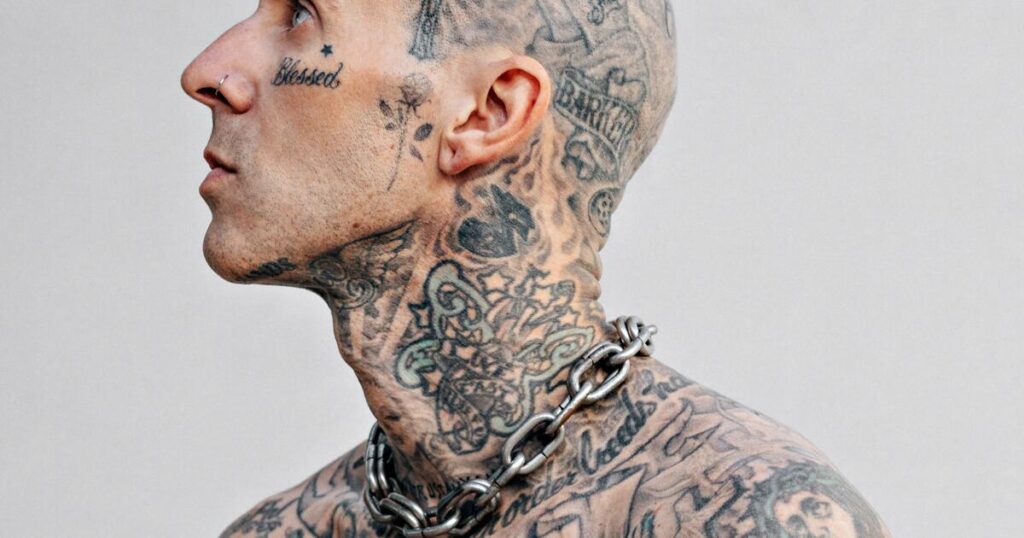
When Michael Dwyer and Justin Krook started filming “Travis Barker: Louder Than Fear” in 2017, they expected it to be completed within just a few years. It took nearly a decade.
“It’s not what we planned,” Krook says. “No one would agree to filming or being filmed for almost 10 years. That’s a quarter of my life.”
The film, now streaming on Hulu and Disney+, starts with a cinematic tribute to drums and drummers, featuring interviews with peers like Questlove, Tommy Lee, Stewart Copeland and others before narrowing in on Barker, the Blink-182 drummer, and his distinctive style.
Then it settles into Barker’s story: He lost his mother as a teen, was kicked out of the house by his father for getting a tattoo, went from being a Laguna Beach trash man to a popular drummer in the Southern California punk scene to a rock superstar. He also struggled with drug addiction for years.
But what makes Barker’s saga different from any other rock doc is that Barker also survived a plane crash that left his best friends dead and his body covered with terrible burns. He was in the hospital for months and required dozens of surgeries. That tragedy and the ensuing trauma was, naturally, the framework for the documentary.
“Travis had pulled himself back from drug addiction but the film had no ending because he hadn’t really found closure from the plane crash,” Krook says.
Barker was dissatisfied too. “He said, ‘I’m a traumatized human being who hasn’t moved on and I want some resolution,’” Krook recalls.
So, they kept filming … and filming. Barker fell in love with and married Kourtney Kardashian, took up running as therapy and even managed to get back onto a plane.
“When we started filming he said, ‘There’s nothing on this planet that will get me on a plane again,’ so we couldn’t believe it when he finally did,” Krook says. “We got to see his recovery to the man he is today but it took almost 10 years to tell that full arc. What we found is it’s not just about how you survive that but who you survive it for and who you become through that process.”
This interview has been edited for length and clarity.
What happened when you were trying to finish the film originally?
Dwyer: We had some ideas about how he would come to terms with the trauma. We gave him ideas like exposure therapy or taking flight lessons.
But that was us imposing our desired arc, which we all know doesn’t work. We give him credit for not giving in to our ideas but sticking with us on the project. What was incredible about taking all this time was actually getting to see him grow and come to terms with those losses and that trauma in his own way.
Did taking all that time also create an intimacy that benefited the film?
Krook: Yes. Trust takes time and when you’ve got six months, it’s hard to do. We watched his kids grow up and really got into his life and got to meet all the people around him. Over that time you also become like a married couple — there’s friction and you fight but that brings out a better product.
Who is the audience for this?
Krook: It’s not a Blink film — that’s a small part of Travis’ musical journey outside of his personal journey. He has drummed with everybody and has these other interests and businesses. He didn’t want this to be Blink-centered, which gave us flexibility.
Dwyer: Obviously, there are a lot of Blink fans and hopefully they’re happy, but we’re trying to make a film that could speak to everybody, exploring the themes of dealing with the accident and his trauma.
The centerpiece is the three minutes where Travis calmly narrates the plane crash interspersed with him drumming, amid flames, in a way that captures each emotional beat of what he went through. How did that happen?
Dwyer: We wanted to figure out how to interweave his talent and his playing into the storytelling.
Krook: It took two years to convince him that that was a good idea to sit in the middle of the pyro and do this, but to his credit he did.
More documentaries to watch this month
‘Mary Oliver: Saved By the Beauty of the World’ (PBS, Aug. 25), ‘Time and Water’ (NatGeo, Hulu, Disney+)
If “Louder Than Fear” is too intense, there’s a quieter take on someone who also overcame trauma and substance abuse and gained a huge following. The Pulitzer Prize-winning poet Mary Oliver survived sexual abuse, battled an alcohol problem and became a beloved and inspirational figure.
Oliver wrote powerful poems about human frailty but spent her days in the woods writing about nature, which she loved as much as she did language. The documentary features admiring poets as well as Stephen Colbert, a huge Oliver fan, and the irreverent and colorful John Waters, a longtime friend. Oliver’s story is moving but the highlight is hearing poems like “The Journey,” “The Summer Day,” “Don’t Hesitate” and “A Visitor” read aloud and set to footage that captures the mood and themes of her words.
Sticking with the lyrical looks at nature, “Time and Water” is a gorgeously shot, meditative and mournful reflection on both the climate crisis and one man’s family.
Icelandic writer Andri Snaer Magnason narrates as he explores how generational memory — the connection from his grandmother, born in the 1920s, to his daughter, who might be alive with her own grandchildren in the next century — can help us understand the depth of time.
Magnason’s family is inextricably linked with the environment — they’ve lived in Iceland for centuries and his grandparents were among the first to explore and research the glaciers. The documentary also explores the damage being done to the planet. He takes time to let us hear what a glacier sounds like while showing the swirls of blue ice, but also what it looks like when glaciers collapse and vanish. “Glaciers are leaving geologic time and are vanishing in the span of a human lifetime, which is unprecedented,” he says.
He ties the threads together with the idea of “holding on to your life as it charges forward and trying to stop it all from slipping away,” which refers to both the stories and memories of those who came before him and his homeland.
‘Novak Djokovic: The Wolf in Winter’ (Prime Video, Aug. 20)
Novak Djokovic spent years chasing Roger Federer and Rafael Nadal, trying to match them in tennis achievements and fan adulation. Once far behind, the Serbian star now holds the all-time records for Grand Slam titles, Masters 1000 titles and weeks at No. 1.
Fittingly, for a man so bent on proving himself the greatest of all time, Djokovic paired up with director Jason Hehir, best known for “The Last Dance,” the documentary about Michael Jordan and the Bulls.
Djokovic is still far from beloved (often for reasons of his own doing) and says in the film, “I understand why people might not like me.” We see how growing up in a war zone and taking on the responsibility of his family’s future shaped him and how he fuels his drive with anger and resentment.
This documentary may not make you love him — it never fully justifies his political stances about Serbia and choices about vaccines — but he comes across as curious, intelligent and a doting father. And you’ll appreciate and understand what he went through on his journey to the top, just as he attempts to win one more Grand Slam at the U.S. Open, which begins at the end of the month.
‘Decades in Sports’ (CNN)
The rare docuseries that’s too short, each episode favors breadth over depth but does reveal how sports increasingly intersected with American culture and politics.
The 1960s episode focuses on race and gender. Boston Celtics coach Red Auerbach changed his team’s uniform so it said Celtics instead of Boston because the city treated Black stars like Bill Russell so badly. Katherine Switzer entered the Boston Marathon as KV Switzer knowing a woman would be banned; when she showed up, an outraged official physically attacked her. She finished anyway.
Race and gender are still prevalent in the ’70s (Henry Aaron, Muhammad Ali, Billie Jean King and Title IX feature prominently), but the episode is also about how television shaped sports and brought games and athletes more into the mainstream of American life. That continues in the 1980s as ESPN enters the picture, while free agency, marketing and the “greed is good” ethos change the games and relationship between athletes and owners, and athletes and fans, with superstars like Michael Jordan becoming brands unto themselves.
CNN inexplicably settles for photos over video way too often and races through so many touchstones that the series often lacks sports context. Coverage of the 1986 World Series doesn’t mention Boston’s 68-year stretch without a title, which heightens the devastation of their Game 6 loss to the New York Mets. (The show feels rushed in other ways — that segment identifies Mookie Wilson by his first name only and I caught a mistake — a misidentified baseball player — in the ’60s episode that CNN subsequently fixed.)
Still, if you want perspective on sports and its role in America, the series has plenty to offer despite its shortcomings.
The post ‘Travis Barker: Louder Than Fear’ took nearly 10 years to make. ‘Trust takes time,’ directors say appeared first on Los Angeles Times.