Every year I choose a university student to accompany me on my win-a-trip journey, which is meant to highlight issues that deserve more attention. My 2026 winner is Brunella Tipismana, a recent Yale University graduate and budding journalist — and with that, I’m handing the rest of the column over to her.
By Brunella Tipismana, reporting from Arkansas, Kentucky and Oklahoma
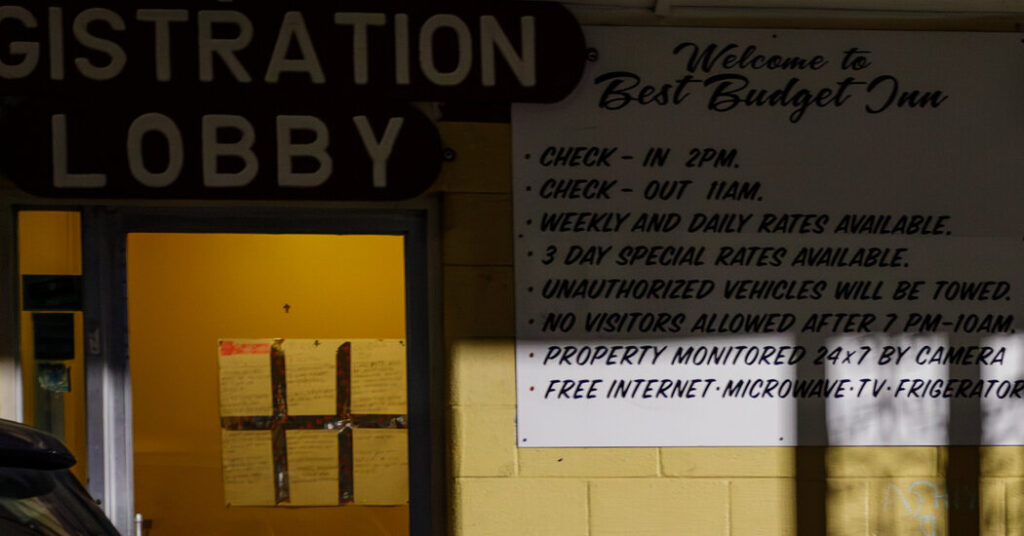
I thought I knew what poverty looked like. I grew up in a working-class neighborhood in Lima, Peru, in a family of former agricultural workers who remembered what it was like to live in thatched-roof houses. So when I drove through Arkansas, Kentucky and Oklahoma, meeting Americans in some of the poorest ZIP codes in the nation, my first reaction was one I’m not particularly proud of.
The people we met drove cars, lived in houses with air-conditioning, owned washing machines and bought groceries with electronic benefits cards. I found it hard to empathize with their circumstances: They reminded me less of my neighbors in Lima than of my country’s comfortable middle class.
As our 1,000-mile road trip went on, though, the people I met and the stories they told convinced me their poverty was more complicated than it appeared: the young people in deindustrialized towns who told us they felt left behind and terrified about their futures, the woman in Arkansas trying to raise six children on $13.40 an hour, the grandmother in eastern Kentucky who told me that I wouldn’t find a single family in her town whose lives hadn’t been touched by addiction — a sentiment I heard again and again as we drove through similar towns in Arkansas and Oklahoma.
The Americans I met were financially better off than many of their counterparts in the developing world. But as anyone who has been poor knows, poverty is about much more than money. Many working-class Americans I met are troubled by addiction, loneliness and contempt to a degree that poor people where I’m from are often spared.
The first thing that struck me about poverty I saw in this country was how it was braided together with the drug epidemic. While Latin America overwhelmingly bears the societal costs of drug production — like cartel-based violence and corruption — the United States bears the human costs of drug consumption at a scale not seen anywhere else. In 2023 it had the highest recorded rate of overdose deaths in the world.
And those who shoulder the lethal cost of this crisis are, disproportionately, poor working-class Americans.
In Tulsa, Okla., I met Drew May, 28, a woman with an easy demeanor. Four generations of women in her family had dealt with teenage pregnancy, addiction, mental illness and sexual violence, she said, and soon those patterns began to replicate in her life. At 5 she was pulling out her own teeth and hurting herself; at 7 she was hospitalized for what doctors thought was a mental health disorder.
“I wanted people who cared about me and who listened to me,” she said. “I found that in the drug community.” She told me that she began to smoke crystal meth at 13. In school she had been in the gifted and talented program, but soon she dropped out and left home.
At 19 she and her partner began engaging in vandalism. “We felt like we’d been left behind,” she said, and they wanted to express their frustration, even if they weren’t striking out at anyone in particular. “I personally didn’t have any strong beliefs,” she added. “I was in for the chaos.”
The second thing that struck me about the poverty I saw in America is that it can be unbelievably lonely. Many of those we met were cut off from extended family and left to fend for themselves. The emotional distance was compounded by the physical: empty miles separate a home from a church, a supermarket or another home, and travel was expensive or laborious.
It was a sharp contrast with the density — both geographic and relational — of where I grew up. My life was a node in a thick network of aunts, cousins, cousins twice removed and friends of friends. My parents still talk about the neighbors who tossed them a bag of oats in weeks when they had no food or money in the house. When our institutions failed, our community acted as social insurance — a threadbare substitute for state capacity but a substitute nevertheless.
American institutions have more resources than Peru’s, though America’s welfare state is thinner than those of other rich countries, and the current administration is eroding it further. But class solidarity and communal structures can make poverty more endurable, and the Americans who have to live without them end up more isolated and scared than we ever were.
America’s stories about itself can breed contempt for the poor. At a Fourth of July party in San Francisco, I mentioned this reporting project to a friend who writes about global development. According to him, it was simple: America’s talent-discovery mechanisms are so efficient, he said, that people remain poor only when it is their own fault.
His comment mirrored the suspicion I felt earlier in the trip. Despite approaching the question from radically different places, my friend and I both were asking, in essence: How real can poverty in America be? His framing was little more than a technocratic retelling of the American promise that anyone can rise here because effort and talent are rewarded. This thinking makes stories like mine — I was poor, and then I came to America, and now I am not — elicit sympathy. It turns the lives of a lucky few into evidence supporting the classic tale of American uplift.
Yet while I’ve experienced the success of meritocracy, I’ve also seen firsthand how often meritocracy fails and how easily effort is undone by luck and circumstance — two forces that particularly afflict those who can’t afford second chances. We can come to hold people responsible for what is, in the end, bad luck.
In Pine Bluff, Ark., Crystal Barnes, a young schoolteacher, painted a grim picture of America at 250. “We’re living in a world that’s taking away resources and forcing people to get desperate. And what happens when too many people get desperate?” she said. “We’ll see.”
Most of the people we met felt their desperation only as powerlessness and anxiety. But for some, like Ms. May, it curdled into nihilism and resentment. If a country whose views of itself tell its struggling people that their suffering is their own fault, it should not be surprising when some of those people decide they are in for the chaos.
And yet when I met Ms. May, things seemed to be looking up. She had been sober for more than three years; she was raising her two oldest children again and preparing to see all five of her children in the same room for the first time. She’d graduated from an Oklahoma program called Women in Recovery, a diversion initiative for women with substance abuse disorders.
Run by Tulsa’s Family & Children’s Services, it provides roughly two years of intensive treatment (housing, mental health counseling, work force training) as an alternative to prison. Only about 4 percent of participants go to prison within three years of graduating from the program. And Women in Recovery costs about $30,000 a year to enroll one woman — less than Oklahoma would have spent imprisoning her for the same period.
What struck me most about the program was not so much its top-line numbers as the immeasurable effect it had on women like Ms. May, who now drives a truck for Family & Children’s Services Thrift Store. It granted them full personhood, built a community around each of them, paid them the courtesy of believing their problems were real and tried to help address them.
Ultimately, a society as rich as America’s should be capable, however imperfectly, of providing families not only with money and consumer goods but also with a glimpse of a path forward.
“I had no hope before, and I couldn’t see past my own two feet, and that’s so different today,” she told me about her time in Women in Recovery. So many of those I spoke with are stuck in shrinking towns, in dead-end economies, in politics that look past them. As Ms. May said, they, too, “deserve to have lives that are full of options.”
The Times is committed to publishing a diversity of letters to the editor. We’d like to hear what you think about this or any of our articles. Here are some tips. And here’s our email: [email protected].
Follow the New York Times Opinion section on Facebook, Instagram, TikTok, Bluesky, WhatsApp and Threads.
The post Growing Up in Peru, I Thought I Knew Poverty. America Surprised Me. appeared first on New York Times.