For a long time, Carolyn Hugley’s job as a Democratic state senator in Georgia largely meant playing defense. Over two decades, a Republican majority pushed through bills overhauling election rules, easing limits on guns and restricting access to abortion.
She and her colleagues could seek compromise and common ground. But more often than not, there was only one real option: register dissent and wait for a new day.
It came on Tuesday.
The sweeping rebuke of Republicans in the midterms positioned Ms. Hugley to become the speaker of the Georgia House of Representatives, as her party claims a majority for the first time since 2003. She will be working with a Democratic governor, something else Georgia has not seen since then.
“I have been the one dancing backward and in high heels,” Ms. Hugley said of her years as the minority leader. “Now, we have the opportunity to lead.”
As Democrats scored victories up and down the ballot in the South, their success or failure in office will determine whether the next two years are a blip caused by an unpopular president or the beginning of a broader political realignment that could elevate Democrats across the South.
For a generation, Democrats in the South would contemplate what they might do differently than Republicans to tackle some of the region’s most persistent problems, like poverty, dire health outcomes and racial imbalances in economic prosperity. But such ambitions often felt out of reach, with the days of sending Southern Democrats from governors’ mansions to the White House long past.
But now Georgia and North Carolina will be laboratories for Democratic leadership in one of the most conservative parts of the country. The opportunity comes with enormous stakes. The problems facing elected officials are not easy to solve. And the newly elected Democrats have a limited window to prove to an electorate that has historically been skeptical that the party can execute a successful and sustainable vision for the South.
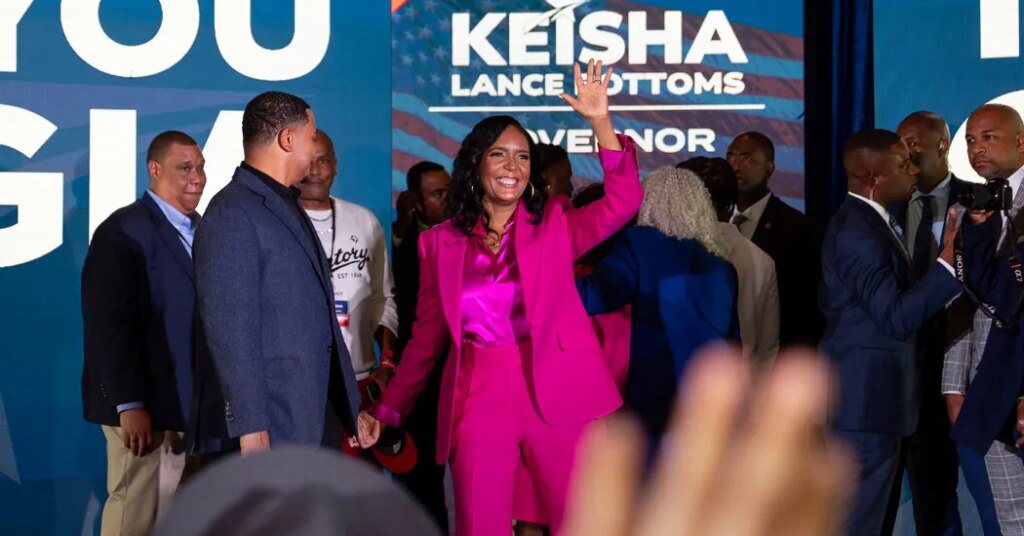
In Georgia, Keisha Lance Bottoms, the incoming Democratic governor, has listed expanding Medicaid under the Affordable Care Act as a chief priority, a move that would extend largely free health care to low-income residents and could resuscitate struggling rural hospitals. Georgia is one of 10 states that have not expanded Medicaid.
She said she would also push for Georgia to make good on the state’s unfulfilled promise of universal pre-K.
In North Carolina, Gov. Josh Stein and other state leaders have discussed undoing gerrymandered legislative maps, putting more money into public education and possibly raising the $7.25 minimum wage.
In both places, Democrats will have to navigate differing instincts on whether to build alliances with Republicans or punish them. And in the South and elsewhere, like Texas and Wisconsin, Democrats have to not only negotiate with the Republicans who still control some levers of power but also go up against government infrastructure and political cultures molded for decades by conservative values and priorities.
“I think we have a mandate from Georgia voters to actually do something about the cost of living crisis, to go after public corruption and to certainly protect our elections,” said Tanya Miller, the first Democrat elected attorney general in Georgia since 2006. “People want a government that works for and focuses on them, on how to make their lives better.”
Democrats in Georgia won every statewide race on the ballot, from the governor and lieutenant governor down to insurance commissioner — offices the party has not held in at least a decade. In the State Senate, Republicans were left with a two-vote majority.
And in North Carolina, the party appears to have overcome a gerrymandered congressional map to flip its delegation to a possible 10-to-4 split. Former Gov. Roy Cooper, a Democrat, won a Senate seat. Democrats also took control of the State House, made gains in the Senate and unseated several county commissioners and sheriffs.
Democratic Party leaders said they recognized their fortunes had been lifted by voters who blamed President Trump and his party for neglecting their mounting struggles. An unpopular war has driven up fuel prices. Inflation has persisted. Rapid population growth across much of the South has made housing less affordable. Health care has stayed expensive and cumbersome, and that’s if care is accessible at all.
Voting rights and access to the polls had also galvanized support among Black voters angered by the Supreme Court decision gutting the remains of the Voting Rights Act and a Republican-led overhaul of the election system in Georgia.
“We can’t keep playing around with the most powerful thing the Constitution gives us — one person, one vote,” said Penny Brown Reynolds, the Georgia Democrat who will oversee elections as the incoming secretary of state.
In North Carolina, some Democrats yearn for a modern reimagining of what they regard as their glory days: the cumulative 16 years, off and on from the 1970s to the 1990s, when Jim Hunt was governor. Back then, the state government invested heavily in public schools, expanded community colleges and universities, and turned North Carolina into a hub of biotech research.
“We’re getting that back!” Robert Reives, the Democratic state representative set to become the next House speaker, vowed to a jubilant election night crowd.
The backlash to President Trump handed Democrats victories in places where the party has struggled to be competitive. South Carolina elected a Democratic senator. Mississippi is waiting to find out if it has done the same, or come close.
In North Carolina and Georgia, the widespread dissatisfaction motivating voters was supercharged by years of demographic shifts, incremental gains by Democrats and sustained voter mobilization efforts.
North Carolina already had a Democratic governor, lieutenant governor and attorney general, all of whom had cut a moderate path to win in a state where Republicans otherwise dominated policymaking.
In Georgia, Democrats have made more fitful progress. Joseph R. Biden Jr. won the state in 2020, a first for a Democrat in nearly 30 years, but Vice President Kamala Harris lost it four years later. The state has also elected and re-elected two Democratic senators, Jon Ossoff and Raphael Warnock. But those successes followed costly, upstream fights.
The midterms have upended the political landscape to a degree that surprised even some Democrats who spent years pushing for it to happen.
“We have done the work,” Ms. Hugley said. Still, she added of the party’s gains, “to win them all, and to win as quickly and with the margins we did, I don’t think anyone can honestly tell you they saw that coming.”
Some Republicans figure their best hope for redemption comes from Democrats’ having this moment in the driver’s seat. Many voters will be turned off by liberal governance, and if the Democrats veer to the right, they will alienate their base, said Paul Shumaker, a Republican strategist in North Carolina.
He thinks Democrats might end up being their own worst enemy. “Please, that’s the best thing that can happen for Republicans,” he said.
There had been speculation in Georgia ahead of the election that if Ms. Bottoms won, Republicans would use their remaining weeks in power to rush through redistricting and reduce the authority of the governor’s office before Ms. Bottoms assumed it.
But Gov. Brian Kemp, the Republican incumbent, shot down that possibility the morning after the election.
The years of Republican dominance and the way they used their power has left a reservoir of resentment for Democrats.
In North Carolina, many Democrats viewed the Republican Party as often wielding its influence like a blunt weapon. Republican lawmakers stripped away enough of the governor’s powers to make him one of the weakest executives in the country. They also passed a restrictive abortion law, enacted multiple gerrymandered congressional redistricting plans and limited school curriculums on gender identity and sexual orientation. Democratic input was rarely sought.
“Some people are going to say, ‘Let’s not do to Republicans what they did to us,’ but I say screw that,” said Mayor Leonardo Williams of Durham, N.C. “We’re going to have to do what is necessary, and that means holding them accountable.”
Others have cautioned against conflating accountability with retribution.
Voters have had enough of that, said Naomi Randolph-Hwesuhunu, the executive director of the Action Institute NC, an organization focused on racial, gender and economic equity. They want elected officials to deliver results that materially improved the quality of their lives. “Not to be immersed in retaliatory politics,” she said.
“We are in a triage moment,” Ms. Randolph-Hwesuhunu added. “There are so many things that are out of alignment that need to be brought back into alignment.”
Ms. Hugley, one of the longest-serving Democrats in the Georgia Legislature, said that many of her colleagues had never experienced being in the majority. The learning curve could be steep, as the job shifts from resistance to steering the state.
That comes with added pressure: Voters who punished Republicans in this election could do the same to them. To avoid that, Ms. Hugley said, they had a lot to do but not much time to do it. Another election is in two years, and the state’s regular legislative sessions last only a few weeks.
“We have 40 days in 2027 and 40 days in 2028,” she said, “to make some things happen.”
Emily Cochrane contributed reporting from Nashville.
The post Southern Democrats Now Have a Chance to Lead. What Will They Do With It? appeared first on New York Times.