Eva Moskowitz is the founder and CEO of Success Academy Charter Schools.
Public education in the United States is known as a K-12 system, but it is nothing of the sort. That phrase conjures images of children moving along a coherent 13-year educational path. What they encounter, instead, are three disconnected institutions — elementary, middle and high schools — that share a district and superintendent but not the responsibility of preparing students for the next phase of learning.
Each stage of school should be different, tailored to support a child’s distinct stage of growth and development. Yet specialization can’t become fragmentation; nor may schools remain unaccountable for poor standards. The consequences of the status quo — of schools moving students along a shoddy academic conveyor belt — have begun to accumulate. On the mathematics evaluation of the 2024 National Assessment of Educational Progress, for example, failure became significantly more prevalent at each stage of schooling. Nearly a quarter of fourth-graders scored “below basic” in math, meaning they wouldn’t be able to complete such everyday tasks as calculating the correct change at a checkout counter. Forty-five percent of high-school seniors, meantime, lacked the skills to compare job offers with different hourly rates.
When students arrive unprepared, teachers inherit the remediation. In a RAND study, roughly one-third of secondary math teachers serving lower-achieving classes said they spent at least half their instructional time on content that students should have already mastered. Another study found that students in grades K-12 spend more than 500 hours each year on below-grade-level assignments and instruction. Instead of being honest about where children stand, schools adjust their standards to signal success, moving students along with high marks despite their not having mastered the material.
It’s a self-perpetuating cycle that results in what many people call a “college-readiness problem.” That, too, is a misnomer: College is simply where the final broken handoff becomes impossible to hide.
Institutions like Success Academy, the public charter school system I founded and lead, have sought to stop this leakage. Ours is the fourth-largest public school system in New York state, serving 22,000 children admitted by random lottery, and it is built on two features: a clearly defined academic destination and accountability at every stage. We start, in other words, at the end. Call it a 12-K approach to learning.
That means studying the syllabi of the most rigorous STEM and humanities courses at leading universities to understand the knowledge and skills students need to succeed. It also means observing 12th-grade classrooms at high schools known for academic rigor to understand the complexity of the problems students tackle and the intellectual independence that’s expected of them. Then, it requires mapping those expectations backward, grade by grade, so every year builds toward that destination and becomes part of one integrated journey.
College assignments for organic chemistry, physics and calculus might reveal that younger students need to develop both deep fluency in mathematical reasoning, so they are able to find entry points to novel, abstract problems, and intellectual grit, so they can persist when solutions are elusive. The solution could be making a school’s science program quantitative starting in kindergarten — and adding, say, a block of math focused on logic and problem-solving in early elementary school. The demands of college humanities courses might shape the breadth and complexity of the literature that teachers select for their curricula, as well as how they teach their students to interpret language, construct arguments and use evidence.
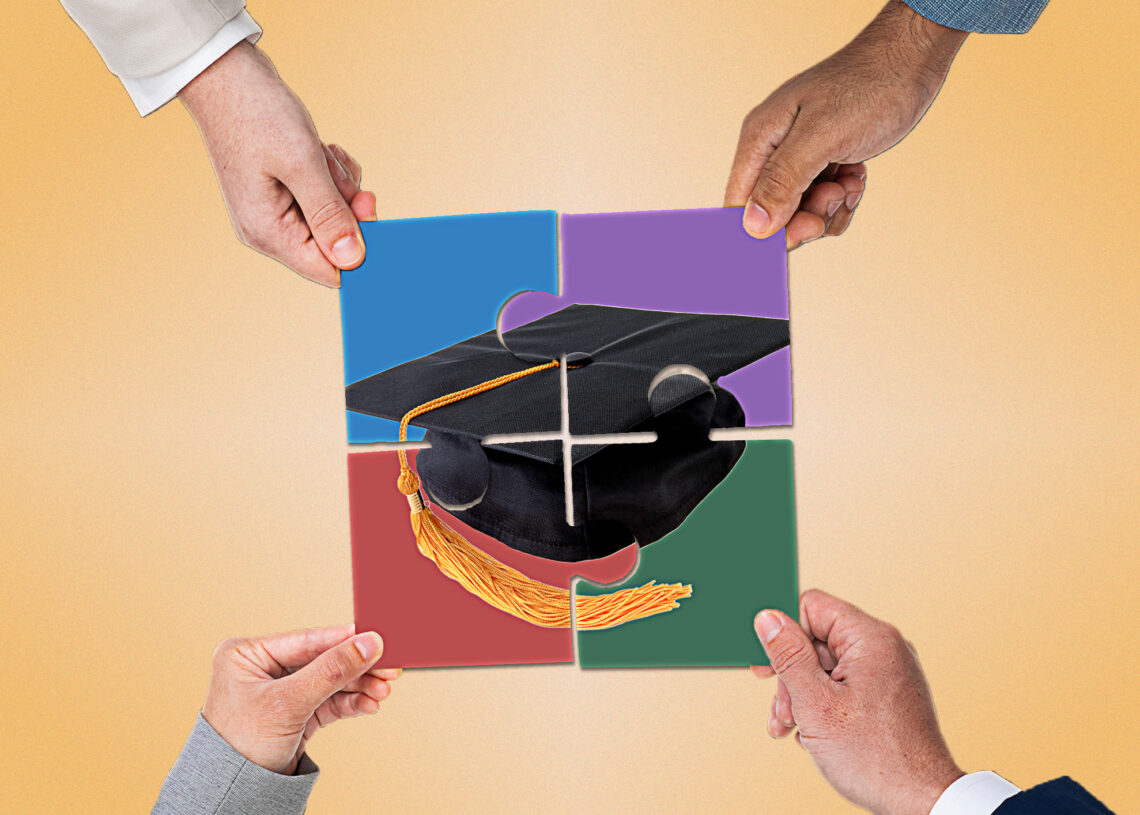
Schools might introduce Advanced Placement humanities courses and exams in eighth grade to ensure middle school readies students for high school. High school, then, might be designed around an all-AP curriculum and STEM dual-enrollment to immerse kids in college-level work before they arrive on campus. Such an approach is what K–12 should mean: not 13 separate grades divided among three academic silos, but 13 years designed as one, with every grade building on the last and preparing students for the next.
Yet developing the right curriculum is only half the work. A school isn’t successful if the students it shepherds arrive at the next stage unprepared. The antidote is to track students’ transitions and to measure their elementary, middle and high schools by how well-prepared enrollees are as they move on. This means confronting grade inflation. High academic marks must reflect real readiness. A school system’s commitment wouldn’t be that it will never find a gap in a student’s preparation. It would be that it will acknowledge the inevitable shortfalls and fix any problems at their source — with no exceptions.
Until K-12 means a holistic, integrated and purposeful 13-year plan that instills the skills, knowledge and habits children need, with every school accountable for preparing students for what’s next, it will remain an empty label that misleads parents and fails students. Children get one childhood and one education. They deserve a system designed with unwavering continuity.
The post The K-12 approach fails students. My school system is flipping it around. appeared first on Washington Post.