Britain’s decision to outlaw Palestine Action, a pro-Palestinian direct-action group, as a terrorist organization has been challenged in a succession of legal hearings since it was imposed last year. Now, the country’s Supreme Court is set to hear a challenge against the ban and decide its future.
The British government accused Palestine Action of orchestrating “a nationwide campaign of direct criminal action,” putting national security at risk. According to the government’s independent adviser on counterterrorism legislation, it was the first time a protest group that did not call for violence against people was proscribed under counterterrorism laws.
Here’s what to know.
What is Palestine Action?
Palestine Action was founded in 2020 as a pro-Palestinian protest group that largely focuses its efforts on demonstrations against corporate and military targets linked to the sale and export of defense equipment to Israel. The group says it does not promote violence against individuals.
It was co-founded by Huda Ammori, an advocate who had previously worked for a Palestinian rights organization, and Richard Barnard, an activist linked with other grass roots movements, including Extinction Rebellion, a global environmental group.
During legal proceedings challenging the ban, Britain’s High Court said that the group claimed to have a mailing list of some 20,000 people but that the “extent and nature” of Palestine Action’s membership and organization was “largely unexplained.” Analysts said that before it was disbanded, Palestine Action was run by a relatively small, committed group of activists.
The group’s actions have drawn international attention. President Trump criticized it after activists were accused of vandalizing one of his Scottish golf resorts by defacing the clubhouse and spraying “Gaza is not 4 sale” across a green. Mr. Trump called the demonstrators “terrorists” and said he hoped they would be “treated harshly.”
Why was the group banned?
The Terrorism Act 2000, introduced under a previous Labour prime minister, Tony Blair, allows the government to ban any group “concerned in terrorism.” It contains a broad definition of terrorism that includes damage to property, not just people, if it is carried out for ideological reasons.
The British government announced its plan to designate Palestine Action a terrorist group in June 2025, three days after some of its members damaged military planes using red paint at Britain’s largest air force base, at Brize Norton in Oxfordshire. Yvette Cooper, then the home secretary, said the group’s activities met the legal definition of terrorism because they included “serious damage to property.”
The ban was imposed in July, and the group was added to the statutory list of more than 80 banned terrorist organizations, alongside the Islamic State, Al Qaeda, and Atomwaffen Division, a white supremacist group. At the time, Palestine Action said it was “plainly preposterous” to group it with such organizations.
The ban made it a criminal offense to belong to Palestine Action, express an opinion or belief in support of the group, or wear clothing or carry items that “arouse reasonable suspicion that the individual is a member or supporter” of the group, among other actions. The maximum penalty for belonging to or expressing support for the group is 14 years in prison.
In August, the United States followed suit, designating Palestine Action as a terrorist group.
More than 4,000 people had been arrested across Britain for showing support for the group as of Nov. 1, according to Defend Our Juries, a civil liberties group. Between Sept. 11, 2001, and March 31, 2025, there were a total of 5,734 terrorism arrests in Britain.
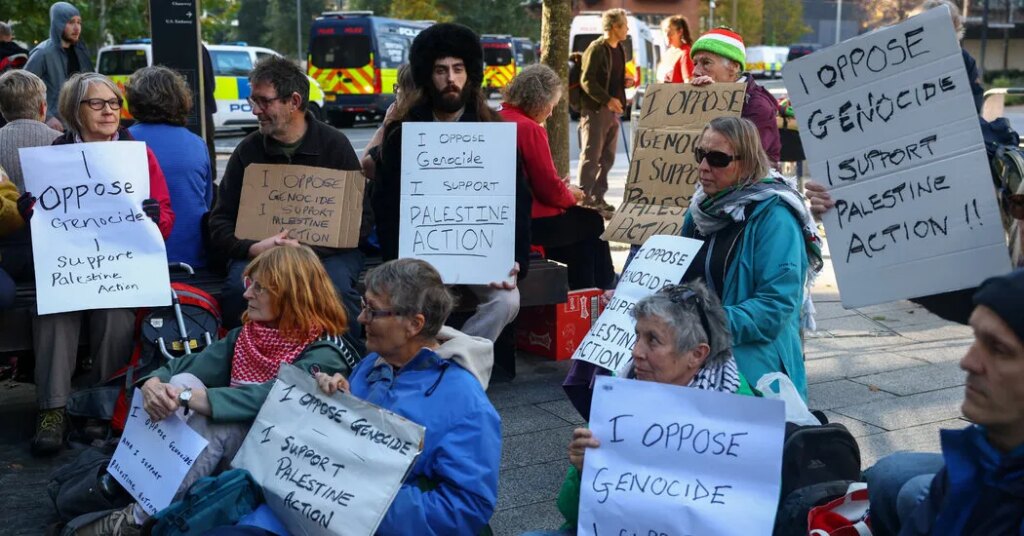
The arrests related to Palestine Action stemmed largely from coordinated demonstrations, analysts say, where some protesters have deliberately risked detention by holding placards reading: “I oppose genocide, I support Palestine Action.” Hundreds of people were detained over the weekend outside the U.S. Embassy in London after staging such a protest.
Why has the ban faced criticism?
Some civil liberties organizations argue that using counterterrorism legislation against Palestine Action is overreach and part of a wider crackdown on protest in Britain. They contend that existing criminal laws cover property destruction, whereas proscription criminalizes anyone expressing moral support for the proscribed group, including by attending peaceful gatherings.
In July 2025, the United Nations High Commissioner for Human Rights, Volker Türk, called the move a “disproportionate and unnecessary” expansion of counterterrorism powers and called on the British government to rescind its decision.
In written submissions to the Supreme Court, Amnesty International and Liberty argue that the proscription of Palestine Action has silenced broad segments of civil society, academics, journalists and even their own human rights organizations.
David Mead, a human rights law scholar at the University of East Anglia, said the central legal dispute turns on whether the ban is proportionate.
“The surprising thing is the U.K. state’s seeming need to use terrorism legislation on a group such as this,” Professor Mead said.
How has the ban been challenged in court?
Ms. Ammori, the co-founder, first challenged the ban in June 2025, and the case has since wound its way through the legal system. In February, the High Court ruled the ban unlawful, calling it disproportionate and an infringement on fundamental rights to free expression and assembly.
That decision was overturned in June by the Court of Appeal. Ms. Ammori appealed that ruling, sending the case to the Supreme Court for what will be the final word in British domestic courts.
Supreme Court rulings are usually issued in three to six months, but legal analysts said the court could rule sooner in this case as hundreds of people arrested and charged in relation to protests are awaiting trial.
Ms. Ammori has said that if the Supreme Court upholds the ban, she plans to take the case to the European Court of Human Rights.
Stephen Castle, Lizzie Dearden and Michael Shear contributed to this report
The post U.K. Supreme Court to Hear Challenge to Ban on Palestine Action: What to Know appeared first on New York Times.