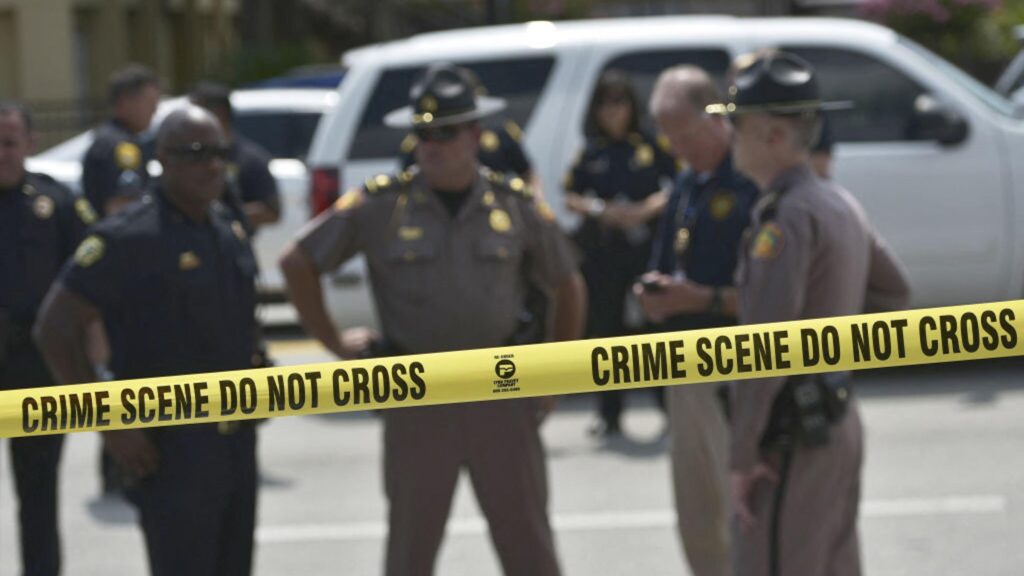
When a mass shooting tears through an American community, we count the dead. That number—26 at Sandy Hook Elementary, 49 at Pulse nightclub, 58 in Las Vegas—becomes the headline, the official measure of the scope of the horror. But anyone who has watched the alerts pile up on their phone, felt their stomach drop, and struggled to focus for the rest of the day knows the damage doesn’t stop at the victims. It ripples outward across the country, affecting in one way or another millions of Americans who were nowhere near the scene.
Intuitively, we can all sense the broader harm, but it is remarkably hard to measure. Nearly two-thirds of Americans say mass shootings are a significant source of stress in their lives. Researchers have found that after these events, antidepressant use rises among teenagers living near a school shooting. Gun purchases made in response to events have been shown, grimly, to lead to still more accidental gun deaths.
In a recent study published in JAMA Psychiatry, we set out to measure another channel through which a mass shooting’s harm could quietly spread: deaths on the road.
At first glance, it might seem like mass shootings and car crashes have little to do with each other. But decades of research show that stress and distraction make drivers more dangerous, and driving is one of the riskiest things most Americans do every day. In the months after the Sept. 11 attacks, fatal crashes rose in part because travelers traded planes for cars—but there was also evidence of an increase in crashes per mile driven, an increase believed to be linked to the fear and stress that spread nationwide. We wondered whether the country’s deadliest shootings might leave a similar mark.
To find out, we used a federal database that logs every fatal crash on U.S. roads combined with FBI data on mass shootings over a 15-year period. We compared the number of traffic deaths in the days just before each shooting with the number the day after the shooting.
Why the day after? Because that’s when the nation pays the most attention. As part of our study, we analyzed Google search traffic data, which showed that the day after a mass shooting is when Google searches for “shooting” peak, and when media coverage floods the news and social media. If a shooting were going to affect how the country drives, the day after is when we’d expect to see it.
Because the timing of a mass shooting is essentially random with respect to the nation’s driving habits, what’s called a “natural experiment” takes place. This lets the calendar stand in for a controlled experiment. The days surrounding each shooting form built-in comparison groups, so any jump on the day after stands out against the typical daily patterns in road deaths.
The result was sobering. On the day after the 10 mass shootings with the most fatalities, traffic deaths rose by an average of 14.3%, about 20 additional deaths nationwide. Put another way, the extra deaths on the road equaled roughly 75% of the number of people killed in the shootings themselves.
Any surprising result invites an obvious question: Could it be a coincidence? To find out, we repeated the analysis 10,000 times, substituting fake, random dates for the dates of mass shootings. A spike as large as the one we observed arose only once in 10,000 iterations, making it clear that our findings were highly unlikely to have occurred by chance. The increase held across nearly every kind of driver, region, and weather condition, and it persisted even in states far from the shooting, which argues against local explanations like road closures or emergency response. And when we examined active-shooter incidents with no fatalities—events that drew much less public attention—we observed no rise in traffic deaths.
Our study, however, cannot tell us exactly why this happens, and it cannot trace any single crash to any single driver’s state of mind. Grief, anxiety, a phone lighting up with notifications, or distraction behind the wheel could all play a role; some mix is likely at work, and we cannot fully untangle them. But the larger lesson here does not hinge on the mechanism. The toll of a mass shooting is bigger than the number in the headline, and much of it remains invisible until we go looking for it in unexpected places.
That is the hard part of studying a national tragedy. The stress and distraction that a shooting spreads across the whole country cannot be seen the way we can see a wound. But we can see its footprints in the form of antidepressant prescriptions filled, in accidental gun deaths, and, as we now show, in lives lost on the road. Each study captures only a sliver of the whole, which may be larger yet.
Of course, none of this diminishes the core tragedy of a mass shooting. But it should change how we picture its scale. When we count only those killed at the scene, we undercount, and what we choose to count shapes what we choose to do about it.
Seeing the fuller toll and how quickly these tragedies move through a highly interconnected country might help us respond more thoughtfully, whether in the media, on Capitol Hill, or in our homes and communities.
The post The Death Toll of a Mass Shooting Doesn’t End at the Scene appeared first on TIME.