THE SAVAGE MIND: An American Legacy, by David Treuer
“The problem is not out there so much as it is within,” the novelist and critic David Treuer writes in his new book. “Violence has become a part of our national and individual character. It has become our Savage Mind.”
Though it reads by turns like a polemic, a manifesto, a history and a meditation, “The Savage Mind” is a letter that Treuer, a member of the Ojibwe tribe, wrote to his children after George Floyd’s murder and the Jan. 6 Capitol siege, in an attempt to hold his family together as the nation seemed to be falling apart.
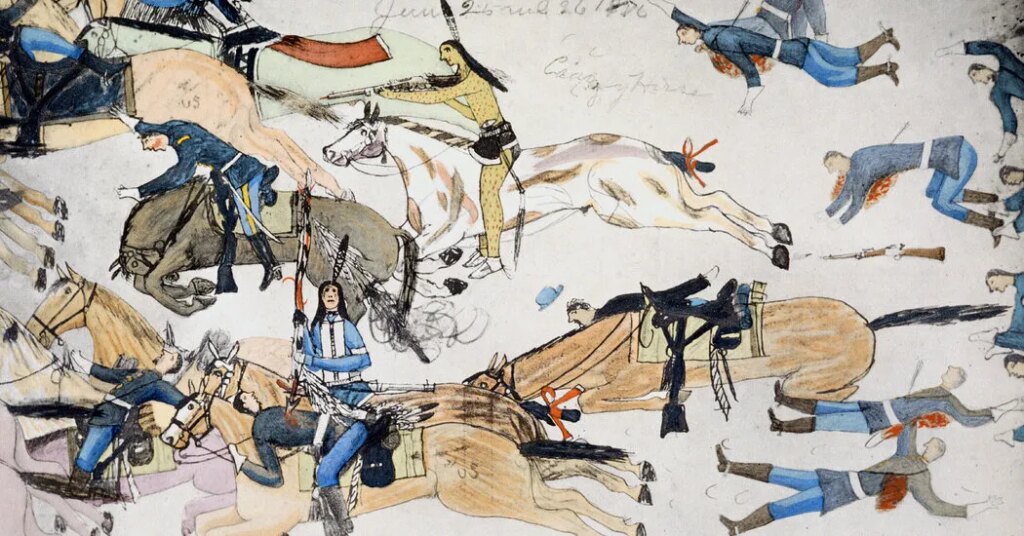
The book is a study of the American frontier and the violence that has always been its defining feature. The frontier no longer exists as a physical space, Treuer asserts, but endures nonetheless as “the idea, the impulse, the culture” of what once lay outside civilized life. The frontier has migrated inside us, and it has become our cultural practice to see violence as the only response to fear.
“The Savage Mind” begins with a childhood story. As boys growing up on the Leech Lake Reservation in Minnesota, Treuer, his older brother and his younger cousin once waited, terrified, for a woman who threatened to burn down the cousin’s house with them inside it. “Deprived of everything — including our imaginations, which are the only thing that will save anyone — we instead did something very American,” Treuer writes. “We found a gun.”
The story’s resolution highlights the absurdity of the situation, the larger social forces that created it and Treuer’s capitulation to them. It’s a chilling and heartbreaking remembrance with a moving finish: “Something was wrong out there. And something was wrong inside and something wrong was being said between the two wrongs — each to each. The wonder lingers, the shame remains.”
This opening narrative establishes Treuer’s dread of “the terror within,” a phrase borrowed from James Baldwin and cited in one of the book’s epigraphs. Like Baldwin, Treuer explores the roiling conflict between internal truth and external identity, and his book is an attempt to parallel “two wrongs”: the trouble within his family and the trouble within America.
He hopes to reveal to his children his own lifelong struggle with this terror — this internalized, reflexive violence — while cautioning them about its dangers. The beginning is promising and compelling, but Treuer struggles to replicate its literary merits in the rest of his early chapters.
“I have begun this letter four times and have failed every time,” Treuer writes, echoing the first line of Baldwin’s 1963 book “The Fire Next Time,” which opens with a missive to his nephew: “I have begun this letter five times and I have torn it up five times.” Baldwin then conjures his nephew’s face and invokes three generations of his family — “tough, dark, vulnerable, moody.” These words create a collective portrait of his family line and the generational danger of being Black, “committed” and “tough and philosophical concerning destruction.”
Treuer doesn’t — at any point in his letter — evoke his addressees. What follows his admission of “failure” is a series of statements that are presented as revealing and profound, but are rather indistinct, ordinary or obvious. Treuer has known his children since they were born. He isn’t sure they understand him. He “came up different.”
We never meet these children. We don’t hear their voices. We know neither the conditions they’ve faced nor the conflicts they might experience. Treuer — though I suspect he wants to protect them — doesn’t offer anything other than euphemism. They are told things he says they already know. What they don’t know, he rushes past. He offers a vague retelling of the breakup of their family, but it seems to serve as a way into a discussion of mass shootings, systemic murder and genocide.
While Treuer states that he was afraid for his children, himself and his country, he doesn’t adequately convey the fear, analyze the fear or give us the substance of the fear. We don’t see his complexity because it isn’t on the page. We have to take him at his word that he is “a deeply flawed (even wounded) man,” even if the flaws seem to be in the writing rather than the man.
Treuer provides many examples of the Savage Mind, including the violence to which victims have resorted: Native Americans who slaughtered white people and other Native Americans; the 12,000 “Black relatives” who fought with the U.S. Army; and the many Black, Hispanic and Indigenous cowboys for whom the bloodshed of the plain was a way of life. Drawing on the examples of some, Treuer implicates all, then and now. In doing so, he conveniently ignores the core principles of “The Fire Next Time” and Martin Luther King Jr.’s “Letter From Birmingham Jail,” as well as numerous examples of nonviolent responses and protest during the 20th century.
Treuer repeatedly tells us what the Savage Mind is and what it does. Rather than an effective literary device, the repetition here is redundancy. The analogies and tautologies he uses to support his claims undermine them.
The fallacies of presumption, however, occur only in the explicitly epistolary passages, which, while distractingly frequent, give way to richer narratives. Much of this book is successful, and often brilliant. Treuer presents us with the complex and brutal history of the frontier. It’s a chronicle of people choosing violence at every turn — violence to others, one’s own and oneself. Laid bare are the atrocities from Columbus’s day to ours, and all the collateral damage in between. They’re powerful accounts because the writing is so lucid and the content so insane.
Even more captivating are his personal memories: his college years, his fencing trials and successes, his romantic life and his relationship with his teacher Toni Morrison. His later portraits of Jim McDougall and Joe Neg — members of the Ojibwe Big Drum society — are relatively short, but are told with such economy and so much palpable love that I reread them many times. His telling of his Jewish father’s escape from Austria, life in America and final years is painful and beautiful. I wanted to re-experience the feelings these narratives evoked and the reflections they asked of me. What violences, in my life, do I excuse?
“The Savage Mind” does not work as an open letter, a polemic or a treatise. Treuer doesn’t effectively maintain or even establish the parallel between his family and America. But he doesn’t need to. The devices and conceits presented by the letter format aren’t necessary. The histories, personal stories and individual portraits echo our individual and collective savagery and grace.
The book amounts to a stunning account of the anxiety, fear and loneliness one experiences on “the border of where, we are taught, our great American civilization ends and the uncouth, ungentle, unkind, uncivil and downright savage world … was supposed to begin.” That border, the split between civil and savage, exists now within all Americans. We will always be tested by our public and personal relationships; failing to comprehend others is the first step toward the wrong side of the divide.
Often while reading it, I often wanted to dismiss Treuer’s work for what I think are literary failings. But I still find myself trying to understand it. To do so, I can’t treat his writing as a confrontation. His book, perhaps, is of another order, and among those we can carry to a new frontier.
THE SAVAGE MIND: An American Legacy | By David Treuer | Little, Brown | 263 pp. | $30
The post How Frontier Violence Defined the American Mind appeared first on New York Times.