A steady hum of activity filled the underground bunker in eastern Ukraine. Soldiers called across one another as they monitored banks of screens showing livestream video feeds from the battlefield one morning last month.
“Guys, let’s fight the war first and deal with our stuff later,” the commander, Yuriy Horobets, shouted, quieting the room. “Our FPV is coming in now,” he said, pointing out a tiny, pale object, a first-person-view drone, moving across the screen of a reconnaissance feed. The drone, a remotely piloted quadcopter, was homing in to attack.
His brigade, the 66th Mechanized Brigade, had multiple drones in the sky that day to strike Russian positions as its troops prepared to storm a tree line. The assault was at the tail end of a monthslong operation that recaptured a sizable portion of eastern territory.
That operation, called Vivaldi, thwarted Russian efforts this year to encircle the last cities of Donetsk Province, the prize that Moscow insists it wants to end the war.
After months of operational silence, the Ukrainian brigades involved have begun to reveal details of how they managed to turn a losing defensive fight against Russian forces into a successful offensive along parts of the front line. They allowed a team of New York Times reporters to embed with them for two weeks and see their work firsthand.
Ukrainian troops had been losing ground to the far more numerous Russian Army for the best part of two years. But the wider use of drones and remote-controlled vehicles, and changes in the command structure and culture within parts of the army, enabled Ukraine to shift gears.
Brig. Gen. Andriy Biletsky, the overall commander of the operation, claimed that the tactics were so successful that his troops had wiped out Russia’s 144th Motor Rifle Division in the fighting and reversed Russia’s gains of a whole year.
“What we are seeing now looks more like desperate attempts to establish a defensive line — an agony, rather than organized, systematic military operations,” he told journalists in a briefing in October.
Alongside several of his commanders, he had gathered members of the news media in an underground bunker to announce the end of Operation Vivaldi, the main thrust of which he said began in May, and to sum up its results.
In October, for the second consecutive month, Ukraine gained more territory than Russia, and Russian forces suffered their highest monthly casualty toll — more than 54,000 killed or seriously wounded — of the war, according to the Institute for the Study of War.
Military analysts and Russian military bloggers have confirmed Ukrainian gains, as Russian forces lost a key salient north of the city of Lyman and an equal amount of territory on the Zaporizhzhia front line in southern Ukraine.
The 66th brigade was essential to that success. Its challenges were typical of many Ukrainian military formations, like struggling with old equipment and shortages of personnel and resources. Many of its infantry soldiers are in their 40s or 50s, like Mr. Horobets, 45, a battalion commander.
Last year, the brigade, vastly outnumbered by Russian forces opposing them, was steadily losing ground, Mr. Horobets said. Their supply routes were under fire, preventing them from bringing in ammunition and evacuating the wounded.
Yet it was from that maelstrom, fed up with being destroyed by Russian firepower, that a few battalion commanders said they took things into their own hands. They seized critical Russian positions on high ground above a village from which Russian troops were directing the strikes against them.
Once they controlled the heights and knocked out Russian communications, they found they had an advantage. The Russian soldiers in the village did not know what had happened and could not replace equipment because the Ukrainian forces were bringing down the Russian supply drones and preventing vehicles getting through on the roads, several commanders involved in the operation said.
“At that point, we had superiority over the enemy in terms of both strike drones and aerial reconnaissance,” said Nazar Kinash, 25, the acting commander of a mechanized battalion. The Russians “had effectively been blinded,” he said.
The 66th brigade began infiltrating soldiers into the village and setting up ambushes, Mr. Horobets said. Within a month, they had taken the village, and six weeks later, they seized another.
“For now, you see silence,” Mr. Horobets said as he gestured at a bank of video screens in his underground command post. “A month ago, there was a terrible war here because the enemy was trying to regain its positions and counterattack,” he said. “But, for now, they are exhausted.”
The operation is the first sign of a new direction under General Biletsky, who took command of the Third Army Corps in summer 2025, bringing a unity of command and coordination among six brigades along their part of the front line, several battalion commanders said.
Decision making was given to commanders on the ground rather than being relayed from a command post, while the senior commanders focused on the broader operational level to disrupt the Russian command, they said.
Working in sync for the first time with the units around them, the commanders of the 66th brigade said they had cracked the problem of Russian infiltration, sealing the gaps between units where Russian soldiers had been slipping through to set up positions behind Ukrainian lines.
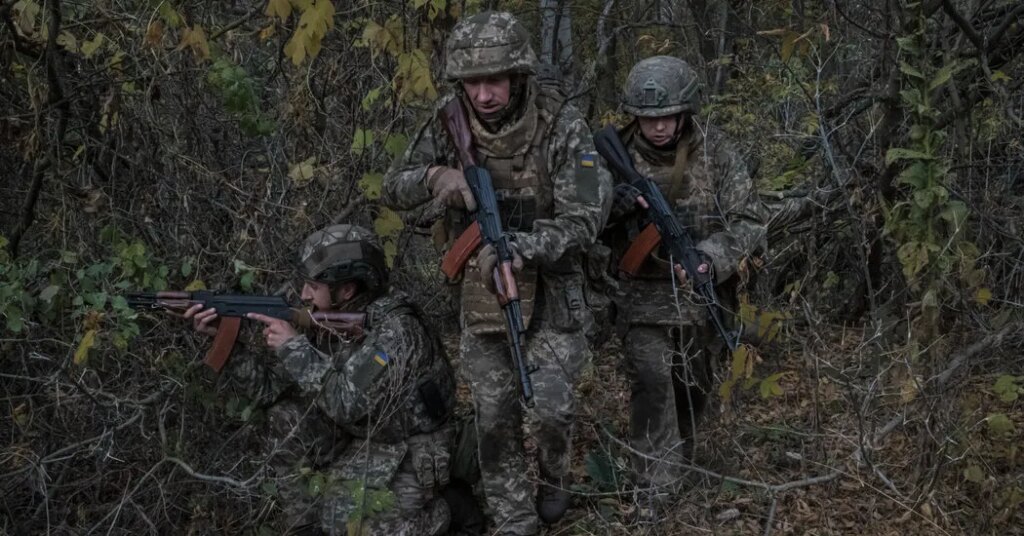
Drone warfare has transformed the front line in Ukraine into a miles-wide kill zone, where vehicles are so easily targeted that soldiers mostly move on foot in small groups. The Russian Army has largely abandoned full-frontal armored assaults in favor of a stealthy advance by inserting foot soldiers.
For months, the 66th brigade hunted down and destroyed every Russian position it could find, including single soldiers holed up in dens behind Ukrainian lines, infantry in trenches and drone pilots in bunkers, Mr. Horobets said.
“Overall, it comes down to coordination,” he said. He showed two areas of scrubby woodland outlined in red on a video screen. Russian soldiers were still dug in there and were his target for the afternoon, he said.
“We will destroy the antennas first, then destroy the generators,” he said. “It will turn out that we destroy the pilots, too.”
As the Ukrainians began advancing, the value of their middle-range drone strikes became clear. The Third Army Corps was striking up to 50 Russian vehicles a day, sometimes as deep as 100 miles behind Russian lines, General Biletsky said.
“It became normal for the enemy to unload 40 to 50 kilometers from the front line and then continue on foot,” he said. Sometimes a soldier would carry a single artillery shell 20 miles, he said. “Their logistics have effectively been paralyzed.”
Russian soldiers were running short of fuel, ammunition and food. Some began holding up cardboard signs outside their positions, saying they were hungry and thirsty, several commanders said.
Critically, when Russian reinforcements were called in, Ukrainian drones struck them as they dismounted from vehicles miles before they could reach the front line, Mr. Horobets said.
The wider use of battlefield robots to beat Russia’s superiority in numbers has steadily grown. A 27-year-old former Ukrainian assault trooper said he had been put in charge of building up a special battalion of remote-controlled strike vehicles since last fall. He asked to be identified by only his call sign, Makar, for security reasons and according to protocol.
The Ukrainians cannot outnumber the Russians in terms of personnel, he said in an interview. “But we can outperform them technologically,” he said, “in terms of quality and scale, if we consistently stay several steps ahead of them.”
By now, ground robots are vital. In several underground command posts our team visited, Ukrainian soldiers watched livestream videos of tracks and undergrowth as the vehicles trundled through the kill zone carrying cargo. Sometimes they brought out the bodies of dead soldiers.
Many of the vehicles break down or get attacked by Russian drones, and their cameras showed the wrecks of other vehicles.
But many of them get through. General Biletsky said his brigades were delivering three times as much cargo to their soldiers on the front line as other brigades that recently came under his command.
“That means a soldier in the Third Army Corps has considerably more resources and capabilities available to them: food supplies, ammunition, equipment, power sources, batteries and so on, compared with a soldier elsewhere,” he said. They were even receiving diggers to help build underground bunkers, he said.
Makar said he had focused on using remote-controlled vehicles as tools of attack. Soldiers of his unit, NC13, part of the Third Assault Brigade, were at the forefront of Operation Vivaldi, piloting such strike vehicles on the battlefield.
The Times met a group of them, 20-year-olds with nine months’ experience in the army, during a live-fire training exercise, in which they directed remote-controlled buggies armed with rocket-propelled grenades and a Browning machine gun. Another team piloted a reconnaissance drone to supply a constant video feed.
The next day, their trainer, who uses the call sign Bar, was at the controls, guiding a robot vehicle into a tree line in a real attack.
The machine, visible in a video stream from a surveillance drone, was moving clumsily back and forth, tangled in the undergrowth as it approached the entrance of a bunker. Then suddenly the screen filled with a cloud of smoke.
It was unlikely that anyone inside the bunker had survived the blast, Makar said as he watched the video replay, “That’s 20 kilos of explosive.”
As Vivaldi was drawing to conclusion, Mr. Horobets was still focused on stragglers in his area. On a livestreamed video, a soldier carrying a backpack and a weapon moved cautiously from the trees into an open field. When he reached a patch of tall grass, he stopped and crouched low, barely visible.
“He’s Russian,” Mr. Horobets said. “We have work to do.”
The post Inside the Operation That Helped Ukraine Turn the Tables appeared first on New York Times.