“Everything is sexual, but nothing is sexy.”
It’s one of those sticky phrases that floats around social media, out of context and unexamined. In the pages of Erotic Review, a twice-annual literary magazine based in Britain, the opposite often seems to be true: Everything is sexy, but need not be precisely sexual.
An issue last fall featured the novelist Max Porter’s five erotic words. They were “slip,” “cut,” “jouissance,” “habibi” and “tether.” It also included a photo essay of the artist Richard Malone’s corporeal textile sculptures and a short article by the critic Ryan Ruby about the sensuality of written correspondence.
An earlier incarnation of the magazine was occasionally erudite, too, publishing the work of George Saunders, Damien Hirst and Evelyn Waugh’s eldest son, Auberon. But its approach to its subject matter was not so subtle. When it was founded in 1995 by Jamie Maclean, then an art dealer, it was a frisky print newsletter with illustrations of women’s bare bums on the front and articles headlined “The Best Nipples in Town.” It retained that sensibility even as it changed hands, led in its heyday through the late ’90s and early 2000s by a female editor, Rowan Pelling.
The staff who put together some of these issues was known for its naughtiness. Like characters in a Mary Gaitskill story, they handcuffed and playfully whipped one another in the magazine’s offices. When the publication was strapped for cash, the female editorial staff members “stripped to their scanties for a photo shoot,” Pelling recalled. At one point, it had 30,000 subscribers.
But every era has its own sexual mores. This one — with more expansive ideas about gender and sexuality — seems to call for a different kind of erotic magazine. So too does this era of media, when readers otherwise ensconced in digital life look to print publications to immerse them in worlds of taste (a rarer commodity on the internet than sex).
It’s fitting then that this iteration of Erotic Review is an elegantly designed, inquisitive periodical more at home beside n+1 than Hustler. Among indie bookstores and newsstands, it can also be found at Barnes & Noble — though still in plastic wrap.
This isn’t to say it’s devoid of actual sexual content. In addition to reveries about the suggestiveness of moss, there are nude photographs, tales of sexual awakenings, accounts of sex parties, musings about (redacted) and (redacted).
The magazine relaunched two years ago after a stretch of dormancy. It faded in the late aughts and early 2010s, when freely available online pornography made subtler forms of titillation seem quaint.
Lately a more literal idea of sex has again exploded into view, displayed by pop stars who simulate sex acts onstage and TikTok fan cams of young male heartthrobs, stirring a desire for something more intimate.
“I realized our erotic lives still aren’t really taken seriously,” said Lucy Roeber, the magazine’s current editor and publisher. “They’re sort of hidden.” She felt a “need for a cultural space” where writers and artists could think through these things.
She knew the magazine would have to be more “highly produced, more considered and collectible” than its precursors. It would also have to reach beyond Britain.
Her deputy editor, Saskia Vogel, a literary translator based in Berlin, helped with that, bringing in contributors writing in their native Mandarin, Swedish, Spanish and Danish. The two women also wanted to avoid associating the magazine with any one identity.
“It’s not a heterosexual magazine; it’s not a gay magazine,” Roeber, 50, said. It does, though, skew more female. Women make up roughly 62 percent of its readership and tend to have a majority of the bylines in each issue. (“One viewpoint that we struggle to find contributors for, and have to search for, is the one that previously dominated: white, heterosexual men,” Roeber added.)
Roeber, who is based in London and now lives above the Review’s office space, rediscovered the magazine when she was looking for “serious platforms” for her fiction about female sexuality. She started doing some editing work for Maclean, and he published a story of hers. When he called her in spring 2022, saying he was thinking about retiring, she suggested he pass on the Review to her.
Though Roeber had past lives heading up an erotic book club and working at a literary consultancy, she had never published a magazine. “Yet I found myself saying I wanted to take it on and completely transform it for a contemporary audience,” she recalled.
She spent the next nine months refining her vision and bringing others on board, including Vogel, an editor and writer who had recently published a novel, “Permission,” about a young woman introduced to B.D.S.M. culture. Vogel also had a history with Erotic Review: She interned there in the mid-2000s, and it was among the first places to publish her work.
She went on to have a career toggling between the literary world and the sex industry. Her first job was at AVN, a trade publication covering adult entertainment. From there, she worked as a publicist for the British literary journal Granta, known for anointing young novelists.
“I had this sort of sense that all of these things could coexist in one place, but there was no place for it,” Vogel, 44, said.
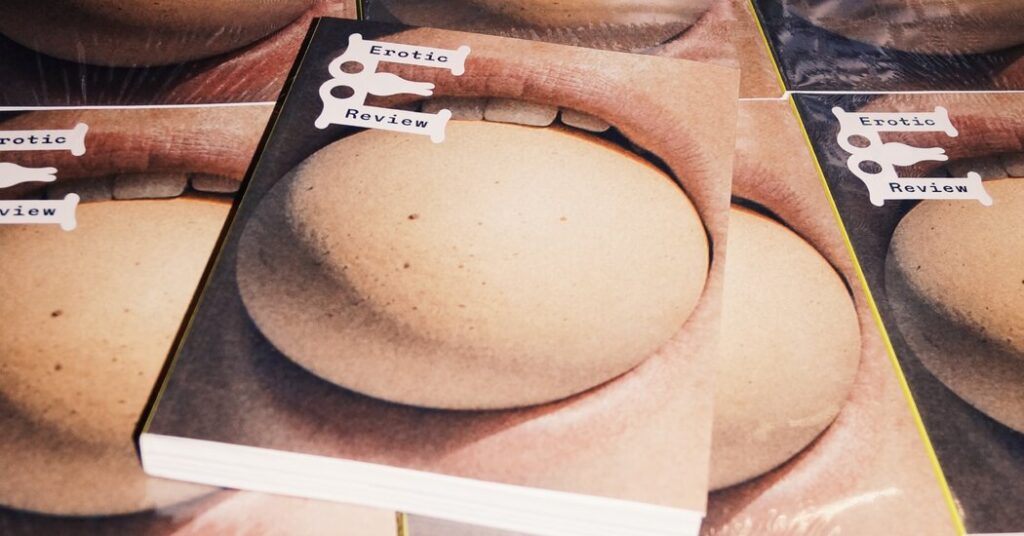
The two women published the first issue of their Erotic Review in March 2024. Gone were the ribald upskirt drawings. The cover featured a closely cropped photo of a woman holding a brown egg in her mouth, the magazine’s new logo, an insouciant E, in the top left corner.
Frith Kerr, whose design studio, Studio Frith, helms its art direction, said it was critical that “it should not present itself as something ‘sexy’ — this felt just too narrow and trite.”
The elevated feel helped draw the attention of Phoebe Philo, the British designer who has attracted a following of women for whom getting dressed is equal parts cerebral and corporal.
The brand became the Erotic Review’s sole advertiser for its spring/summer issue. Ad campaigns for Philo — who so far has done little advertising but has also made print placements in magazines including The Paris Review and The Whitney Review of New Writing — will also feature in Erotic Review’s forthcoming fall/winter issue.
Lately, the currents between literature, sex and fashion mingle freely. The same year Vogel and Roeber relaunched the Review, the kink-friendly dating app Feeld rolled out a biannual print magazine, AFM.
The two publications share some contributors as well as an overarching ethos, viewing desire as a “framing device,” as Vogel put it, or as a “form or a structure,” in the words of Haley Mlotek, a co-editor of AFM.
At Playboy, the storied erotic magazine revived this year, its new editor, Phillip Picardi, says he too is considering the balance between brainy and bawdy.
“On the one hand, I get the feeling from folks that we have either overly analyzed or overly intellectualized sexuality,” he wrote in an email. But with the advent of OnlyFans and A.I.-generated content, he worries “we’ve reduced it to something too crude or even banal.” He added, “I think in order for sex to be fun and interesting, it probably can’t be too much of one or the other.”
Maclean, the Erotic Review founder, appears on the masthead as a contributing editor, but he says he mostly looks on appreciatively as he divides his time between London and Croatia. Readers deserve a “fresh take on sex” free from “any of the previous editorial clutter,” he said.
Still, he sees a through line with the project he began in the 1990s.
“Maybe there’s a difference between the more analytical inquiries into the very nature of desire that Lucy pursues and the more tongue-in-cheek, Rabelaisian, but informed, romp that Rowan and I produced three decades ago,” Maclean, 77, said. “Even so, there are, of course, plenty of overlaps.”
Vogel said one of the pleasures of the job was working with writers who never thought they would publish in an erotic magazine.
“I get excited when I approach a writer and I say, ‘Have you ever considered …’” Vogel said. Some, she said, answer with a version of: No, I feel very far from the erotic and don’t relate to it at all.
“And then,” she continued, “there’s the other person who goes, Well, actually I’ve been thinking about this thing …”
The post The Sexy Magazine You Really Will Read for the Articles appeared first on New York Times.