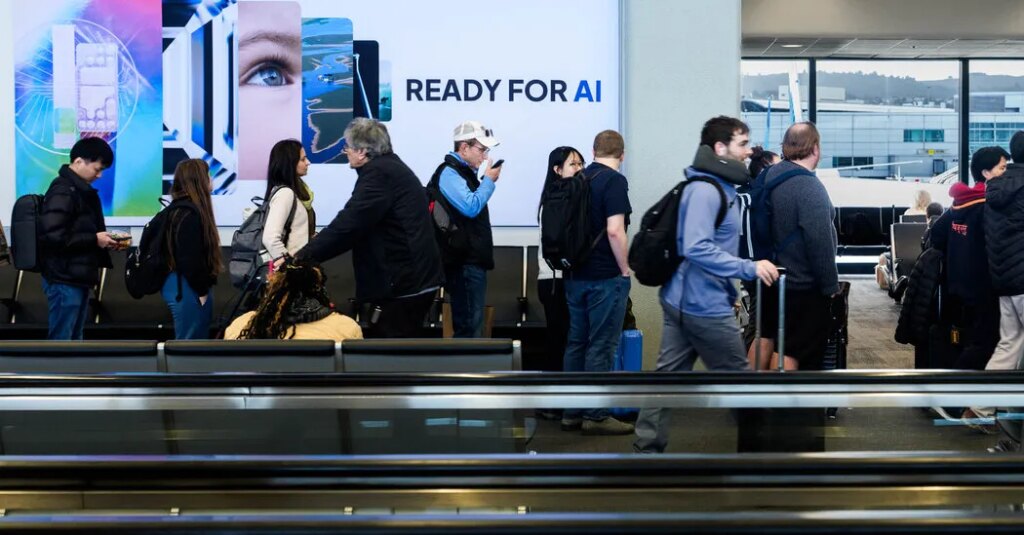
A nationwide ground stop on all flights. Customers unable to conduct transactions at America’s largest bank. Microsoft Outlook down. Apple services inaccessible. Even, the National Security Agency’s classified email system went offline.
A spate of recent tech outages and the resulting mayhem annoyed and puzzled many people. Some officials linked the outages to routine tech upgrades. Marco Rubio, the secretary of state, suggested that a cause might be the global rush to build defenses against A.I. hackers, although no public evidence suggested cyberattacks had caused any of the failures.
Such mishaps may seem like unique crises of the information age. But historians of technology call them mundane. They argue that disasters in complex systems are inevitable parts of innovation’s boom-bust cycles. In ages past, the advancements often came with the loss of thousands of lives, such as steamboat explosions at the dawn of the industrial age. There was also the Hindenburg disaster in the early years of commercial flight and the Apollo 1 fire near the start of the space age.
From this view, the recent outages are simply part of the learning curve, and blessedly bloodless. Because inventors tend to work at the cutting edge of physics, materials science and human understanding, significant failures — trial and error — are the main way they uncover the hidden flaws behind their bright ideas.
The Paradox of Advancement
Historians tend to agree that the cycles of progress and failure have been part and parcel in the creation of steam power, electrical grids, airplanes, chemicals, medicine, rocketry and computers.
Charles Perrow, a Yale sociologist best known for his 1984 book, “Normal Accidents: Living With High-Risk Technologies,” said that major failures in complex systems were not just probable but unavoidable, regardless of the level of competency in a system’s management, safety training and prevention steps.
And Henry Petroski, a Duke University historian, put a positive spin on a similar argument, writing that failure was a prerequisite for breakthroughs.
The high-pressure steam boilers of the 19th century regularly exploded. On steamboats plying American rivers, the violent bursts killed thousands of people before public rules emerged for passenger safety, pressure-relief valves and standardized steel alloys. In 1865, a blast near Memphis killed 1,700 passengers, many of them discharged Union prisoners.
So, too, early electrical wiring led to calamitous urban fires, and linemen were frequently electrocuted on live overhead wires. The tragedies led to better insulation, circuit breakers and wire grounding that redirected stray currents.
Early airplanes experienced structural failures, engine stalls and aerodynamic riddles that baffled pilots. The de Havilland Comet, the world’s first commercial jetliner, had a series of fatal breakups starting in 1953. In time, engineers found that the square shape of the plane’s windows caused nearby structures to crack and weaken to the point that the plane’s body would rupture.
Drugs and industrial chemicals were made public without clinical trials or toxicology screening. Things like radium, lead paint and early synthetic drugs caused severe harm before the establishment of regulatory frameworks and bodies, such as the Food and Drug Administration.
Rocketry and spaceflight were dazzling spectacles of catastrophic failure. In 1957, the Atlas, America’s first intercontinental ballistic missile, roared off the launchpad on its inaugural flight test. It lasted 24 seconds before the engines failed.
All these nascent technologies managed, on balance, to turn the corner and make the world a better place, where safety tends to rule and people tend to prosper.
It took years and sometimes decades of detective work, tinkering, public protests, lawsuits, building codes, safety margins, tech standards and independent bodies that certify safety — all on top of engineers and designers learning as much as they possibly could from the lessons of failure.
When Failure Isn’t Inevitable
Most often, catastrophic failures in the past were caused by the limits of what was known, or could be known, without first trying. But in some instances, they were the result of recklessness, born from a desire to be first, or faster or cheaper.
That recklessness can be tempered, said Ryan Hearty, a historian of technology at Johns Hopkins University, who rejects the idea that failures are inevitable.
The dangers “can be managed with safety in mind,” he said. The objective, he added, is to “‘move slow and upgrade’ instead of ‘move fast and break things’” — a tech-industry motto popularized by Mark Zuckerberg at Facebook.
Political factors, some analysts said, can intensify or lessen the cycles of technological feats and failures.
“We’ve invested a great deal of money in large, complex systems that we don’t completely have a handle on,” said Matthew Hersch, a historian of technology at the Institute for Advanced Study at Princeton.
Often making matters worse is the fact that those systems are not properly maintained. In the case of the recent F.A.A. outage, officials blamed the running of new software on old copper wiring. That infrastructure had not been upgraded because of spending cuts.
“What we’re seeing now,” Dr. Hersch said, “is a collapse of infrastructure due to neglect, as a result of penny-pinching.”
“It’s not sexy,” he added, pointing to upkeep on air traffic control systems and power grids. “We know exactly how to fix them. It’s about money, and the money hasn’t been spent.”
The frenetic pace of A.I. tends to intensify the alarms, risk analysts say. Modern society is already hooked on devices that rely on advanced semiconductors and is quickly becoming reliant on artificial intelligence.
“We don’t recognize how dependent we are on certain systems until they stop working,” said Zachary Loeb, a historian of technology at Purdue University. “And it’s easy to assume that things will keep working because, generally, they do.”
But there is hope that proactive measures can help insulate us from catastrophe.
A case study is Y2K — or the millennium bug, a threat that arose as the calendar turned to the year 2000. To save memory, computers had been programmed to read years as two digits rather than four, as in “99” for “1999.”
People feared that banks, power grids, air traffic control, elevators and medical devices would shut down. However, a major global effort rewrote millions of lines of computer code, making the new millennium largely uneventful.
“There was this laserlike focus,” Dr. Loeb said. The moral, he added, is never “to take things like computers and electricity for granted.”
The post A New Era of A.I.-Driven Chaos? That Might Just Be Progress. appeared first on New York Times.