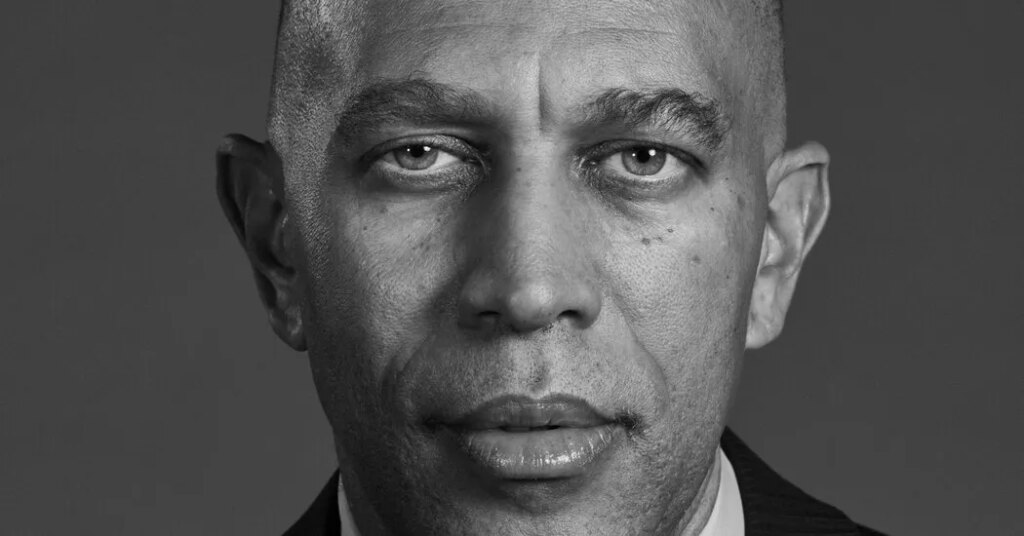
On Wednesday, House Democrats overwhelmingly nominated Representative Hakeem Jeffries to be the next speaker of the House, all but ensuring that come January, he will be the nation’s first Black speaker.
Jeffries, who is known for his careful, disciplined messaging and approach, faces a complicated proposition. He has to hold his ideologically diverse party together, navigate a lame duck President Trump, figure out how to quickly deliver on the promises Democrats made to American voters and not ruin the Democrats’ chances to win the 2028 presidential election.
How will he handle this historic nomination and urgent political moment? I sat down with Jeffries on Friday in Washington to find out.
Subscribe: Apple Podcasts | Spotify | YouTube | Amazon | iHeart
You had an overwhelming vote for your nomination to be speaker. What was the first thing that went through your mind when it happened? I was just thankful for the support of my colleagues, which came from all across the caucus, every part of the country. The ideological diversity of the caucus is one of our strengths. We have progressives. We have New Dems. We have Blue Dogs. And I was proud to have strong support amongst every group. We have a shared mission and objective, which is to deliver big things for the American people. And I’m humbled.
This is a time, though, when the American electorate is pretty angry. It wants radical change. Democrats have been given a mandate. Can you tell me why you think you’re the man for this moment? House Democrats, over the last several years, have worked incredibly hard to battle Republicans on every single issue, and we’ve done that forcefully and aggressively. Battle them on the One Big Ugly Bill. Battle them on Medicaid cuts. Battle them on the Affordable Care Act tax credits. Battle them on Epstein files and transparency. Battle them on a reckless and costly war of choice in Iran. We’ve battled them on ICE funding — certainly battled them as it relates to the unprecedented corruption that has been unleashed on the American people.
So are you saying that happened because you were leader and you led that effort, and that’s why you’re the man for the moment? No, what I’m saying is that we have a track record of success that I was proud to be a part of in terms of rising to the occasion at a moment where everybody was down on the ability of House Democrats to actually do anything, let alone win a historic election.
But this is a moment for you, and the thing that I would like to understand as we go through this conversation is how you see your leadership. You’ve convinced your caucus, but if you had to tell the American people why Hakeem Jeffries is the man right now, what would you say? Well, when it comes to the pain being felt by the American people — which is extraordinary, because there are far too many people in this country working hard, playing by the rules, but they can’t thrive and they can barely survive — I understand the struggles of working-class individuals, because I grew up in a working-class neighborhood. Both my parents were public servants. My mom worked for the city for 45 years. My dad was a substance abuse social worker who worked in the trenches during some incredibly painful times in the city, both the heroin explosion and the crack cocaine epidemic. I grew up in the Cornerstone Baptist Church and came of age myself in the middle of the crack cocaine epidemic, when most of us weren’t sure we would even be able to survive to the next day, the next week or the next month, because of the violence. So the struggles that the American people are experiencing right now, I’ve lived.
Have you heard from the president since the vote? Not yet.
Are you expecting to? It certainly seems to me that we’re going to have to have a conversation about how we are actually going to respond to the demands of the American people to get things done on their behalf.
Obviously, he is still the president, and he will have a lot of power over your agenda. Do you consider a weaker Trump to be a more dangerous Trump or a more pliable Trump? It remains to be seen how the president is going to respond to the decisive defeat that the American people just dealt to Republicans, to the president and to MAGA extremism. Clearly, the American people want a dramatic change in direction. We’ve indicated a willingness at all times to try to find common ground with the other side of the aisle whenever and wherever possible if it means delivering real results for the American people. That was just done in this Congress on a transformational housing affordability bill, the most meaningful one in a generation. That was done in a Congress where Republicans control the House and the Senate, and the Congress came together to pass this bill. We got it to the president’s desk. He didn’t sign it for whatever the reason, but he didn’t veto it, and it became law. That’s a foundation for the type of things that we should be doing.
We’ve seen Mayor Mamdani find ways to develop a relationship with President Trump. Is that something you’re going to try to do on a personal level? Mayor Mamdani has done a tremendous job. He’s gotten off to a great start in working hard to deliver upon the affordability promises that he made to the people of New York City and has developed the ability to have a working relationship with the president in ways that are designed to serve the City of New York. From our standpoint, we continue to maintain a willingness to work with anyone on the other side of the aisle to get things done. Even if I’m going to strongly disagree with the president, the vice president, members of the administration, on the overwhelming majority of issues, the American people want us to do all we can to deliver for them.
In our brief conversation, I think you’ve said “the American people” like a hundred times, and I know that they are at the center of this, but I do want to understand your particular perspective. You had a controversial meeting with the president’s son-in-law Jared Kushner several months ago. You do not get along with Stephen Miller, the president’s new chief of staff. You’ve called him a “stone-cold racist” whom you have “zero interest in working with.” So who is going to be your conduit, practically speaking, to the White House? It could be the vice president. There are cabinet secretaries that we can talk to.
Which one do you like? I wouldn’t say I like any of the cabinet secretaries at this particular point in time. I’ve had conversations probably most frequently with Secretary Marco Rubio. I’ve had a conversation with the secretary of Treasury. Here’s the thing: The Republicans have taken a “my way or the highway” approach over the last two years to jam MAGA extremism down the throats of everyday Americans and the country. That’s what they’ve done. And that approach failed. They broke every promise. This is a group of people who promised to lower costs on Day 1. Costs didn’t go down. Costs have gone up.
Do you imagine sitting down with Stephen Miller? No.
Really? No. I made clear that Stephen Miller’s a stone-cold racist. Why would I deal with him at this point in time? This is the architect of Donald Trump’s violent mass deportation machine, and there’s cruelty associated with that. There’s chaos. There’s death associated with what’s taking place. Now, to directly answer your question about practical engagement, we understand in prior administrations that it often has been the case that secretaries in the cabinet — Steve Mnuchin, for instance, negotiated a lot with Nancy Pelosi — or that vice presidents, such as then Vice President Joe Biden, was the primary negotiator often with majority leader Mitch McConnell at the time.
Have you heard from JD Vance already? No, I haven’t heard from JD Vance, either. But we have heard from the American people. And by the way, I will consistently use that phrase. You are correct. Because we work for the American people. That shouldn’t be confusing to anybody.
What do you make of your new counterpart on the Republican side, Jim Jordan, who is a very staunch Trump ally? We had a brief conversation yesterday, and we’re going to sit down at some point when the dust settles to see what the opportunities may be to actually get things done.
What signal do you think it sends that the Republicans elected Jordan, who isn’t exactly known as super friendly to Democrats? I mean, listen, I think that’s a question that they’re going to have to answer. The reality is MAGA extremism was completely and totally repudiated by the American people up and down the ballot and all across the country.
Do you see any evidence that Republicans in Congress are willing to break with the president after these elections? It remains to be seen, but here’s what is interesting, and this is one of the things that House Democrats were effectively able to do in this current Congress: We repeatedly forced successful votes on the floor over the objection of both President Trump and Mike Johnson.
So you’re saying you can work around them? Well, what I’m saying is that we’ve repeatedly done it, clearly. We did it on the Affordable Care Act tax credits. We did it on the Epstein files.
Do you think you need them? We have a robust majority. We’re going to have a 260-seat majority. We’re going to move aggressively, as I mentioned, to end the reckless and costly war of choice very early on in the new Congress. We’re going to move aggressively to restore SNAP benefits. We’re going to move aggressively to reverse the Medicaid cuts. We’re going to move aggressively to extend the Affordable Care Act tax credits. We’re going to move aggressively to end these Trump tariffs, which have also increased costs on everyday Americans by thousands of dollars per year, and we’re going to move aggressively to ban members of Congress from trading stock. And we’ll see whether a handful of Republicans or more join us.
I want to get to the agenda, but just a few more questions on the situation inside of Congress. Do you have an epitaph of Speaker Johnson’s speakership? How do you view his time there? Not really. I’m sure that Mike Johnson will articulate the story of the Republican accomplishments, such as he believes they are. We’ve tried to have the most communicative relationship possible. At times, certainly very early on when we were in divided government and Joe Biden was president, there was a lot more cooperation, this is what the record shows, in the previous Congress than in the current one. Because Republicans decided to just conduct themselves like a wholly owned subsidiary of the Trump cartel and serve as nothing more than a reckless rubber stamp for Donald Trump’s agenda.
That’s been the criticism of Speaker Johnson’s tenure, that he ceded a lot of power to the executive branch and diminished the role of Congress. Is that the way you see it? Certainly, and the days of the House of Representatives functioning in that fashion are over. We’re going to be a check and balance on an out of control executive branch.
There’s a debate about whether or not Chuck Schumer should be re-elected as Senate majority leader. You’ve had your conflicts with him in the past. I remember one during the shutdown fight of March 2025 in particular. What’s your view? No one has delivered more for the people of New York City and the people of New York State over the last several decades from a legislative standpoint than Chuck Schumer. Those are the facts. I’ve had an opportunity to work with him as the leader in the House over several years. And as you pointed out, there are times that we agree on the course forward, and there have been times that we agree to disagree. That’s just the reality of governing.
But you didn’t answer the question about whether you support Chuck Schumer for Senate majority leader. I’ve said yes, I do. I’ve said that repeatedly.
I think there’s a real concern when you look at Chuck Schumer, not that he hasn’t delivered in the past, but is he the man for the future? Well, listen, the senators are going to have to work that out. I understand the dynamics in terms of the intrigue around the inside parlor game, that these questions are going to be asked.
It’s not the parlor. It’s the American people. I feel like I need to invoke it, too. [Laughs]. I appreciate that. But listen, what I’m saying is that from the House perspective, I can tell you clearly and unequivocally, we don’t like it when the senators start messing around in our stuff, getting involved in our agenda, telling us who our leaders should be, suggesting what bills we should bring to the floor, telling us how they think we should be talking to the American people. We don’t like it. So I think I should hold myself to the same standard in advance of a Senate election. Let them work it out amongst themselves.
Do you think it’s healthy to have the debate, or do you think that it would have been better to just get this majority, a huge victory, and not have the conversation be Chris Van Hollen or Senator Schumer? I think debate is definitively healthy on all things. In fact, that’s the reason why this week, even though my election was uncontested, I called for a recorded vote, a secret ballot recorded vote, to give everybody within the caucus the opportunity to express themselves as to who they thought was best capable of serving in a leadership position of significant consequence.
I’m going to move on, but I guess the question is, can you confidently say that Senator Schumer, who is 75 and about to turn 76, is up for this? Just a yes or a no. What I can confidently say is that I don’t like it when senators get involved in our stuff. And I’m going to answer the question.
Because people are going to hear this and think, “He didn’t answer the question, so that means no.” Of course he’s capable of leading us into the future, but that’s a decision that the Senate Democrats are going to have to make.
OK, I want to talk about the plan, and specifically your first 100 days. As journalists, we always love to have a round number. I’m there with you, by the way. I do think it’s important to contextualize for the American people that we’re going to get off to a fast start.
I want to hear about this fast start. What will be the first bill? Well, we’re going to have that conversation. We just talked about all of us coming together. Here’s what I think we should do very early on in the first week or so of the new Congress: We should aggressively move to end the reckless and costly war of choice in Iran. There’s probably nothing more immediate in terms of being able to provide economic relief to the American people than ending this conflict that should have never started to begin with.
I know Democrats are currently wrestling with whether to demand limits to funding the war in order to vote to fund the government and avoid a shutdown. That’s happening in this Congress. Where is your head on that right now? There are ongoing discussions about what can be done in the appropriations bill in advance of Dec. 11 to make clear that this [war] has to end. It needs to be over. In fact, Donald Trump can end it right now. That doesn’t mean there’s not going to be a lot of work ahead, because Iran is in a stronger position now than they were before this reckless and costly war of choice started.
You’ve been through a few shutdowns. It seems like it’s a hard thing for the country and the Congress to go through. It’s a hard thing for the country and for the Congress. We have made it clear that we’re going to fight for a spending bill that protects the health, the safety, the national security and the economic well-being of the people of this great country.
Are you willing to shut down the government in order to get that? I’m not going to say that one way or the other, because we’ve got to figure out right now what’s possible in terms of the appropriations process. What I will say is that we have made clear repeatedly that taxpayer dollars should be spent to make life more affordable for the American people. And we’ve seen several instances when there was disagreement on the other side of the aisle, including during the 43-day government shutdown, that we were not going to go along simply to get along. That was the longest complete shutdown in American history. And at the end of it, we actually were successful in forcing a vote to extend the Affordable Care Act tax credits.
A lot of this is psychology, right? You’re just seeing who’s going to blink, where people are at in their relationship with their caucus, etc.? And when you look at President Trump, as you’re going into this, I’m wondering, do you think he cares if there’s a government shutdown that lasts 200 days? Because this is his last term. I think presidents get motivated because they’re worried about the next election. They’re worried about the health of their party. But those don’t seem to be the motivating factors for him anymore. So I’m wondering how you think that this is going to be a tool that he might respond to. It remains to be seen how he’s going to react to what just decisively occurred electorally over the next two years.
I guess what I’m asking is, do you think he cares? I think what I’m saying is that it remains to be seen.
You do have to think about it, because it’s a bit of mental jujitsu here that you’re doing. Well, we certainly think about all these things. It didn’t just come out of thin air that we were able to win a historic majority. It didn’t come out of thin air that we were able to win the narrative around the 43-day government shutdown. And it will not come out of thin air that we will successfully end this reckless and costly war of choice.
But you’re not answering whether you think Trump is actually going to be able to be pressured. I did answer the question.
Do you think he’s going to be able to be pressured? You know what the answer is? It remains to be seen.
That’s not an answer. That’s the answer. Do you think that this is a president who is in any way predictable? This is a president who, in one breath, in a nationally televised interview on “60 Minutes,” said we went too far on immigration and that we need to course correct — on the same weekend that he elevated Stephen Miller, the architect of the violent mass deportation machine.
All right. How are you going to approach investigations and accountability? There’s a danger, which I’m sure you’re aware of, that it can seem like Democrats are looking at vengeance and lawfare, as has been portrayed by the Republican side and by the president himself. How do you get accountability without falling into a trap? The notion that these MAGA extremists are going to lecture anybody around overreach is crazy. These people have weaponized the federal government to go after people they perceive to be enemies of the president, illegitimately and consistently. They have zero standing to talk about overreach. Our perspective has been clear. We are going to follow the facts, apply the law, be guided by the Constitution and let the chips fall where they may.
You saw when you were an impeachment manager for Trump’s first impeachment trial, it made him more politically powerful. He used that as a messaging device to show that he was the subject of, in his view, unfair prosecution. So there is a danger that the American people might view this as a distraction as opposed to what you are saying it is. I have great trust in the legislative leaders of this effort and every single Democrat who’s on the Oversight Committee. We’ve done accountability in this Congress.
What happened with Pete Hegseth and that impeachment [vote], because there was a real sense that this might be a moment with Thomas Massie’s attempt, and the votes by Democrats fell short. And people blamed you. It was disappointing that a few members were unable to make it to the floor.
Why wasn’t it whipped? It was whipped.
Why didn’t they show up then? Well, we have to talk to them about that.
But do you see that as a failure of your leadership? No, I don’t see it as a failure of our leadership. It’s a collective disappointment. It should never happen again. Now, listen, in the minority, we ran Pam Bondi out of town. She should have never been appointed in the first place, but we successfully, in the minority, ran Pam Bondi out of town. We successfully, in the minority, ran Kristi Noem out of the town, who was a disgrace in terms of what was going on at the Department of Homeland Security. So in the majority, on behalf of everyday Americans and people who believe in accountability in this country, we certainly are going to continue to hold cabinet secretaries who have broken the law accountable.
Are you going to try and impeach Hegseth again in the new Congress? Pete Hegseth should be impeached if Donald Trump fails to remove him. Pete Hegseth abused his power, undermined America’s national security. Of course, he has to go.
In terms of oversight, Elon Musk allegedly throttled Ukraine’s internet connectivity earlier this year. Will you be looking into what happened? Do you think the U.S. government should be in business with Elon Musk? I think we have to look into what happened in Ukraine. We need to look at what has happened with respect to the DOGE assault on hard-working federal employees and civil servants. We need an understanding of what has happened with respect to personal information of the American people.
Do you imagine asking him to come to testify in Congress? That’s going to be in the hands, preliminarily, of soon-to-be chairman [of the House Oversight Committee] Robert Garcia.
Do you think he should? Listen, we have to follow the facts, apply the law, be guided by the Constitution and then let the chips fall where they may. And when you conduct investigations — and as you pointed out earlier, I was an impeachment manager — you have to be thorough, and you have to make sure that every step that you take is designed to deliver the outcome that is both comprehensive and consistent with the problems that you are seeking to unearth.
Just this past week, I saw Musk say that he’s suddenly not MAGA. He had said in the past not only was he MAGA but he was “dark MAGA.” Do you think this is political posturing in order to avoid accountability? I don’t know, but —
Because I’ve seen a lot of people now suddenly say that they’re moderates, that they are not MAGA, they’ve found a different political religion. Brutal midterm elections do seem to have a clarifying impact on what people want to say publicly. But we can’t forget what has occurred over the last two years. You had people bending the knee in ways that were inconsistent with their own previously articulated values, pretending as if the era of MAGA extremism was a permanent realignment here in the United States of America. It was not. And the American people clearly and decisively showed that to be the case.
One of the toughest issues in your caucus is the role of AIPAC and what to do about Israel. AIPAC has recently changed the way it’s going to give money to candidates. It’s encouraging individual donations from members because of the blowback it’s gotten. In this most recent cycle, you got money from AIPAC. How much was that, by the way?
You tell me, how much was it? Well, I mean, I get asked the question all the time, and I just want the numbers to be clear. In the last two cycles, I’ve raised — from my own re-election campaign, because there’s been no super PAC involvement in any of my campaign activities related to my own re-election — about $40 million for my own re-election. That’s raised and then spent to help elect Democrats all across the country. The average contribution to my re-election campaign is $29 per donor. I’m proud of that fact. I’m proud to be able to raise money from everyday Americans, not special interests.
The question I have, though, is more about what has become such a very touchy issue, the AIPAC funding in particular. But I presume that the reason why it’s become an issue is because people are suggesting that members of Congress are somehow bought and paid for. When I talk to members of Congress, they’re voting their districts, regardless of who they may be raising money from.
Will you continue to accept support from AIPAC? AIPAC has said they’re no longer contributing the $5,000 per contribution that they can make under the current laws.
But would you accept money from them? They’re not giving money at any point in time in terms of AIPAC as an entity. Now, am I going to continue to raise money in the way that I’ve been raising money? In small dollar increments, $29 per donation? Yes, I will. And I’m going to continue to make the case that I’m going to try to raise money subsequently to help House Democrats now hold the majority. And I’m thankful that we’ve won the majority, but to do it in a principled way and to do it in a way that will hopefully continue to give confidence, all of us, that we’re putting the interests of the people that we represent first. Now, I understand that, from a broader issue perspective, things need to change.
You’ve said about Israel: “The status quo is unacceptable. We need dramatic change.” What do you mean about dramatic change? We have to find a path toward a just and lasting peace between Israel and the Palestinian people. To me, the foundation of that is a safe and secure Israel living side by side in peace and prosperity as a Jewish and democratic state with an independent Palestinian state that provides dignity and self-determination for the Palestinian people. That has to be the North Star. And I think it’s fair to say that the U.S. commitment to the two-state solution has left a lot to be desired for decades. There have been administrations, largely on the Democratic side, that have really worked hard to try to bring that type of just and lasting peace about. It certainly happened under the Clinton administration, and it definitively happened as well under Secretary John Kerry’s leadership within the Obama administration. I think we’ve got to make sure that we revive and renew that commitment with everything we’ve got.
There are bills that are currently sitting in front of Congress, the Block the Bombs bill, which has 82 co-sponsors as we record, and the Stop the Settlements bill, which has 76 co-sponsors. Will you put them up for a vote? What I’ve said is that we have to enact dramatic change in terms of the direction of the way things have been going in both the West Bank and in Gaza. The death, the destruction, the devastation that has been experienced in Gaza by Palestinian civilians is unacceptable, unsustainable and un-American. And the conditions on the ground have to change. That requires a surge in humanitarian assistance, including medical assistance and housing support and ensuring that there’s both clean water and clean air.
Those two bills, do you see them as not addressing that? And do you support them? No, I haven’t articulated a position one way or the other.
I’m asking. With respect to any of these bills, because we’re going to have a conversation about the steps that we need to take together as a caucus, what I have made clear is that within the first 100 days, I think the most decisive step that we can take relative to the situation in the West Bank is to move the West Bank Settler Violence Protection and Prevention Act. That is certainly something that I think we’ll have strong support for within the House Democratic Caucus, and I believe we should move on it early in the new Congress as a meaningful step forward to changing the conditions on the ground and hopefully meaningfully improving the relationship between Israel and the Palestinian people in the march toward two states for two people.
Some people see that particular bit of legislation about the West Bank as insufficient. The clarion call in the wake of the Gaza war and the broader conflict in the Middle East is that there needs to be a stop on exporting the weapons from the United States that help enact those wars. What I’ve made clear is that’s a conversation that we are going to have but that the current construct is not sustainable, and it needs to change.
In our last few minutes, I do want to get to your own personal story. We touched on it a bit at the top, but I think people want to get to know you. And I want to ask you about growing up in Crown Heights and how that impacted you. You discussed a little bit about the difficulties that you faced in the community back then. How would you say Crown Heights impacted your sense of justice, political activism and just your own leadership? It’s a wonderful neighborhood to grow up in — a working-class neighborhood, good people, hard-working folks. That’s my parents, but that was our neighbors. That was everybody. I had the opportunity, thanks to my mom, to grow up in a loving environment within the Cornerstone Baptist Church. That certainly has had a big impact on me. What was also interesting to me growing up in Crown Heights is that during the first 12 years of my life, my congresswoman was Shirley Chisholm. I never met her, but it’s an honor to stand on her trailblazing, legendary shoulders and to try to continue the fights that she started in such an unbought and unbossed way, particularly as it relates to the children of the Crown Heights community that she so effectively represented. Black Brooklyn, but all across America. Hip-hop, of course, is also a very important part of my upbringing, because I came up during a golden age where hip-hop artists were telling the story of the streets.
I think you were Kid Fresh at some point? You’ve done some great research. My aspiring hip-hop career turned out to be not too successful. Neither did my desire to be a point guard for the New York Knicks. But playing basketball in the streets of Brooklyn, that was an amazing thing, whether that was in my neighborhood or traveling with my boys from Midwood High School to other neighborhoods to find an outdoor court where we could play ball. It was such an amazing time. It was a dangerous time in New York City. You’re talking about 2,000 plus homicides in the heart of the crack cocaine epidemic. But all of us still grew up in such a loving environment. I think that adversity for everyone who emerged from that time has put us all in a stronger position to deal with the slings and arrows of life.
Can you take me back to a moment, something that you remember that really stuck with you and helped you on your way? Even before the crack cocaine epidemic hit, which was probably around ’84 or ’85, it seemed to me that almost every other week or every month or so, my mother would come home having just been robbed. Now, it can’t have been that frequently, but it happened. She was mugged repeatedly, particularly during the winter months, in my recollection. I’ll never forget: Mom comes home, robbed again, and clearly, my dad, who was a loving man but a tough man, had enough. And I saw him grab a saw and race out of the house, apparently trying to track down the person who had just mugged our mom and his wife. Now, I never found out what happened with the saw or the incident, but it was a searing memory about a dad standing up for his family in the face of all the adversity that was going on. I’m thankful that nothing ever happened from the standpoint of harm being done to Mom.
Is your mom still alive? She is. Dad passed away a couple years ago. He was able to see me transition from being chair of the caucus to this current position that I hold, but passed away at the end of 2023. Mom is still alive. In fact, before the vote, as I often do in connection with any big moment in my life, I’ll call Mom, and I’ll just ask her to pray for me, because she’s a praying woman. And prayer changes things. It doesn’t mean the outcome that I hope for has always been achieved. Everybody faces ups and downs in life. That’s the reality. But the last person I spoke to before I walked into that caucus room on the day of the vote a few days ago was Mom. I just told her I loved her. I thanked her for everything and just asked her to pray for me as she’s always done.
This interview has been edited and condensed. Listen to and follow “The Interview” on Apple Podcasts, Spotify, YouTube, iHeartRadio or Amazon Music. Follow us on Instagram and TikTok.
The post Hakeem Jeffries Thinks He’s the Man for This Moment appeared first on New York Times.