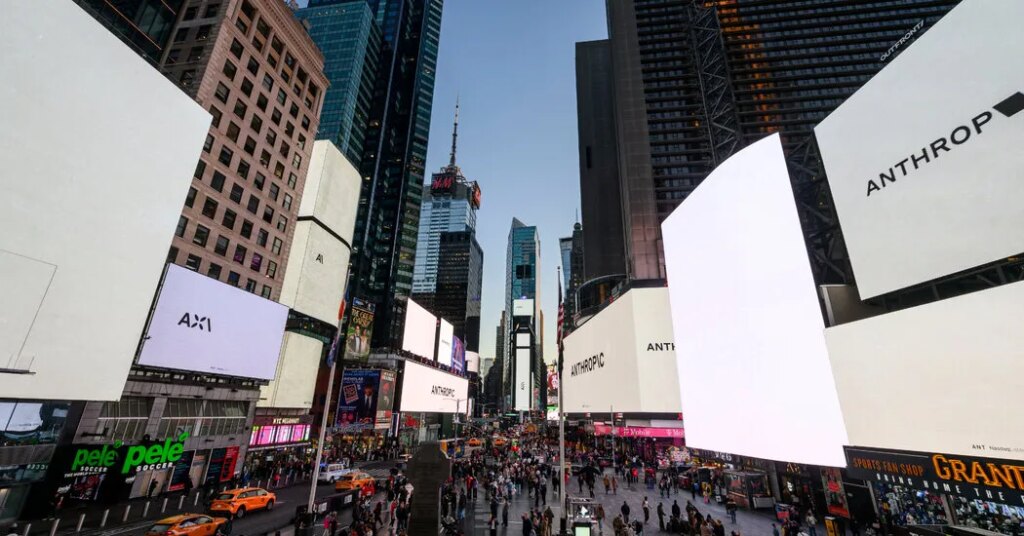
Anthropic on Thursday celebrated its first day of trading as stock prices surged and the company touched a valuation of $2 trillion. On Friday, its stock deflated, sinking 9 percent.
In the aftermath of its record-breaking initial public offering, Anthropic, which makes the Claude chatbot, has vacuumed up more than $120 billion in investor funds. It also consumed the good will of investors, many of whom were already becoming spooked at the artificial intelligence industry’s trillions of dollars of spending on data centers and other infrastructure to power the technology.
Following the huge investments in Anthropic, rival OpenAI and other A.I start-ups may face new hurdles going public, analysts and investors said. And even more established A.I. companies which need to raise debt or equity to pay for their expansion projects may encounter an uphill battle as the sector loses its glow.
That new hesitation was on full display this week, reflecting the widening disconnect between Silicon Valley optimism over A.I.’s potential and Wall Street’s growing doubts about whether the businesses are financially viable.
“The old-school way of looking at this is: This is the largest I.P.O. in history, late in the A.I. cycle. Psychologically, that could be a topping event,” said Michael O’Rourke, chief market strategist at JonesTrading, which brokers stock sales for hedge funds.
The market was shaken on Friday by some of those fears, ending the week with the worst stock slide in more than a year. The tech-heavy Nasdaq composite fell 5.3 percent, wiping away the gains it had made this year. And the S&P 500 fell 3.7 percent, reaching correction territory, or a drop of 10 percent from its recent high.
Stocks of bellwether A.I. companies including Nvidia, CoreWeave and Advanced Micro Devices fell by double-digit percentages on Friday.
Contributing to the sell-off was last week’s resignation of Jensen Huang, the chief executive of Nvidia, and worries about what that means for the chip maker’s important role financing other A.I. companies. Interest rates are also rising, making it more expensive for some companies to build data centers and buy chips. And Democrats swept into power during the midterm elections, many promising A.I. regulation.
Those developments put the enormous amount of money needed to finance the chips, data centers and electricity underpinning the technology at risk. Companies are planning to spend about $5 trillion between now and 2030 on the infrastructure, said Michael Arougheti, chief executive of Ares Management, a large investment manager, on an earnings call last month.
SpaceX, Meta and others tapped the markets last month for tens of billions of dollars to fuel their A.I. spending. Executives at most tech giants have told investors they are increasing their spending on the technology each quarter. And Anthropic’s initial public offering piled on top, causing fatigue, analysts and investors said.
Many concerns about A.I. spending are easily dismissed in Silicon Valley, which, by nature, lives in a different world. Venture capitalists this year have minted nearly 200 new unicorns, or start-ups worth more than $1 billion, more than in any other year since the private market frenzy in 2021, according to PitchBook, which tracks start-ups.
But a market for the kinds of initial public offerings or mergers to justify the velocity of investments hasn’t yet emerged.
Even in Anthropic’s case, the company allowed early employees to sell more than $25 billion of combined stock at the start of trading, an unusually large sum that some investors and analysts viewed as aggressive. Companies and their investment bankers usually limit employees and other shareholders from selling their stock for weeks or months after I.P.O.s to help stabilize the price.
Many hedge fund managers failed to get stock in Anthropic’s offering at the initial price of $83 per share, said Raphaëlle D’Ornano, an A.I. industry analyst who also invests in public stocks. The hedge funds instead paid a significantly higher price for shares when trading opened on Thursday at $111.50.
Those hedge funds would have lost money as the stock quickly sank, closing at $88.91 on Friday. At the same time, funds have been trying to limit how much stock they own in A.I. companies overall, she added.
Friday “was pure panic,” Ms. D’Ornano said.
Wall Street and Silicon Valley largely agree that A.I. tools are certain to upend how people work, use the internet, and maybe even make discoveries in medicine. But no one is confident on how quickly the technology will produce those benefits.
And as the tech companies invest heavily, it isn’t clear how many will bring in enough revenue to become profitable. Anthropic’s rapid revenue growth has depended on businesses that use Claude for automating software engineering work, and the company will need to broaden that customer base in the coming years, analysts said.
OpenAI, which has filed for an initial public offering expected as soon as next year, is hoping for a similar shift into a broader customer base. The company also wants to get more free users of its popular chatbot, ChatGPT, to start paying.
(The New York Times has sued OpenAI and Microsoft, claiming copyright infringement of news content related to A.I. systems. The two companies have denied those claims.)
Those business realities have led to some criticism from Wall Street fund managers, who feel that many in Silicon Valley are overly optimistic about potential returns. For example, Dylan Patel, a closely followed A.I. industry analyst, has predicted unrelenting growth, saying Anthropic and OpenAI would together surpass a half-trillion dollars in revenue by the end of next year, despite shaky markets.
As Mr. Patel walked onstage at a private San Francisco conference for venture capitalists and start-up founders this month to an upbeat electronic song, “Levels” by Avicii, tech stocks were tanking. “Do you have more depressing music, given what’s going on in the market?” he joked.
Mr. Patel, who runs the San Francisco-based market research company SemiAnalysis, said at the conference that investors’ skepticism about the continued pace of revenue growth at OpenAI and Anthropic was one big reason for market turmoil. He predicted those companies would generate more revenue from new business lines, like offering cybersecurity tools and designing chips.
“I myself am a little cuckoo, and I think they actually will hit this, just to be clear,” he said. “But I think many people are a bit skeptical.”
Some A.I. start-up executives said they have noticed a pullback from investors as they consider jumping into their next rounds of funding. Those company leaders are starting to openly acknowledge one awkward reality of the A.I. boom: The technology’s growth has been largely powered by a relatively small number of voracious business customers and consumers who pay for it.
“Eighty percent of the revenue is probably coming from 20 percent of the users. It might even be 90 percent,” said Aravind Srinivas, the chief executive of the Nvidia-backed A.I. start-up Perplexity, at a conference last week hosted by the tech publication, Newcomer.
(The Times has sued Perplexity, accusing it of copyright infringement of news content related to A.I. systems. The company has denied the claims.)
Even as Silicon Valley venture capitalists watched Anthropic’s rocky entry into the public markets, they remained upbeat about the future.
Hemant Taneja, the chief executive of tech investment firm General Catalyst, said he felt relief that Anthropic’s stock price held above the offering price amid “turbulent” markets. Anthropic, he added, was not a one-off example of a venture-funded company that would capitalize on A.I. advances.
“I’m walking away saying: Who’s the next set of founders with the same opportunity?” he said.
Erin Griffith contributed reporting.
The post Anthropic’s Debut Shows the Disconnect Between Wall Street and Silicon Valley appeared first on New York Times.