“America, We lost last night. Full stop,” wrote Michael Flynn, the retired lieutenant general who had helped President Trump try to overturn the presidential election of 2020.
The X post on Wednesday was stark — and unexpected. Mr. Trump had started his second term intent on harnessing the power of the federal government to resurface false claims that widespread fraud had tainted his earlier defeat — and to use those claims to assert unprecedented control over the midterms this year.
He failed.
Voters so thoroughly rejected Republicans on Tuesday, ushering in the largest Democratic House majority in generations and flipping seats that had been red for decades, that it became impossible to blame the outcome on fraud.
Since returning to the White House in 2025, the president has resurrected outlandish and disproven theories of machines tainted by Democrats to steal votes and rampant voting by noncitizens. He tried to redirect the Postal Service to restrict mail voting. He seized ballots from 2020 in Georgia. And his administration launched a massive investigation of state voter rolls, suing states to remove suspected noncitizens.
But the courts reined in many of his most brazen attempts, including on the eve of the election, when the Supreme Court rejected the administration’s effort to require that California set aside 20,000 mail-in ballots that the administration claimed had been provided to noncitizens.
The nation’s decentralized elections system worked reasonably smoothly on Tuesday. Millions of Americans cast their ballots in an election that showed the resiliency of democracy.
The U.S. Constitution states explicitly that the states hold the power to administer elections. Congress may pass laws. The executive branch is given no role.
The victories on Tuesday appear poised only to strengthen the independence of the nation’s election administrators. Democrats who opposed Trump’s federal intervention will soon control the top election office in every significant battleground state for 2028, including newly competitive Texas, Ohio, Kansas and Iowa.
Democrats also swept into power in statehouses where Republican lawmakers had played a key role in attempting to overturn the 2020 election on Mr. Trump’s behalf, including in Pennsylvania, Michigan, Arizona and Wisconsin.
That means fewer election deniers will hold office at the state and local levels as the nation heads into the 2028 presidential election. Fewer state legislatures are likely to adopt voting restrictions, such as limiting access to vote by mail or prohibiting nursing home aides from helping older voters cast ballots. There will also likely be fewer attempts to upend the electoral process through timely and cumbersome hand counts or changes to the certification process.
Election administrators and voting-rights advocates who have spent the last six years fighting election deniers and their unfounded allegations of fraud are now hoping that the midterms have broken the movement.
“I think American voters are tired of this,” said David Becker, a former Justice Department lawyer who runs the Center for Election Innovation and Research, a nonpartisan group that works to support election officials in both parties. “It’s not based on fact. They’ve been making claims for well over six years. They’ve been raising money off of these claims, taking money off of sincerely disappointed supporters of losing candidates. And after six years, they produced zero evidence.”
Even Mr. Trump acknowledged that he had fallen short. “I am absolutely willing to accept those results, yeah,” the president told The Times in a telephone interview late Tuesday. Tuesday’s sweeping Democratic victory, it seemed, was too big to deny.
It was not for lack of trying.
It remains to be seen whether Mr. Trump, the nation’s most influential election denier, is entirely done pushing the idea that this week’s election was rigged.
His administration has appeared eager to continue to investigate and intrude on the electoral process. On Tuesday, before polls closed, both Attorney General Todd Blanche and Homeland Security Secretary Markwayne Mullin pledged in television interviews to investigate the election.
“After this election, we’ll be gathering all the data, we’ll be gathering the voting logs and we’ll be going through those and making sure that no illegals voted,” Mr. Mullin said during an interview with Fox News on Tuesday afternoon.
The president also continued to fixate on the Senate race in Alaska, where a spoiler candidate recruited by Democrats shares a name with the Republican incumbent, Dan Sullivan. His administration sued to throw out the results if Senator Dan S. Sullivan, the Republican incumbent, loses by a margin that can be blamed on the spoiler. The case was dismissed on Nov. 1, but the Justice Department has appealed.
It’s the one frontier the president has not abandoned since Tuesday’s resounding results. On Thursday, he posted on his social media platform, Truth Social, that any votes for the spoiler, Dan J. Sullivan, should be awarded to the incumbent senator.
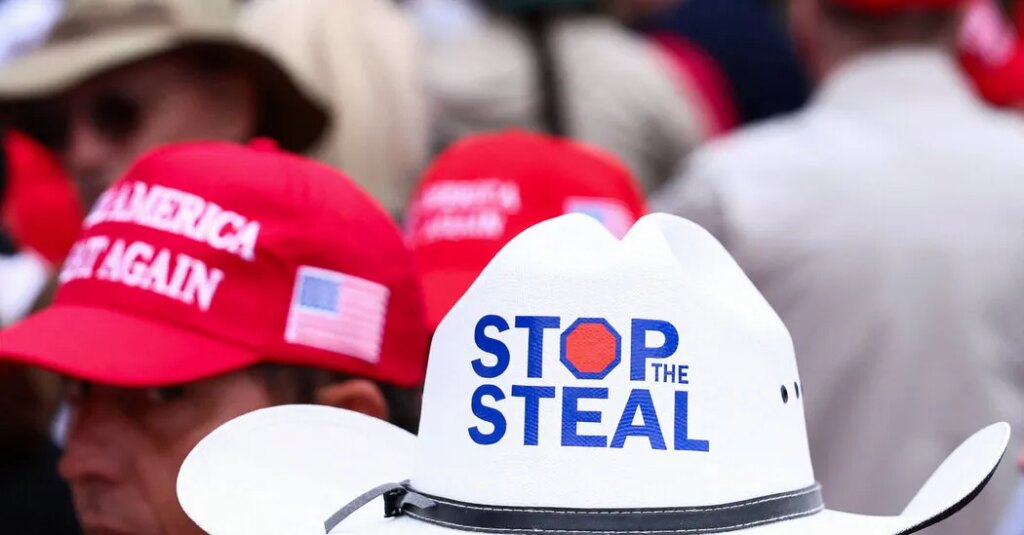
The core of the election denial movement is that the electoral system itself has been corrupted. Advocates over the years have alleged, among many theories for which they have no evidence, that large numbers of noncitizens vote illegally, that voting machines are compromised, that fake ballots made of bamboo were shipped to the U.S. from Southeast Asia, and that Italian satellites hacked voting systems to deny Mr. Trump victory.
The denialist movement has become central to Mr. Trump’s brand, and is deeply embedded in the culture of Republican politics. A Reuters/Ipsos poll this year found that 63 percent of Republicans believe the president’s lie that the 2020 election was stolen.
It’s not yet known if the size of the Democratic victories this week, which were fueled at least in part by Republicans voting for Democrats, has changed such views.
Some of the most fervent voices have been richly rewarded by Mr. Trump in his second administration. They have become his close allies, earned audiences with him, helped guide his agenda, and inspired a wave of voting legislation across the country aimed at making voting harder, often to the benefit of Republicans.
In April, ProPublica reported that at least 11 administration appointees had ties to the Election Integrity Network, a conservative group that has spread misleading claims about the American election system.
The group was founded by Cleta Mitchell, a lawyer and close ally of the president’s who was on the infamous 2021 phone call between Mr. Trump and Georgia Secretary of State Brad Raffensperger, in which Mr. Trump made false claims of fraud and pressured Mr. Raffensperger to “find” enough votes to overturn his loss in Georgia.
In a phone interview on Wednesday, Ms. Mitchell took umbrage when asked whether, like Mr. Trump, she had accepted the results of the election.
”I am not going to answer that question because that is a stupid question,” Ms. Mitchell said.
When asked if her movement would remain an influential force in American politics, Ms. Mitchell said, “We’ll see.”
“We’re going to be continuing to be very active,” she said. “We’re adding state coalitions as we speak.”
Looking ahead to 2028 was critical for Democratic candidates for secretary of state, said Cisco Aguilar, the Democratic secretary of state in Nevada.
“Everybody was thinking short-term of House and Senate, and we had to get donors and voters focused on the long-term goal of 2028,” Mr. Aguilar said. “And sometimes that didn’t register through the panic, through the chaos of what was happening. So it took us a while to get our message to resonate. But once it resonated, it hit. Really well.”
Some Republicans welcome the possibility that the election denier movement might be dimming. Gabriel Sterling, the former chief operating officer in the office of the Georgia secretary of state, said the dominance of false claims about election fraud made it harder for conservatives like him to focus on actually preventing fraud by keeping voter rolls clean. Although deniers talk regularly about the need to remove noncitizens from the rolls, they led the movement to dismantle the multistate system that helped states prevent double votes and duplicate registrations, which are far more common types of fraud.
Mr. Sterling, who serves as senior fellow at the Secure Democracy Foundation, was forced into the national spotlight just after the 2020 election. As Mr. Trump continued to spread falsehoods about that year’s election in Georgia, Mr. Sterling criticized the president for failing to condemn threats of violence against people overseeing Georgia’s voting system.
In an interview this week, Mr. Sterling said he was not sure whether the movement was on the way out.
“One election cycle does not an election denialism kill,” he said. “You know, it depends on the closeness of elections, and it depends on the efficacy of the election administrators.”
He said elections officials around the country likely helped beat back conspiratorial thinking by carrying off an Election Day marked by only a few glitches.
“We were all terrified to jinx it, because it was all going so smoothly,” he said.
The post Trump Tried to Undermine the Nation’s Elections. It Didn’t Work. appeared first on New York Times.