This week in Newly Reviewed, Andrew Russeth covers Gedi Sibony’s scavenger hunt, Mildred Thompson’s vivid planets, Fiona Tan’s voices and ghosts, and Ben Kinmont’s archives.
GREENWICH VILLAGE
Gedi Sibony
Through Nov. 21. The Renee and Chaim Gross Foundation, 526 LaGuardia Place; 212-529-4906, rcgrossfoundation.org.
The capacious townhouse that the artist Chaim Gross (1902-91) and his wife, Renee (1909-2005), shared for decades is a New York treasure, stuffed with his work and their sprawling art collection.
Somehow, the midcareer Brooklyn artist Gedi Sibony still managed to find room for almost 20 of his scrappy pieces to make this invigorating scavenger hunt of an exhibition.
Most of Sibony’s contributions are makeshift objects that, on the street, would be mistaken for intriguing junk, but in these environs, they glow. A metal shower rack, bent and twisted, turns anthropomorphic next to sturdy bronze heads by Chaim Gross. An awkward plywood table by Sibony serves as a humble pedestal for two more strong Gross heads, these carved from wood. A small wood bat, hung from the ceiling, lends an antic touch.
Time is one of Sibony’s principal themes here. He has placed a battered office chair in the elevator, and up on the third floor, a giant white Swatch watch atop a doorway. The artist has also brought in a tiny terra cotta figurine from around 2500 B.C. and floated it over a table with nearly invisible wires — an ancient visitor surrounded by more recent history.
By arraying his understated pieces throughout the building, Sibony punctuates and intensifies the menagerie of art on view. Lovingly, he is playing a supporting role in a far larger tale about how creative lives can be sustained and remembered.
CHELSEA
Mildred Thompson
Through Dec. 19. Galerie Lelong, 528 West 26th Street; 212-315-0470, galerielelong.com.
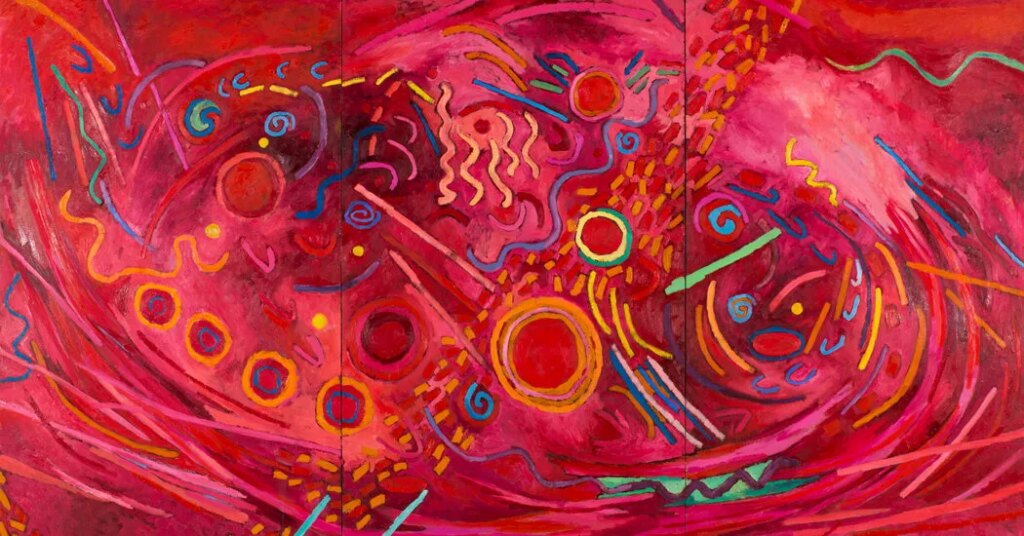
Four massive abstract paintings that the great Mildred Thompson (1936-2003) made in 1996 make for one of the most thrilling art experiences in the city right now. Intricate networks of thick, quick lines and brilliant color, they were each inspired by a planet.
Mars is a raucous swirl of cranberries and crimsons, with floating orange dashes, while Venus is a medley of yellows that resemble rays, beams and stars. Mercury is off-kilter, mercurial, a deep purple blob sneaking up on a luscious expanse of greens. The masterpiece is Jupiter, with lines streaking across a field that could be a smoldering flame.
Thompson was fascinated by how science could be channeled into art, and she titled the series “Music of the Spheres.” Speakers above each piece play spectral and luminous compositions that she recorded with electronics and toy instruments. We are floating in space.
Additional paintings, drawings and a vitrine with books, photos and other personal objects illuminate Thompson’s vast interests and range, which included writing poetry and playing in a band. There’s a syllabus for a class she taught in 1992, “Making the Invisible Visible,” which is the mission she shared with other 20th-century originals, like Han Mook, Wassily Kandinsky and Hilma af Klint.
SOHO
Fiona Tan
Through Dec. 19. Peter Freeman, Inc., 140 Grand Street; 212-966-5154, peterfreemaninc.com.
Halloween is over, but the frights continue in Fiona Tan’s disquieting 2025 film “Janine’s Room,” the centerpiece of this elegant exhibition. Tan’s three-screen piece centers on an older woman, a scholar hard at work amid precarious stacks of books. Snails climb atop her plants, which is a bit odd, but all is slow and tranquil until sand starts falling into the space, as if it’s a giant hourglass. (There are other alarming sights, but let’s not spoil it.)
Letters by psychiatric patients scroll along one screen. “I seem to be but an empty shell possessing nothing but a pain within me,” one from 1948 reads. These unattributed words also appear: “My desire is to understand everything, ignorant as I am of any life that isn’t mine.”
Tan, who was born in the Indonesia city of Pekanbaru and now lives in Amsterdam, debuted the piece last year in a show she curated at the Rijksmuseum about how art portrays the inner self and mental illness. The film speaks of the voices and ghosts that are buried in archives and libraries, as well as the aching futility of trying to fully understand another person, or an artwork.
Even Janine’s simple labor has a haunting quality. As books are sucked en masse into digital databases and digested by opaque artificial intelligence programs that spit out answers, her meticulous page turning looks increasingly rarefied, outmoded. Like that sand, powerful forces are encroaching on her pursuits. Quietly but firmly, Tan insists that they must endure.
NOHO
Ben Kinmont
Through Nov. 8. Yoshi Hill, 41 Bleecker Street; 646-420-4652, jonathanahill.com/pages/events/22/ben-kinmont.
“Sometimes a nicer sculpture is to be able to provide a living for your family,” the conceptual artist Ben Kinmont wrote in 1998, after starting a company to sell antique books about food and drink. “The artwork is not the business itself,” he added, “but my contribution to our cost of living.” Kinmont’s statement is silk-screened on the wall of this inspiring little show organized by the bookseller Yoshi Hill and the artist Cooper Campbell, which includes the bookstore’s original door and his sales tally to date: 4,969.
A table in another room is piled with records of an exhibition that Kinmont first staged in 1996 about how fellow freethinkers like On Kawara and Gordon Matta-Clark developed project-based artworks as alternative economic models. (Kinmont’s own body of work includes once serving a waffle breakfast in his home to 32 visitors.)
As making a living as an artist feels ever more untenable, Kinmont’s example is heartening as well as cleareyed. Success, he argues, should be measured not in big-dollar sales, but in the creation of ways to connect with others.
See the October gallery shows here.
The post Art Gallery Shows to See in November appeared first on New York Times.