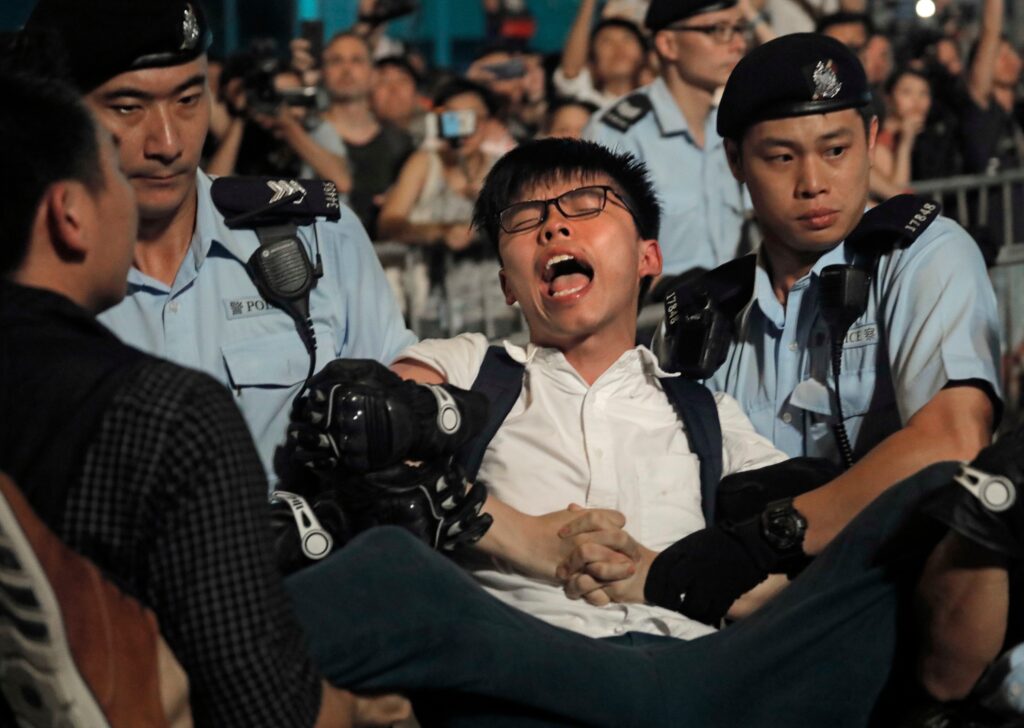
Pro-democracy activist Joshua Wong, who recently spent his 30th birthday behind bars, was sentenced on Thursday to another 10 years in a Hong Kong prison under China’s national security law. First arrested for protesting at age 17, Wong was accused in the current case of “collusion” with “foreign forces” because his advocacy prompted a government crackdown that helped spark U.S. sanctions.
The 2020 sanctions sought to hold Hong Kong and Chinese officials accountable for restricting personal liberties, including free expression and assembly, as well as violating Beijing’s promises of autonomy when the British transferred control of the city in 1997. “I have never advocated Hong Kong independence, nor have I ever promoted the ‘collapse of China’ or regime change,” Wong said during the mitigation phase of his trial.
But a lengthy sentence was predetermined. China labeled Wong a “separatist.” Ten years was the mandatory minimum.
Wong is already serving a sentence of four years and eight months on previous charges, including for organizing an unauthorized protest in 2019. He was due to be released in January; Hong Kong, almost certainly at Beijing’s direction, produced a new collusion charge ensuring he wouldn’t walk free anytime soon.
Wong became politically active as a teenager by protesting proposals to add a “moral and national education” curriculum supportive of the Chinese Communist Party to the city’s schools. He helped spearhead the 2014 sit-ins, remembered as the “Umbrella Movement,” and became the public face of Hong Kong’s youth movement. The decade added Thursday means Wong will be locked up into middle age.
He isn’t alone. Newspaper publisher Jimmy Lai was sentenced in February to 20 years in prison for sedition and violating the national security law, including the same charges of collusion with “foreign forces.” Lai is 78 and in ill health, so 20 years amounts to a de facto death sentence.
The Trump administration deserves credit for continuing to speak out against these injustices even as U.S. officials work to improve diplomatic ties with China. The U.S. Consulate in Hong Kong said Thursday in a statement that Wong is “unjustly imprisoned” and that the latest charges prove “Beijing will go to extraordinary lengths to silence those who advocate for fundamental freedoms.”
Hong Kong and China clearly hope that by removing Wong and Lai from the public space, the territory can smother any remaining pro-democracy sentiment and scare dissidents into silence. They’re counting on business leaders to look the other way. The government announced on Tuesday that Hong Kong’s economy grew 5.2 percent in the third quarter compared with a year earlier. The city’s financial secretary predicted earlier this year that Hong Kong would become the world’s second-largest financial hub within 10 to 15 years.
It’s true that Hong Kong’s economy is recovering. The stock market says it’s on track to reclaim from the Nasdaq its position as the world’s premier destination for initial public offerings. But what officials usually leave out is that the great majority of those listings are mainland Chinese companies. Hong Kong’s historical advantage was combining access to China’s vast market with Western values of openness, freedom and an independent judiciary. The once-vibrant international center has become just another Chinese city.
Foreign investors value stability and predictable rules, but free markets require more than that. They require a free press, transparency and the open flow of information. Any city that jails newspaper publishers and its brightest young people is not a wise place to make long-term investments.
The post Hong Kong’s cruel punishment of Joshua Wong appeared first on Washington Post.