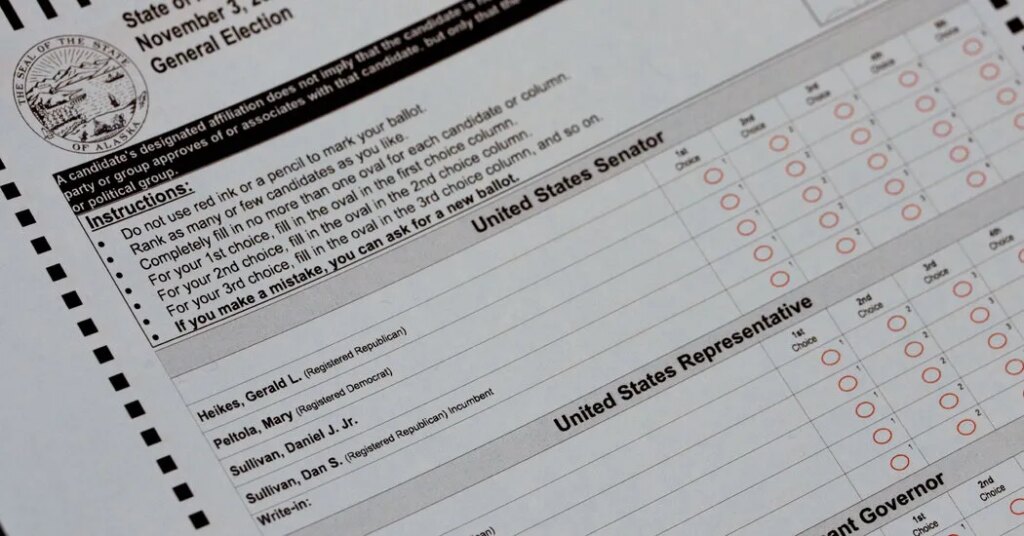
Senator Dan S. Sullivan is unlikely to make significant gains if the Alaska Senate race advances to ranked-choice tabulation, according to a New York Times analysis of the available ranked-choice data in the state. This holds true despite the fact that the reallocated ballots will come from voters who backed two candidates who ran as Republicans — including one also named Dan Sullivan.
The findings suggest that Mary Peltola, the Democratic nominee, is on track to eventually prevail in the Alaska Senate race. Ms. Peltola currently leads by less than one percentage point, but she is expected to build a more substantial lead once about 60,000 more votes, mostly cast by mail, are counted in the days ahead.
If Ms. Peltola doesn’t win the 50 percent needed to win outright and the race advances to ranked-choice tabulation on Nov. 18, the analysis suggests that Mr. Sullivan might not even claw back half of a point in ranked-choice tabulation, which would not be enough to overcome Ms. Peltola’s expected advantage.
In a surprising twist, one reason Mr. Sullivan doesn’t fare better is that more of the voters who backed the other Dan Sullivan — a candidate named Daniel J. Sullivan Jr., who was recruited by allies of Ms. Peltola to siphon votes from the incumbent — ranked Ms. Peltola as their second choice rather than Mr. Sullivan.
The analysis is based on the state’s initial release of ballots from more than 200,000 voters, or nearly all the votes tabulated thus far. The data shows how every voter ranked the candidates in the Senate race, including whether they left their subsequent choices blank.
About 4 percent of ballots counted so far ranked Gerald L. Heikes, Daniel J. Sullivan Jr. or a write-in candidate first. According to The Times analysis, Dan S. Sullivan would gain only four-tenths of a percentage point in vote margin from ranked-choice tabulation among these ballots.
The role of Daniel J. Sullivan Jr. as a potential spoiler has loomed over the Alaska Senate race for most of the year, but it vaulted to the forefront after a New York Times investigation last week found that the Peltola campaign had recruited him into the race. President Trump wrote on Truth Social that the ballots cast for Daniel J. Sullivan Jr. “should be immediately given to the REAL Dan Sullivan” and ordered the Justice Department to start an investigation into Ms. Peltola’s campaign. (That would amount to fewer than 4,000 ballots as of Thursday.)
Two-thirds of Daniel J. Sullivan Jr.’s supporters ranked a second choice, with most of those voters supporting Ms. Peltola in subsequent rounds — an indication that they were not intending to vote for Dan S. Sullivan. If all the voters who voted for Daniel J. Sullivan and did not rank a second choice at all had actually intended to vote for the incumbent, he would only gain about one percentage point in vote margin — an increase that would not offset Ms. Peltola’s expected gains from uncounted mail vote.
With Mr. Heikes, a similar share of his first-choice voters chose to leave the rest of their ballot blank. On the ballots that did have a second choice, however, Dan S. Sullivan was by far the most common choice, which accounts for the small overall gain that the incumbent would be likely to receive if things advanced to ranked-choice tabulation.
The state has published the full ranked-choice selections only for ballots that could be scanned electronically. About 10,000 hand-counted ballots, which come primarily from rural areas where Ms. Peltola has performed well, are therefore not included in the analysis.
The post In Alaska, Ranked-Choice Ballots Are Unlikely to Be Enough for the Republican appeared first on New York Times.