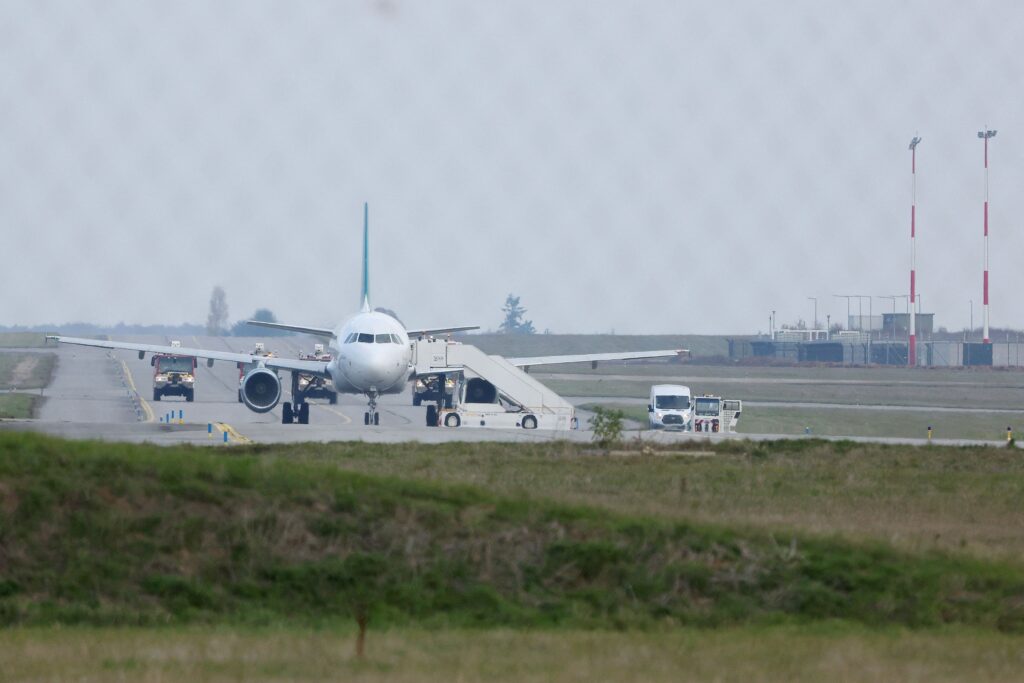
A spate of bomb scares disrupted air travel across Europe on Thursday, diverting flights and forcing emergency landings, days after similar hoax threats.
Aviation security analysts pointed to a suspected hoax campaign as some European governments dispatched fighter jets Thursday to escort passenger planes in their airspace.
More than a dozen flights were affected, including from airports in Dublin, Madrid, Copenhagen, London, Warsaw, Milan and Helsinki.
Inspections found no explosives on board, according to authorities and airlines, and European officials did not assign blame.
The European Union’s transport commissioner, Apostolos Tzitzikostas, said that such threats were “unacceptable” but that it was “too early to draw conclusions on whether the incidents are linked.”
Security analysts, however, said the higher-than-usual frequency of the incidents suggested they were linked, although it also appeared to be a chaotic operation with no particular target.
The disruptions followed a slew of warnings that prompted at least seven airplane searches or diversions earlier this week.
The latest threats involved planes operated by such airlines as Ryanair, Europe’s biggest, as well as the national carriers of Greece, Finland and Poland: Aegean Airlines, Finnair and LOT Polish Airlines.
The alerts have generated concern, although they affected only a small share of the planes traveling the continent. More than 27,000 flights were scheduled across Europe on Thursday, according to air-traffic agency Eurocontrol.
In one case, a flight from Dublin to Rome was diverted Thursday to France’s Évreux air base in Normandy because of a bomb threat, French Prime Minister Sébastien Lecornu’s office said.
The 151 passengers and six crew members on the Aer Lingus flight were taken to safety while a bomb squad inspected the plane, it said. French military jets escorted the aircraft to the base.
The Irish airline said in an statement that Flight 402 was diverted “as a security precaution” and landed safely.
The same day, Finnair said in a statement that two flights, Flight 1761 from Helsinki to Rome and Flight 1471 from Helsinki to Vienna, faced “unfounded or hoax bomb threats.” Both flights were searched by authorities upon landing, it said, but “nothing out of the ordinary was found.”
In Prague, Czech police said they deployed at the Vaclav Havel Airport to prepare for the arrival of four planes after receiving a threat of explosive devices on board. Police later said their search had concluded, and the planes were cleared.
LOT Polish Airlines, meanwhile, said its flight from Warsaw to Brussels landed at its destination, where inspections found no suspicious items. None were found either on another flight from Warsaw to Paris, which was stopped while taxiing and directed to park while the aircraft and baggage were screened, the airline said. The flight continued on a different aircraft.
Bomb threats also affected three Ryanair flights bound for Sofia, Bulgaria, the country’s Transportation Ministry said.
The flights from Madrid and Copenhagen continued to Sofia’s airport, while the flight from London was diverted to Plovdiv, Bulgaria’s second-largest city, it added.
A spokesperson for low-cost Hungarian operator Wizz Air confirmed that one of its flights from Milan to Bucharest received a threat but was able to land safely. The aircraft was cleared after inspection, the spokesperson said.
In Austria, fighter jets were deployed to assist affected planes in the country’s airspace, Defense Ministry spokesman Michael Bauer said on social media. Bulgaria’s air force also said its fighter jets intercepted and escorted three planes targeted by bomb threats.
The threats come at a time of heightened geopolitical tensions as European officials increasingly warn of possible acts of sabotage tied to Russia’s war in Ukraine. In recent weeks, cyberattacks targeted refrigeration systems in supermarkets around Europe, and on Sunday, emergency alert apps in Ukraine and Russia were hacked.
Aviation security group Osprey Flight Solutions on Thursday advised airlines to expect more possible threats in the coming days, and to prepare to adjust itineraries and tighten security. It said the reports seemed consistent with a hoax campaign to disrupt air operations and generate media or public attention.
In an analysis note, the firm added that there was “no significant trend identified at this stage, other than all impacted routes are in Europe.”
The post Bomb scares disrupt multiple flights across Europe appeared first on Washington Post.