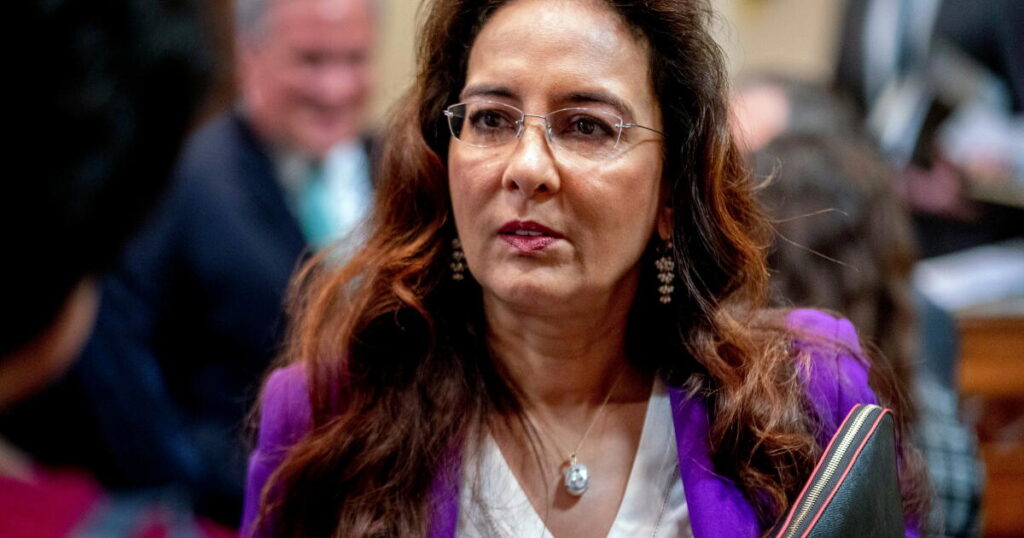
Assistant Atty. Gen. Harmeet Dhillon, a California attorney who radically reshaped the Justice Department’s Civil Rights Division to focus on political issues important to President Trump — including by targeting transgender rights and launching a nationwide probe for alleged voter fraud by noncitizens — resigned her post Thursday.
In a resignation letter and in a post to X — where she routinely lambasted liberal policy and touted her office’s legal work to dismantle it — Dhillon said serving as the division’s chief was an honor.
“We ushered in the downfall of illegal DEI, we fought to protect women and girls’ sports, and so much more,” she wrote on X. “I want to thank President Trump for giving me this opportunity. I look forward to what’s next!”
Critics of Dhillon — including prominent civil rights leaders who had opposed her confirmation to the post — cheered her departure, saying she had flipped the storied Civil Rights Division on its head by attacking pillars of its past work, such as affirmative action policies, diversity, equity and inclusion initiatives, LGBTQ+ rights and voting rights.
“Is Harmeet running from a sinking ship? Trying to avoid actual oversight? Or getting pushed out by DOJ leadership?” said Vanita Gupta, who headed the Civil Rights Division under President Obama. “Maybe it’s all of the above but regardless, she used the Civil Rights Division against the very communities and values it was founded to protect and that will be her legacy.”
Another part of her legacy, Gupta said, will be that she “oversaw the decimation of the Division’s incredible career workforce.” Many career civil rights attorneys left the department after she took over and demanded an ideological shift in the work.
Dhillon’s departure comes two days after a midterm election in which Republicans suffered sweeping losses, and amid widespread speculation as to how Trump and other leaders in his administration would respond — and who among them, if any, would leave or be unceremoniously ousted. Turnover after such an electoral drubbing is not uncommon.
In her resignation letter, Dhillon said she initially resigned in October, but that White House chief of staff Susie Wiles asked her to stay until after the midterms. Lauren Bis, a White House spokesperson, said in a statement that Dhillon did “a fantastic job … boldly protecting Americans’ civil liberties.”
Dhillon also touted what she called “historic victories for the American people” under her leadership, and specifically cited her work ending diversity, equity and inclusion programs, suing states such as California over their policies for transgender students and athletes, suing California and other states for their voter rolls, defending gun rights, and fighting anti-Semitism.
Dhillon’s success in those initiatives was middling at best — and in some areas disastrous. Out of dozens of lawsuits demanding states turn over their voter rolls, for instance, she had zero wins.
Atty. Gen. Todd Blanche, on X, wrote that Dhillon “has defended the civil liberties of every American and enforced the law without fear or favor,” and that the department “is grateful for her dedicated public service” and wished her “every success in her future endeavors.”
A spokesperson for Dhillon said she was returning to her firm, the Dhillon Law Group.
Mark Trammell, the CEO of the conservative Center for American Liberty — which Dhillon founded — praised her work in the Justice Department as “advancing civil rights for all Americans.”
Others expressed stridently different feelings about her tenure.
Stacey Young, executive director of Justice Connection, a nonprofit organization of former Justice Department employees that advocates for a non-politicized department, blasted Dhillon’s tenure in the department and cheering her departure.
“Harmeet Dhillon has been the most destructive, lawless, and hateful head of the Civil Rights Division in DOJ history,” Young said in a statement. “After she upended the division’s mission-critical work, the civil servants who dedicated their careers to protecting vulnerable communities were instead told to target them — and more than three-quarters of the division’s lawyers left.”
Dhillon turned away from the division’s traditional role of investigating problematic police departments and rebuffed calls for federal civil rights investigations into the killing by immigration agents of Renee Good and Alex Pretti in Minneapolis. She later relented amid intense public pressure to launch an investigation into Pretti’s killing, but was criticized for assigning inexperienced staff and not taking the probe seriously.
Dhillon also helped dismantle long-standing firewalls between the Justice Department and the White House, acknowledging that she saw her mission as pursuing civil rights in line with Trump’s executive orders.
She focused on targeting universities for allegedly discriminating against white and Asian students, attacking policies protecting transgender students and athletes in California and elsewhere, and launching her failed nationwide effort to obtain state voter rolls in order to root out alleged noncitizen voters.
She also took a leading role in threatening election workers processing ballots in the midterms.
As of Thursday morning, Dhillon still had pinned to the top of her X account a post from July, in which she discussed sending letters to elections officials in all 50 states warning them that it is a crime to knowingly process ballots from noncitizens.
“Every state and local election official is on notice — knowingly encouraging noncitizens to vote or conspiring to fraudulently register noncitizens is a federal crime,” she wrote.
Before being appointed to the Justice Department, Dhillon had made a name for herself in California by attacking transgender rights and challenging COVID-19 restrictions and voting rights initiatives.
California Atty. Gen. Rob Bonta, asked about Dhillon’s departure, said, “Good riddance.”
“Few people have done more to undermine U.S. DOJ’s civil rights legacy than Harmeet Dhillon — undermining free and fair elections, subverting anti-discrimination laws, and targeting marginalized communities,” Bonta said — efforts he said his office helped thwart in court.
Brian Levin, a professor emeritus of Cal State San Bernardino and founder of the Center for the Study of Hate and Extremism, said Dhillon’s tenure atop the Civil Rights Division “was nothing short of an unmitigated catastrophe” compared to the division’s work under past Republican and Democratic administrations alike.
Levin said Dhillon ignored data showing discrimination against “the very vulnerable communities for whom the Civil Rights Division” was created to help to instead focus on things like “anti-white discrimination” and gun rights — overseeing “a complete abdication of protecting voting rights, housing and a slew of other projects that have been the foundation of what the division was founded to do.”
Levin said that “among these vulnerable communities that need the help the most that she has turned her back on have been the gay community, the trans community, immigrants, racial minorities, as well as the disabled,” and accused Dhillon of having “butchered” the division’s career staff and replaced it with people who “were vastly under qualified.”
“She was horrible, and anyone who cares about the preservation of civil rights, and, and those who are the most vulnerable in our society, while not rejoicing today, can at least take some solace that the hemorrhaging will at least temporarily stop,” Levin said.
Young, of the Justice Connection, called on the next Senate — which will have a Democratic majority thanks to Tuesday’s elections — to exercise its confirmation powers to ensure Dhillon’s successor atop the Civil Rights Division fulfills its “congressional mandate to enforce all Americans’ civil rights diligently and fairly.”
The post Harmeet Dhillon, California attorney who radically reshaped DOJ civil rights unit, resigns appeared first on Los Angeles Times.