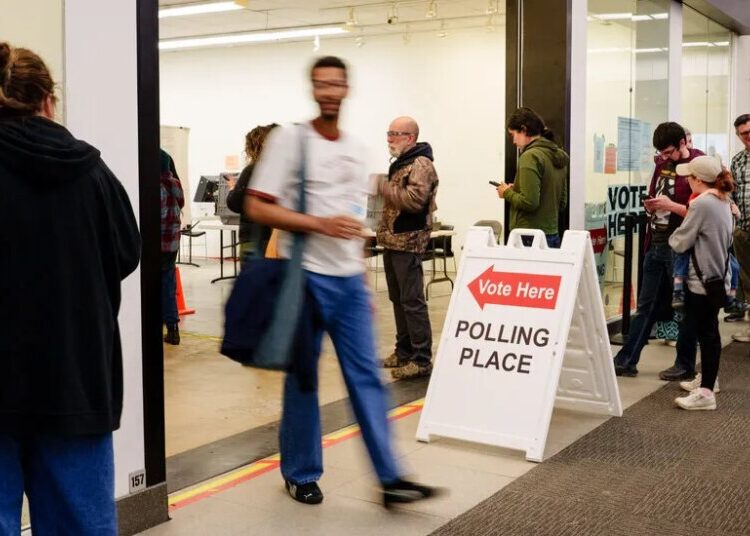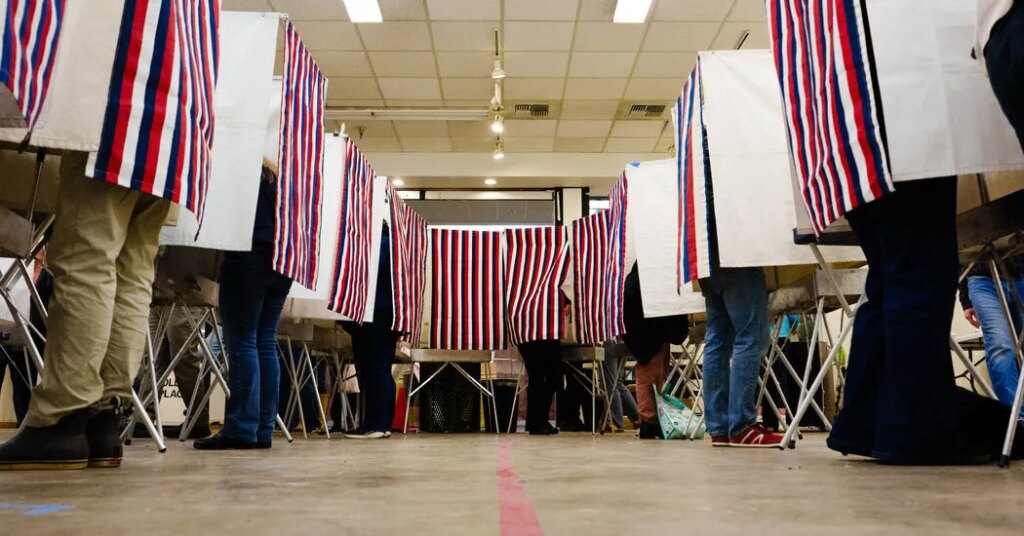
Local law enforcement and election officials are bracing for a tense Election Day as President Trump has kept up a sustained attack on the integrity of U.S. elections, including by offering a $1 million reward for information that leads to an election fraud conviction.
In response to Mr. Trump’s unsubstantiated claims about voting problems and his campaign to assert more federal control over state-run elections, officials have prepared for potential worst-case scenarios in which the federal government tries to intervene in voting.
Now some local authorities have said they also fear that the president’s offer of a large financial incentive could foster unrest or even vigilantism, with Americans eying one another with suspicion as they head to the polls.
“Don’t drag in the public and basically a vigilante-type system where we’re going to say, ‘Hey, you can make a million dollars here by going over here and accusing somebody of fraud,’” said Sheriff Chris Nanos of Pima County, Ariz., a Democrat. “Our elections are handled at the local level, but yet we have fire and brimstone, if you will, coming down from the federal level.”
Mr. Trump’s unfounded claims that the election could be rigged come at a time when violent threats against public officials and election workers have increasingly become a new normal. To prepare for Tuesday, election officials and local law enforcement agencies have held hundreds of exercises to anticipate a variety of possible threats and disruptions at polling sites.
Chief Chris Davis, who leads the police department in Green Bay, Wis., said the level of fear surrounding elections has increased in recent years, particularly in his battleground state.
“I worry about disturbances at polling places, and we’ve developed pretty comprehensive plans for that if it happens,” said Chief Davis, who added that he was concerned Mr. Trump’s reward offer could further heighten tensions at polling sites.
“If one voter challenges another voter, the potential for that to turn into a disturbance and a big problem for us is very real,” he said.
Deidre Henderson, the Republican lieutenant governor of Utah, has also warned in recent weeks that the federal government has contributed to a tense environment for the midterms.
Ms. Henderson told CBS News’s “60 Minutes” that in previous elections, “the threats were all external: nonstate actors, cybersecurity threats and other things. But now we also have threats coming from within our own government.”
The atmosphere is already fraught. The Justice Department has asked California to set aside 20,000 mail ballots, claiming they were provided to likely noncitizens. The administration has also sought to pre-emptively challenge the results of the Senate race in Alaska, where two candidates named Dan Sullivan are on the ballot. So far, the courts have blocked those efforts.
State and local officials have responded to Mr. Trump’s attacks by seeking to create guardrails to prevent potential disruptions.
Gov. Gavin Newsom of California, a Democrat, sent an extraordinary “alert” on Saturday to the four U.S. district courts that cover California, warning the judges that the Trump administration may try to seize ballots.
And in response to the Justice Department’s plan to dispatch 1,000 federal monitors across the country, some local officials have issued statements saying that monitors are prohibited from crossing into an established perimeter surrounding polling locations, citing state law.
Justin Elicker, the Democratic mayor of New Haven, Conn., said the Justice Department told local officials last month that it would be sending two teams of two people to polling sites in the city to ensure New Haven was complying with federal voting requirements on language assistance and disability access.
The city responded by sending the Justice Department a letter saying the monitors were not welcome to enter any polling locations.
“They intimidate people not to vote,” Mr. Elicker said in an interview. “We would prefer that they not be here.”
In discussions with local and state officials, the Justice Department committed to monitoring from outside a 75-foot perimeter, like other observers, and pledged not to interfere with voting, according to Stephanie Thomas, Connecticut’s Democratic secretary of state.
A Justice Department spokeswoman said federal monitors do not require approval from state or local authorities but added that monitors are trained to follow local laws that govern access at polling sites.
In the final stretch of the midterm campaign, Mr. Trump has continued to make unsubstantiated claims that the country’s elections can be manipulated, falsely asserting that there is widespread fraud.
“I’m also going to be issuing a $1 million bonus or reward, or whatever you want to call it, for anybody that reports voter fraud, leading to the arrest and conviction of somebody,” Mr. Trump told reporters last week before flying to Mississippi for a campaign rally.
The president has said the offer applies to past elections, as well as the midterms.
Mr. Trump’s dangling of a $1 million reward caps a year in which he has trained the full arsenal of his administration on sowing doubt about the country’s election systems.
The White House declined to answer questions about what money would be used to pay for the reward or how Americans should report fraud, and did not address criticism that the financial incentive could spur people to vigilantism.
Lauren Bis, a White House spokeswoman, said that Democrats were the ones eroding election security. “They refused to enact common-sense election security measures like voter ID and citizenship verification,” she said in a statement. “President Trump is right: We have to have honest elections.”
Despite the inflamed rhetoric, local and state officials said that the authorities tasked with ensuring a safe election are prepared for this moment.
“A lot of what has been said has been designed to provoke and cause fear, so we’re paying attention to it but we’re not going to overreact,” said Aghogho Edevbie, the deputy secretary of state of Michigan, who said that his office has helped conduct about 125 security exercises this cycle.
“That is going to cause us to be ready for anything that comes along,” said Mr. Edevbie, a Democrat. “You could ask, ‘Was that more preparation because of what’s happening from D.C.?’ Absolutely.”
Gowri Ramachandran, the director of elections and security in the Brennan Center’s Elections and Government Program, said Americans should not lose faith in poll workers.
“Election officials just really have been working super hard to provide a free and fair election for voters,” Ms. Ramachandran said. “The rhetoric that we see coming out of the administration just does not square with the reality of what election officials and voters are doing. And I would say the only way all of that rhetoric works is if people don’t exercise their rights to vote.”
Nearly three-quarters of voters said they largely trusted that the results of Tuesday’s election would be accurate, including large majorities of Democrats, Republicans and independents, according to a recent New York Times/Siena poll. Still, half of likely voters were worried about Republicans trying to overturn the outcome of the election, while 31 percent of voters were worried about the possibility of Democrats taking such action.
Chuck Wexler, the executive director of the Police Executive Research Forum, which advises departments on best practices, said that current and former police chiefs discussed at a recent gathering how the political divisiveness at the national level had trickled down to communities trying to prepare for the election.
“There are some people who are willing to go beyond rhetoric to actual exercise violence, and that has not been lost on police chiefs,” Mr. Wexler said, noting the Jan. 6, 2021, assault on the U.S. Capitol by supporters of Mr. Trump who were angry about the outcome of the 2020 election. “What used to be a simple constitutional right of voting now has become an issue of considerable agitation.”
Neil Vigdor, Devlin Barrett and Eileen Sullivan contributed reporting.
The post Trump’s Election Fraud Reward Raises Fears of Vigilantism, Local Officials Say appeared first on New York Times.