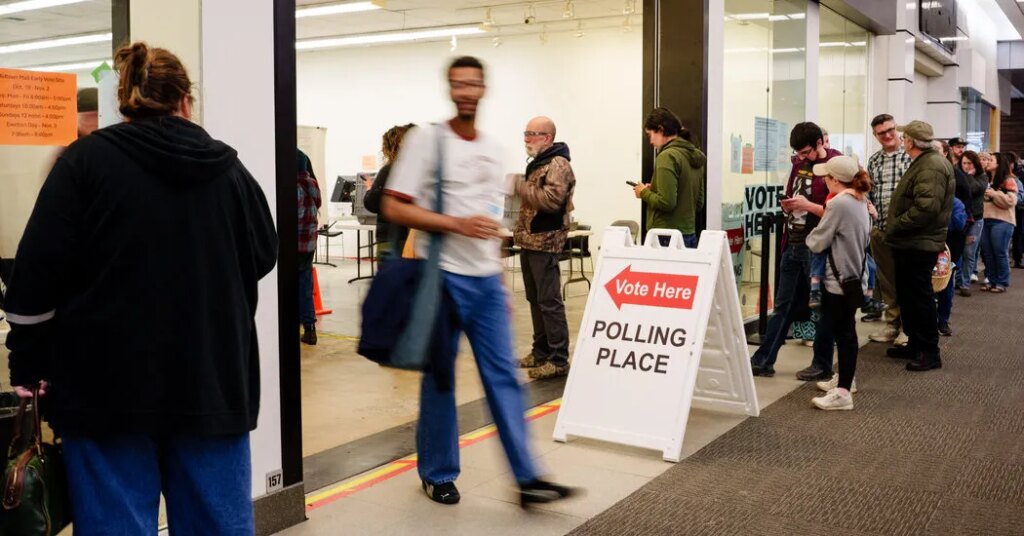
It’s Election Day in the United States, and the whole world seems to be remarkably engaged. I found myself discussing with a Welsh dentist the chances that Kansas will elect a Democratic senator for the first time since 1932. An Indian friend had a lot to say about Elon Musk spending nearly half a billion dollars to boost Republican candidates.
And of course everyone wants to know the outcome. Most polls show Democrats with a sizable lead, though polls have been wrong before. What would a big Democratic win mean for President Trump’s last two years in power? If his party loses, will he accept the outcome? The fact that this question now routinely hangs over elections in the U.S. is, in itself, amazing.
Last week, we asked you to send us your questions on the midterms, which are held halfway through a president’s term. You sent many, so thank you. We selected five and asked our colleagues who’ve been reporting on the elections to respond.
Your midterm questions, answered
What, realistically, could a Democrat-led Congress do to restrain Trump? — Keith Parr, France
Annie Karni, congressional correspondent:
If Democrats win back the House — the lower chamber of Congress — they will have subpoena power and will be conducting oversight and investigations into the administration. And they will have to consider whether it is worth their time and the political price that may come with moving forward with impeachment against cabinet officials, or the president himself. If they win back the Senate — the upper chamber — Democrats would also have the power to block any Trump cabinet appointments or judicial nominees.
They will also be in control of what bills come to the floor. And many Democrats think that some of the popular legislation they plan to bring up if they win the majority — like reinstating subsidies for people who buy the health insurance known as Obamacare — could attract some Republican support in the Senate. And even if Trump refuses to sign it, they see a political upside in forcing him to veto broadly popular legislation.
Can the federal government actually overturn results that they don’t like? — Elena Yee, United States
Devlin Barrett, who covers the U.S. Justice Department:
No. The Constitution gives the authority to administer elections to the states, not the federal government.
That doesn’t necessarily mean the administration won’t try to influence the outcome. In 2020, Trump urged state election officials in Georgia to “find” roughly 11,000 more votes to change the outcome there. That effort failed. This year, the administration has filed aggressive lawsuits seeking to assert greater control over the elections. To date, those suits have been resoundingly unsuccessful; most election experts and lawyers expect the administration’s ongoing legal gambits to continue to fail, even if they reach the Supreme Court.
The Constitution also does not grant the president sweeping emergency powers to affect elections. And there are laws on the books designed to ensure access to the polls and to explicitly bar armed federal agents from being present at polling stations.
Whatever the outcome, will it have any effect on tariffs and the Iran war? — Samarkant Kukreja, India
David Sanger, White House and national security correspondent:
Trump has enormous latitude when it comes to tariffs, no matter who controls Congress. And he has powers as commander in chief that mean he could keep forces in and around the Persian Gulf without Congress having much say.
But the fact is that the tariff policy hasn’t been very effective. And Trump himself has backed off somewhat, notably when he placed huge tariffs on Chinese imports and Beijing shot back by shutting off shipments of rare earths and magnets.
On the conflict with Iran, it’s more complicated. The House passed, and the Senate rejected (by a single vote), an effort to invoke the War Powers Resolution and require the president to pull American troops out of the region. He would have vetoed it, and there were not enough votes to override, so the vote was mostly symbolic. And that is unlikely to change.
But it’s notable that Congress has never approved the White House request for supplemental funds to pay for the Iran action. So at some point, it’s possible that Trump could run out of money for the war, meaning he would probably look for ways to move other funds to accomplish his goals.
Money talks loudly in U.S. politics. If Democrats win the midterms, is there any appetite to change this? — Andrew Levens, Britain
Theodore Schleifer, who covers money in politics:
No. I have been writing about this topic for a decade now, and each successive year I become increasingly convinced that the Democratic Party is equally bought-in on the status quo. In some ways, the left has leapfrogged the right in finding more creative ways to use big money in the political system, such as soliciting money through organizations that do not disclose their donors. The Democratic Party’s voters might say they want to see less money in politics, but the actual incumbent politicians are often advantaged by the current system, given how skilled the party has gotten at courting big donors. And so I do not think there is enough momentum to actually force change.
How likely is it that a Democratic win could signal success for Democrats in the presidential race? — Ilias Papounidis, the Netherlands
Lisa Lerer, national political correspondent:
A Democratic sweep in the 2026 midterms would indicate that voters are willing to give the party another look. But it’s far from a sign of certain victory in 2028.
Traditionally, midterm elections act as referendums on a president’s first two years in office. These races are no exception. Much of the Democratic strength appears to stem from deep unhappiness with President Trump. Majorities say they disapprove of some of his signature policies, including the Iran war, tariffs and aggressive immigration enforcement.
There are some bright signs for Democrats. Their candidates appear to be winning back Latino voters and young men, who swung to Trump in 2024.
But voters aren’t giving particularly high marks to the Democratic Party. Surveys indicate that there is still dissatisfaction with the party’s national brand. And some of the most successful Democratic candidates are working hard to distance themselves from Democratic leaders in Washington. So, even if their candidates win, Democrats still have plenty of work to do to persuade Americans to send them back into the White House.
-
Ultrawealthy donors: The biggest U.S. donors have spent $2 billion in the midterm elections.
-
Cost of living: Concerns about high prices have dominated the race, with many voters linking Trump’s policies with inflation.
-
The presidential weave: An A.I.-assisted review of Trump’s public statements found that he is more vulgar, uninhibited and incoherent than a decade ago.
Our U.S. politics coverage is still free in The New York Times app for a limited time.
MORE TOP NEWS
-
Iran said it was ready to reopen the Strait of Hormuz in two days if the U.S. agrees to its demands.
-
Israel’s president will begin consulting party leaders this week about who should be tasked to form the next government.
-
A Russian glide bomb hit a humanitarian hub in southern Ukraine, killing at least 24 people.
-
Britain’s legacy of slavery was at the forefront during King Charles’s visit to three former colonies in the Caribbean.
-
FIFA quietly paid millions of dollars in taxes for its president, Gianni Infantino, according to documents reviewed by The New York Times.
WHAT ELSE IS HAPPENING
-
A 20-year-old was a pilot on the private jet that crashed in Florida on Saturday, killing all nine people on board.
-
The media mogul Martha Stewart apologized for dressing up as a homeless person for Halloween.
-
An English adventurer returned home after completing a 28-year journey across the globe on foot.
TOP OF THE WORLD
The most clicked link in your newsletter yesterday was about Heidi Klum’s Halloween party.
OPINION
What’s next for Israel? Four writers talk through the election results.
The protests roiling Europe are an expression of generational futility, Anton Jäger argues. And they’re not likely to stop anytime soon.
Thomas J. Campanella writes about the long and messy history of the triumphal arch.
RESURGENCE OF THE DAY
“This Hour Has 22 Minutes”
This Canadian sketch show has been on the air for over three decades, roasting North American politics, culture and quirks. The program is having a surge in popularity after Trump’s threats toward Canada — and Canada’s “uncharacteristic blush of patriotism” in response. Get in on the joke.
MORNING READ
The Vatican owns no dedicated planes and has no equivalent to Air Force One, the plane that carries the American president. Instead, the pope always flies business class on charter flights operated by regular airlines. For more than six decades, ITA Airways (and its predecessor Alitalia) has been the Vatican’s preferred airline for the first leg of the pope’s foreign journeys.
Flights with the Holy Father aboard, however, are not ordinary flights. For one, they’re almost always on time, unlike over half of ITA’s other flights last year.
Leading the crew on more than 80 of those flights is Gennaro Anastasio, a senior cabin manager. Anastasio is preparing for the pope’s trip to Latin America, which is set to start on Friday. Read more about what happens on a papal plane.
AROUND THE WORLD
Speaking Hanbono in Japan
Korean words or slightly altered versions of them are increasingly being heard in conversations between young Japanese. Moeka Takamatsu, a student in Tokyo, said she often used Korean words like jinjja (really) and mianhae (sorry).
The phenomenon is called Hanbono, a portmanteau of the words Hanguko (Korean) and Ilbono (Japanese). During the Japanese colonial era, Koreans were pressured to adopt the Japanese language. Now the Korean language is seeping into Japan’s youth culture, thanks to the success of K-pop, K-dramas and world-renowned beauty products. Read more about Hanbono.
RECOMMENDATIONS
Refresh: A designer in London gave her dining room an easy upgrade.
Watch: “Closure” is a gorgeous, devastating documentary about a father looking for his son.
Discover: A new Georgia O’Keeffe exhibition shows a lesser-known side of her work.
Tone: You don’t need to put in hours at the gym to build a strong, stable core.
RECIPE
Tahchin is a buttery, almost cakelike Persian dish in which rice is mixed with yogurt, oil, egg yolks and saffron and then baked until a golden crust forms at the bottom (Iranians refer to this as the tahdig). It’s often layered with chicken and barberries, a tart dried fruit that has a beautiful crimson color.
WHERE IS THIS?
Where is this colorful medieval town?
TIME TO PLAY
Here are today’s Spelling Bee, Mini Crossword, Wordle and Sudoku. Find all our games here.
That’s it for today. See you tomorrow! — Katrin
We welcome your feedback. Send us your suggestions at [email protected].
The post America Votes appeared first on New York Times.