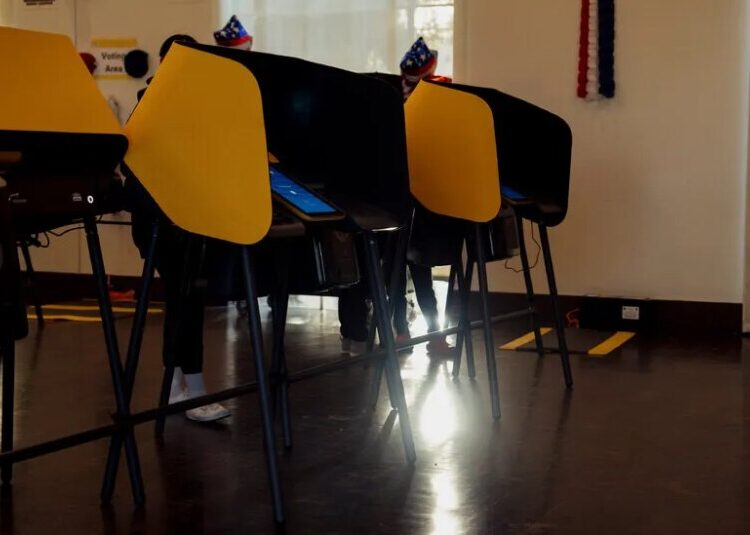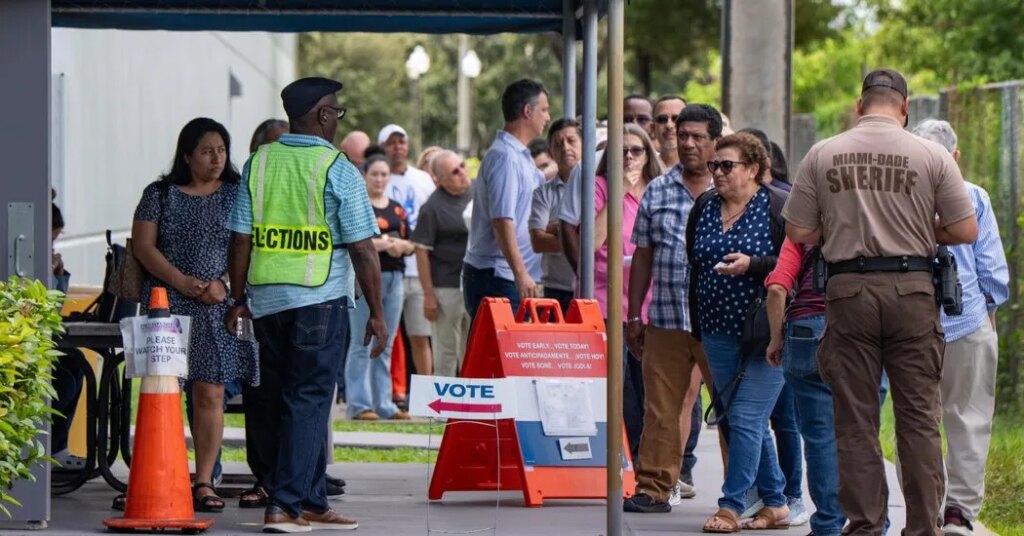
Americans will head to polling sites on Tuesday after a year in which President Trump has used the levers of the federal government to bolster unsubstantiated claims of election fraud.
Many election officials and Democrats have said they fear that the president’s attacks on the integrity of elections could lead to tensions as people vote, and to baseless challenges of the outcome. Local and state officials have even incorporated planning for potential federal intervention into their preparations for Election Day.
Nevertheless, it remains to be seen whether any worst-case scenarios will play out. And state and local authorities have emphasized that they are well prepared to help run a fair and safe election.
“The election officials in this country, the law enforcement in this country and other stakeholders are doing everything they possibly can to make sure that Election Day goes off without a hitch,” said Tina Barton, the co-chairwoman of the Committee for Safe and Secure Elections, an organization that has helped conduct election training sessions around the country. “Any incident that does happen is quickly mitigated because they already have a game plan for it.”
Here’s what voters should know:
Could the military or federal agents show up at polling sites?
Mr. Trump has notably refused to rule out invoking the Insurrection Act, in connection with the election. The 1807 law gives the president broad authority, under some conditions, to use the military to quell widespread domestic unrest. The extreme move has been encouraged by some of the president’s outside supporters.
In late August, however, the president’s top military adviser, Gen. Dan Caine, said there were no plans for the armed forces to deploy troops in relation to the elections. “I have neither received nor anticipate receiving any unlawful order concerning the role of the Joint Force in the upcoming November 2026 midterm elections,” he wrote in a letter to a Democratic senator.
Legal experts say federal laws also prohibit troops or armed officials from being deployed to polling sites, even if Mr. Trump were to cite the Insurrection Act. “Federal law unambiguously prohibits the presence of armed federal officers at the polls, unless necessary to repel an armed attack by foreign enemies,” according to the Brennan Center for Justice.
Some voting rights advocates have also grown concerned about the prospect of Mr. Trump’s deploying Immigration and Customs Enforcement or other federal agents to polling sites. The Homeland Security Department has played a leading role in trying to find noncitizen voters to support the president’s false claims of widespread illegal voting.
But federal officials have downplayed that idea. Speaking to reporters in September, Markwayne Mullin, Mr. Trump’s homeland security secretary, said it was not the job of immigration agents to patrol polling places. He said they would be dispatched only “if there is a threat to that polling place or we’re serving a warrant on someone that we have been actively tracking down.”
Some election experts have noted that ICE agents are regularly dispatched on American streets as a part of their routine work, and that the mere sight of them near polling places could lead to misreporting on social media and cause fears among voters. They encourage members of the public to report concerns to poll workers or to election hotlines.
What role can Justice Department monitors play?
The Justice Department expects to have roughly 1,000 election monitors deployed in all 50 states on Election Day, according to Harmeet Dhillon, the head of the department’s civil rights unit. That is an expansion of past efforts, in which a smaller number monitors focused on states and city jurisdictions with a history of voting problems.
In an interview in August with Bloomberg, Ms. Dhillon said that the monitors would be deployed to places “where there may be language issues, the places where there may have been access of disability rights issues, places where there may be voter fraud issues that we’ve seen.”
The overall goal, she said, is “increasing all American citizens’ confidence in our elections.”
The large deployment by the Justice Department, which has promoted contested claims about election fraud and sought to preemptively challenge the results in the Alaska Senate race, has worried some local election officials. In recent days, some jurisdictions have issued statements saying that monitors are prohibited from crossing into an established perimeter surrounding polling locations, citing state law. Those laws vary by jurisdiction.
A Justice Department spokeswoman said that federal monitors did not require approval from state or local authorities, but added that monitors were trained to follow local laws that govern access at polling sites.
The Justice Department monitors will also not be authorized to make any arrests, a department lawyer said on Monday at a court hearing in Washington.
In nearly every place in the country, Justice Department monitors must follow the state regulations that apply to any visitors to polling places, including prohibitions on interfering with voters or intimidating them, said Justin Levitt, a law professor at Loyola Marymount University who formerly worked as an adviser on voting rights in the Biden White House.
The rules are different for a separate category of federal observers, he added: monitors sent by the U.S. House of Representatives. Those observers have also been present at U.S. polling places for decades. Their job, according to the Committee on House Administration, which provides credentials to the observers, is to “ensure that conduct of the election was free and fair.”
Could there be issues with voting machines?
Election machines are heavily monitored and regulated through testing and certification by federal agencies, states, local election offices and private labs.
In recent elections, however, rumors about “vote flipping,” in which voters’ choices are incorrectly logged, have gone viral on social media.
Election officials say that many of these problems are the result of user error. A recent examination of the issue by PolitiFact determined that “there is no evidence of voting machines deliberately designed with such flaws or that it is happening on a wide scale.”
“Historically, these types of rumors emerge from poorly designed or malfunctioning interfaces (and occasionally user error) but are often misleadingly framed as intentional attempts to switch votes instead of rare errors with remedies,” according to the Election Rumor Research team at the University of Washington’s Center for an Informed Public.
Still, Mr. Trump and top administration officials have continuously promoted false claims that voting machines can be manipulated. Earlier this year, Mr. Mullin asked the Justice Department to examine whether a commonly used voting machine could be trusted. And Mr. Trump last month met with Tina Peters, a former Colorado county clerk who was convicted of tampering with voting machines after the 2020 election. Ms. Peters has called on Mr. Trump to inspect or seize voting machines — a move that legal experts say would be an overreach of federal authority.
Election experts said the public should be wary about any claims they see online about widespread irregularities with voting machines.
“It’s really important, first things first, for people to not spread unverified reports on social media about things that they’re seeing,” said Gowri Ramachandran, the director of elections and security at the Brennan Center for Justice. “It’s much better to, you know, let a poll worker know.”
Devlin Barrett and Eileen Sullivan contributed reporting.
The post What Voters Should Know About Possible Problems at the Polls appeared first on New York Times.