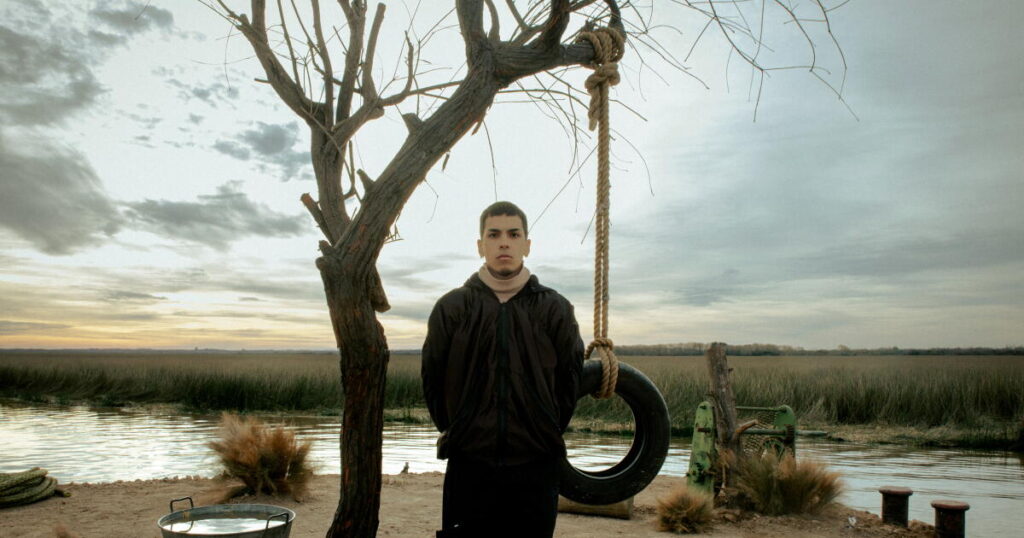
Argentine MC Milo J may be on the precipice of 20 when we meet, but on a cool October morning in L.A. as he approaches me inside a hotel lobby on the famous Sunset Strip, he carries the calm demeanor of a seasoned superstar.
The wordsmith, born Camilo Joaquín Villarruel in Buenos Aires, is not alone, of course. A small posse of lifelong friends keeps the conversation lively while shooting a documentary about his current tour and promo trip.
Milo’s mother, Aldana, who is also his manager, smiles warmly when I tell her how proud I am that a fellow Argentine has released such a transcendent album: last year’s “La Vida Era Más Corta.” We’re also joined by the managing director of Sony Music Argentina, as well as Milo’s full PR team.
“Experiencing all this by myself wouldn’t be easy,” says Milo.
Needless to say, expectations are high. He’s nominated for six Latin Grammys this year — among them five artist awards, including for record, album and song of the year, as well as an industry award for recording package.
The album, of which the title translates to “Life Was Shorter,” is the kind of layered, virtuoso manifesto that has the power to redefine a genre. Produced by tastemakers Tatool and Santi Alvarado, it resettles Milo’s gravelly voice away from the trap context that made him famous as a teenager and into the smoldering soul of South American neo-folk; the crackle of acoustic guitars framing narratives of broken childhoods and making peace with life.
Nominated for record of the year, the track “Niño” is a devastating lullaby. A duet with rapper Trueno, “Gil” — also nominated for urban performance — rolls and grooves with joyful abandon. “Luciérnagas” guests Cuban nueva trova icon Silvio Rodríguez, implying that Milo has been chosen to carry the torch.
Milo followed it with a smash Tiny Desk session in April, and “La Jangada,” a newly released live album taped in front of the Río de la Plata, with special guests such as Chilean diva Mon Laferte.
The singer spoke to De Los about the challenges of his generation, the pressure of early fame and his future in music.
What records were playing at home when you were growing up? We lived in my grandmother’s house, the place where she herself had grown up. There were all sorts of records there. I remember a Kapanga one, and Bersuit Vergarabat’s “Hijos del Culo,” with the little girl on the cover. Tons of Ramones stuff. We had a lot of rock records, but with a conceptual, party vibe. Later, my sister Alma got me into rap.
“La Vida Era Más Corta” has a very warm sound, with your voice leaping out of the speakers. How did you create that effect? It’s a very nostalgic record, and I think everyone interprets it in a different way. It also belongs to a specific moment in the music industry where we’re all trying to get back home. My generation doesn’t know what it wants, so we gravitate to the sounds of childhood. In my case, it’s the rioplatense identity and the murga vibe. The folk vein arrived later, as it wasn’t part of my life when I was little.
Something I love about artists like you and Akriila: you refuse to become prisoners of the urbano genre. Was that a conscious decision? I don’t think about it that much. But I’ve always loved to experiment, and my latest album will always mirror the music that I was listening to while recording it.
It’s interesting, because I made my previous record, “166,” while I was already working on “La Vida Era Más Corta.” I think there is a fan base ready to assimilate the message that I want to deliver, no matter what shape it may take. It’s getting harder to classify music genres — I think that’s a positive change.
I see “La Vida Era Más Corta” as a message of hope. Sure, life is short, but there is so much beauty in it. There’s a lyric in the title track that sums up the message: “You thought that life was shorter in order to fulfill the promise of loving us forever.” You know how saying that life is short implies a pessimistic viewpoint, something that precludes you from enjoying the present. This record goes against that line of thinking. Sure, it’s bleak, but also a bit hopeful. The glass is half full, and listeners can interpret it as such.
There’s also hope in the fact that it’s such a gorgeous record. If I live longer, I will be able to listen to more beautiful records like this one. So waking up tomorrow is worth it. What a great perspective! I’ve said before that I have high hopes for my generation. I get very emotional about everything, both the good and the bad. This is reflected in my music.
Let’s talk about “Gil,” your collaboration with Trueno. It’s such an infectious, rollicking tune. That’s a marcha camión from Uruguayan murga, but mixed in with bossa nova. We wrote it in early 2024, when we held the first song camp for the album and decided to experiment with Andean sounds. “Gil” just showed up, and we were like, ‘What’s up with this tune?’ Sometimes you come up with a song and have no control on how it materialized. The entire album was made by Tatool, Santiago Alvarado, and myself. The combination of our three creative personas is surprising. It’s a song about sorrow, but at the same time, it lifts you up.
Something that annoys me: everybody asking you how you managed to make such a mature record at 19. The time has finally come to admit it [laughs] — yes, it annoys the hell out of me too. I think the real surprise is that someone of my generation would be capable of making an album like this one. And I couldn’t disagree more. It’s such a big lie. My generation has a huge message to share. We’re completely overwhelmed by a long history of unexplainable sorrow. And capable of coming up with concepts that have never been heard before. So yeah, the age question pisses me off.
It’s the kind of record that could generate feelings of jealousy, because it’s such a huge, generous album. It has sparked conversations that go beyond the record itself, and I think that’s positive. I’m not sure about jealousy, but I focus on the good messages. “Look, Milo, I tattooed this phrase on my arm.” “You saved my life with these songs.” [That’s] the stuff that the right people tend to say. If I schedule a concert, those who buy a ticket to see me are the right people.
What steps do you take to preserve yourself from the people who criticize you? You know when you have a friend and realize that they’re talking [from] a place of anger? Something similar happens to me with the people who criticize me. I started putting my music out there when I was 15, and the negative comments affected me. I’ve learned not to pay attention anymore. I made this album with a very specific intention, and many people understood it. I’m also surrounded by an amazing team, and they help me out. Experiencing all this by myself wouldn’t be easy.
I always go for long walks by the river with my friends when I’m in Buenos Aires. I love that you used the river as the visual backdrop of your new live album. This is my third live project, and I wanted it to be different. We were lucky to experience that lovely sunset when we shot the session. It rained every other day except that one, and we recorded everything in one take. It’s a very Argentine motif: the tradition of enjoying the landscape around us.
Have you started thinking how you will follow up such a momentous record? It was actually during this trip that I finally realized the story that I want to tell next. I’m not going to tell you what it is, but it definitely won’t be “La Vida Era Más Corta” Volume 2. I don’t think my next project will blend urbano with folk so literally, either. I’ve been going to the studio in my spare time and writing new songs. There’s always something brewing, but it’s going to take some time.
The post Latin Grammy nominee Milo J charts a new course for Argentine music appeared first on Los Angeles Times.