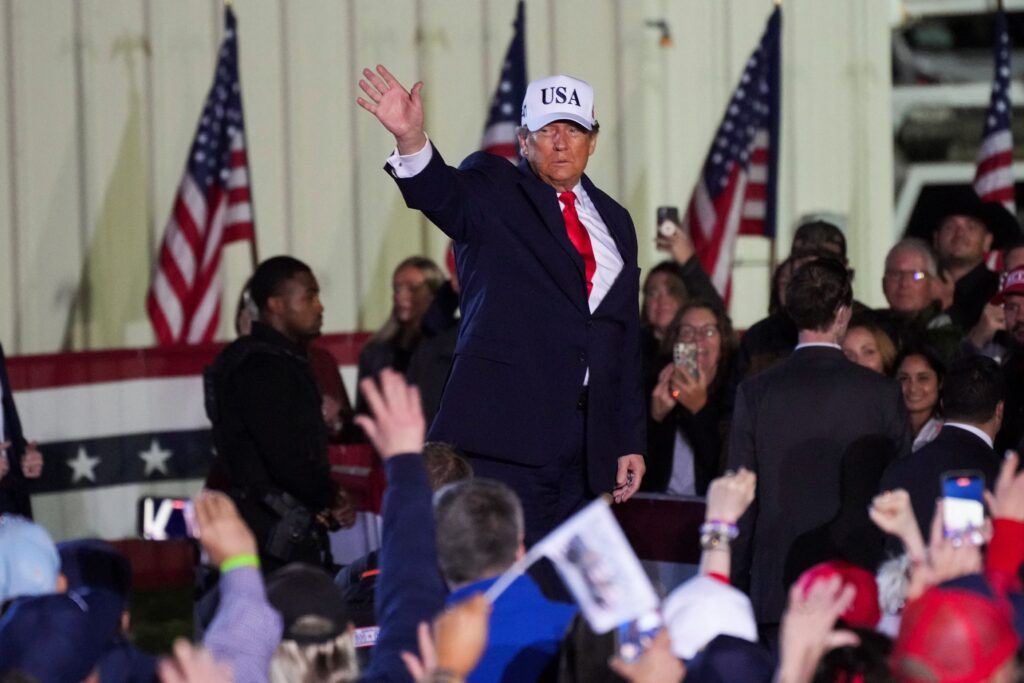
For 11 years, President Donald Trump’s raucous rallies have offered a signature spectacle to a political movement that remade the Republican Party and then the country. As Election Day approached, Trump appeared to be contemplating the end of an era.
”I’m closing it down tonight,” Trump said Sunday as he opened his final rally in Salina, Kansas, before the midterm elections. “This is it.”
With 30 events in 32 days, Trump’s rallies in this midterm campaign have underscored his enduring dominance of the Republican Party and his determination to make himself the center of the election debate.
The rallies provide a unique mix of politics and entertainment, combining the theatrics of a rock concert, the fervor of a Christian revival and the fierce loyalties of a sporting event. In 2026, they have offered Trump a refuge from the political challenges confronting his presidency. (Though the bubble is punctured occasionally by protesters and empty seats.)
But as Trump approaches the lame-duck phase of his presidency, he has begun contemplating a future without the friendly arenas where his historically low approval ratings disappear beneath the roar of thousands of adoring supporters.
Trump on Sunday night celebrated the rally as “a unique thing that’s taken place.”
“We’ve been doing this for 11 years, and there’s never been anything like it, and there probably never will be again,” Trump said before closing his speech at Salina Regional Airport in Kansas. “There’ll never be the crowds. There’ll never be the feeling.”
The rallies have changed little since Trump first drew tens of thousands to a Mobile, Alabama, football stadium in 2015. Today’s crowds are smaller and sometimes more subdued, but whether Trump is visiting ruby-red counties or battleground states where his presence could complicate the prospects of Republican candidates, the soundtrack, the grievances and elaborate rituals run on repeat.
As thousands of supporters pour into college arenas and community entertainment centers, speakers blare Elvis Presley, Frank Sinatra, Sinéad O’Connor and selections from Andrew Lloyd Webber musicals. Supporters in MAGA hats and T-shirts bearing the president’s likeness cheer as administration officials enter the arena. Supporters, ranging from senior citizens using walkers to parents holding young children in their arms, wait in lines for hours to see the show.
Then a video begins to play, portraying Trump as a messianic figure chosen to save the country.
“And on June 14, 1946, God looked down on his planned paradise and said, ‘I need a caretaker.’ So God gave us Trump,” the narrator declares, as a baby picture of the president appears on the screen.
The opening strains of Lee Greenwood’s “God Bless the USA” signal Trump’s entrance. He surveys the crowd, often swaying to the music, sometimes tossing souvenir hats to the audience, before launching into his speech.
No two speeches are exactly alike, but the rallies follow a familiar set list, typically lasting about 90 minutes, although at an early evening rally in Dubuque, Iowa, on Sunday, Trump spoke for a near-record two hours and two minutes. Trump urges supporters to pretend he is on the ballot and remarks on the number of “fake news” reporters in attendance. His personal attacks and disparagement of the Democrats draw boos and jeers from the crowd. He almost always boasts of the military’s swift capture of Nicolás Maduro in January and insists that the war against Iran is going fine and will be over soon.
He recently expanded the script to include an unusual focus on what he insists is the handsomeness of his political allies, with frequent notes on male posteriors.
He frequently dangles economic incentives, including a promise of $5,000 checks for every adult citizen if Republicans retain control of Congress. Even some of the president’s supporters have expressed skepticism that the checks will be distributed.
On Sunday night, he said people could spend those checks at Mar-a-Lago, but warned that “unfortunately at Mar-a-Lago at $5,000, all you get would be one hamburger and a very small dessert. So I would say that’s probably not a wise, that’s not a wise choice.”
The speeches always end with the same refrain, as Trump rattles off a series of promises to make the country powerful, wealthy, healthy, strong and, finally, “to make America great again.”
Then the Village People’s “Y.M.C.A.” begins to play. Trump pumps his fists and sways his hips, his feet planted in place, as supporters cheer, reach toward the stage and raise their phones to capture one of the most recognizable rituals in American politics.
Along with their stock theatrical bits, the rallies also come with stock villains, including the Democratic Senate candidates Abdul El-Sayed of Michigan and James Talarico of Texas and Rep. Ilhan Omar of Minnesota. As the campaign has stretched on, Trump has focused more and more on them, sometimes going for long stretches without mentioning the local candidates he traveled to support.
Long criticized for their inflammatory rhetoric, violent episodes and cult-like atmosphere, Trump’s rallies have offered a particularly stark display in these final weeks before Election Day.
He has repeatedly attacked El-Sayed, as a “jihadist” and accused him of being a member of the Muslim Brotherhood, which El-Sayed has repeatedly denied and for which Trump has offered no evidence.
“If you’re Black or if you’re Jewish, and if you vote for Abdul, you’re crazy, okay?” he said at a rally last week in South Carolina and repeated Sunday in Dubuque. “You’re crazy. Yeah. You’re crazy anyway.”
Also in South Carolina, he called Sen. Darline Graham’s Democratic opponent, Dr. Annie Andrews, “tranny Annie” as Republicans attacked the pediatrician’s record on trans issues. He has repeatedly referred to Talarico as “Talafreako” and claimed he’s “puking all over the place” as part of a routine where he alleges Talarico is a secret vegan who gets sick from eating BBQ. Talarico has repeatedly denied being a vegan.
He’s focused extensively on Omar, a Somali American member of Congress. At the final rally in Kansas, he again claimed that she had married her brother. Omar and her representatives have denied the allegation, calling it a baseless conspiracy theory.
He called Adam Hamilton, a Methodist pastor challenging Sen. Roger Marshall (R-Kansas), a “pervert” during an October rally and claimed that the pastor “openly mocks Jesus.”
At that same rally, Trump used an antisemitic slurto defend Marshall’s aggressive medical-debt collection lawsuits.
On Sunday night, Trump referred to Hamilton as a “possibly perverted pastor or pastor that’s caused a lot of problems with this church.”
He has at times egged on supporters’ violent responses to protesters who interrupt him. At Clemson University in South Carolina, Trump praised an attendee for punching a demonstrator who was being escorted out of the venue.
“That was great, man. Wow. Man, I loved that,” Trump said, comparing the person who threw the punch to former heavyweight boxing champion Evander Holyfield.
In Kansas on Sunday, Trump spoke in front of an enthusiastic and especially young sea of people, including a baby, children and many supporters under the age of 30. The crowd repeatedly broke into chants of “USA” as Trump spoke.
“I wanted to make you the last, but the best,” Trump said.
The president’s voice grew raspier as he delivered his final rally speech.
“When God made vocal cords, he didn’t make them to do 30 rallies,” Trump said.
At some of his events in October, Trump suggested that he would wear a brick suit for his final rally, in an homage to Blake Marnell, a supporter who attends almost every rally wearing a brick-patterned suit to symbolize his support for a border wall with Mexico.
“I’m gonna wear that suit one day,” Trump said Sunday. “It can’t be for this particular group, cause, Mr. Senator, I’m closing the sucker down. I’m getting out of here. I gotta get a little sleep. I’ve been doing little too many of these.”
Doyle reported from Salina, Kansas.
The post Trump faces a future without the rallies that made him a political force appeared first on Washington Post.