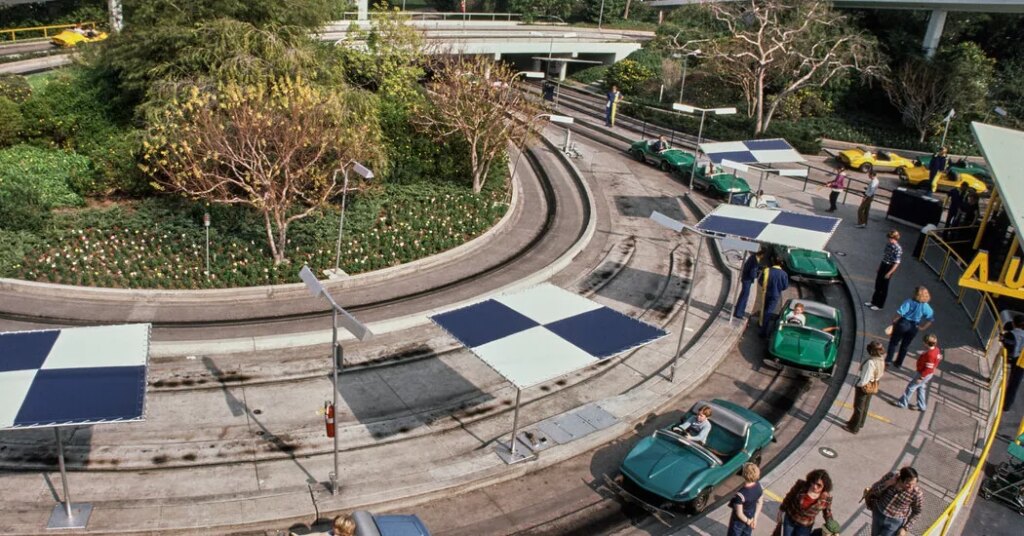
In 1955, Walt Disney’s vision of the cutting edge came in the form of 40 candy-colored miniature cars that allowed pint-size drivers to push a real gas pedal and steer around a track at the Anaheim theme park.
Autopia, a focal point of the Tomorrowland section of Disneyland, mirrored the real-life love affair that Americans were having with the automobile. Work would soon begin on the interstate highway system, suburbs were expanding, car sales were skyrocketing and the future felt like a shiny coupe, windows down, speeding along an open road.
But Mr. Disney’s midcentury vision of the future has run up against today’s environmental reality. Autopia, the only surviving original attraction at Tomorrowland, is in violation of California’s stringent emissions regulations.
So now, after 71 years, Autopia is going electric.
The cars currently run on 8.5 horsepower Honda four-stroke engines like those typically used to run generators or industrial pressure washers. They are loud and belch exhaust for up to 16 hours a day. The result is a microclimate of smog hovering over Tomorrowland, a section of the park that includes rides like Space Mountain and Buzz Lightyear Astro Blasters.
Sometime next year, the gasoline powered engines will be phased out and Autopia will join the age of E.V.s.
Disney arrived at this decision after the powerful California Air Resources Board issued a notice of violation against the company in 2024, stating that it had not obtained the proper emissions certification for the Autopia cars.
In a settlement between Disney and the state, the company paid $56,250 and agreed “to retire the gas-engine powered Autopia fleet” by early 2027. Disney declined multiple requests for comment, and declined to permit The Times to take photos or videos inside Disneyland for this article.
Bob Gurr, who designed the attraction for Walt Disney, said the move was overdue.
“For 26 years, I’ve been arguing, ‘When are you going to do anything to get rid of that gasoline?’” said Mr. Gurr, 94, in a phone call from his home in Los Angeles. “The dirtiest place on Earth is the Autopia attraction at Disneyland in the city of Anaheim.”
After the interview, Mr. Gurr’s representative asked to retract it, saying Disney had requested Mr. Gurr stop doing interviews about the ride he designed. Mr. Gurr did not ask for the interview to be off the record, or not to be published.
Autopia has been running more or less interrupted since Walt Disney christened the park in 1955. Different designs and sponsors, including Honda, Chevron and Richfield Oil, have come and gone. By 1971, the company said some 47,756,550 people had taken a spin on the track. At that pace, total ridership today may have now eclipsed 210 million people.
An anachronism in a world of fully immersive high-tech rides, riding Autopia is not unlike strapping a lawn mower to one’s head. It is a jerky, stinky, noisy ride.
Adriel Ceja, an Angelino who was visiting the park with his wife on a recent day, said the ride seemed outdated.
“It would be more modern and feel better for Tomorrowland if it was an electric car,” he said.
Other Disney parks have featured similar rides over the years, including gas-powered versions in Tokyo and Paris, and an electric version in Hong Kong that closed in 2016. At Disney World in Orlando, Fla., an Autopia facsimile is called Tomorrowland Speedway, and still features gas-powered engines, with no known plans to go electric.
But in California, the state with the most E.V.s on the road, Autopia is finally saying goodbye to the internal combustion engine.
Mr. Gurr said that earlier this year, executives from Disney invited him to a facility and showed him a model of the new Autopia. The track will be electrified, he said, which would obviate the need for each car to have its own battery.
“It will be electric, but not the conventional idea of a battery in a car,” Mr. Gurr said. “It’s very different.”
Mr. Gurr said he was told that Honda would continue as the sponsor, but Honda declined to discuss its plans.
“Our current sponsorship agreement with Disneyland Resort runs through early 2027,” Matt Howells, a Honda spokesman, said in an email. “Discussions regarding the future of the partnership and sponsorship of the Autopia attraction are currently ongoing.”
Like other carmakers, Honda is scaling back its E.V. sales in the United States, after Republicans in Congress ended federal subsidies designed to increase electric vehicle sales, and amid the Trump administration’s efforts to promote gas-powered cars.
Honda’s only all electric model currently on the market, the Prologue, is set to be discontinued next month, and the company has not announced a new E.V. for the U.S. market.
Like many Disney rides, Autopia has inspired legions of ardent fans. Chief among them is Peter Menotti, who first encountered the ride as a boy and was immediately transfixed.
“I don’t know how to describe it, man,” said Mr. Menotti, a 59-year-old Disney superfan who runs a 3-D printing company in Los Angeles, recalling his first ride. “It’s just this feeling as a kid that I’m empowered, I’ve got a car, I can drive, I’m growing up.”
In 2001, Mr. Menotti bought a decommissioned Autopia car and spent $65,000 refurbishing it.
A friend who worked at Disney smuggled out original schematics for the car, which allowed Mr. Menotti to create a meticulous restoration, replete with a 3-D-printed steering wheel and a suspension system that allows him to navigate speed bumps.
One crucial difference: the speed of the cars at Disneyland tops out at six miles per hour, while Mr. Menotti’s roadster can travel at up to 18 m.p.h.
Mr. Menotti keeps his Autopia car covered in a tarp in the garage of his home near the Los Angeles International Airport, taking it out for the occasional drive.
On a recent afternoon, he revved up the motor and sped through his neighborhood with a reporter in the passenger seat.
“That’s part of the magic,” he said as fumes filled the air. “It’s that gas smell that takes you back. Without that buh-buh-buh-buh-buh sound, it’s just not the same.”
As for what’s next in Tomorrowland, Mr. Menotti said he would still be a fan, even if Autopia is all electric.
“Would I like it to stay the way it is? Yes,” he said. “But they’ve got to do what they’ve got to do. I mean, we’re moving into the future.”
The post After 71 Years and a Lot of Exhaust, Disneyland’s Autopia Goes Electric appeared first on New York Times.