California billionaires waging an epic fight against a ballot measure that would tax their wealth have outspent their opponents on advertising by more than 250-1 as it heads to Election Day, a Washington Post analysis shows.
“Building a Better California,” a coalition funded by Sergey Brin, Eric Schmidt and multiple other billionaires, has spent more than $148 million to defeat Proposition 40. In total, opponents have raised more than $379 million to kill the “Billionaire Tax Act,” making it one of the costliest electoral battles in the history of California, where ballot campaigns that spend more than $100 million have become almost routine.
“It will be the most expensive ballot measure in the history of the world,” said David McCuan, a political science professor at Sonoma State University, north of San Francisco, who has studied ballot initiatives for 20 years. “Sergey Brin alone put in $102 million. No one has given nine figures on a ballot campaign.”
It’s not just billionaires who oppose the measure. So does California Gov. Gavin Newsom (D) and the Democratic Party’s candidate to succeed him, Xavier Becerra, who argue the tax will hurt the state’s economy by causing billionaires to leave.
Until recently, however, neither the money nor the opposition from prominent Democrats seemed to move the needle. Poll after poll found voters supported the tax by a good margin.
But history shows that most voters don’t focus on ballot measures until the final few weeks of the campaign, and when they do, they more often than not sour on contested proposals. As the advertising has ramped up, support has dropped. A new poll by the University of California at Berkeley’s Institute of Governmental Studies, co-sponsored by the Los Angeles Times, shows it is paying off, with 50 percent of likely voters intending to vote against the measure and 42 percent for it.
“The strategy has been to blanket the airwaves in weeks three and four, and carpet-bomb the airwaves in the last two weeks,” McCuan said.
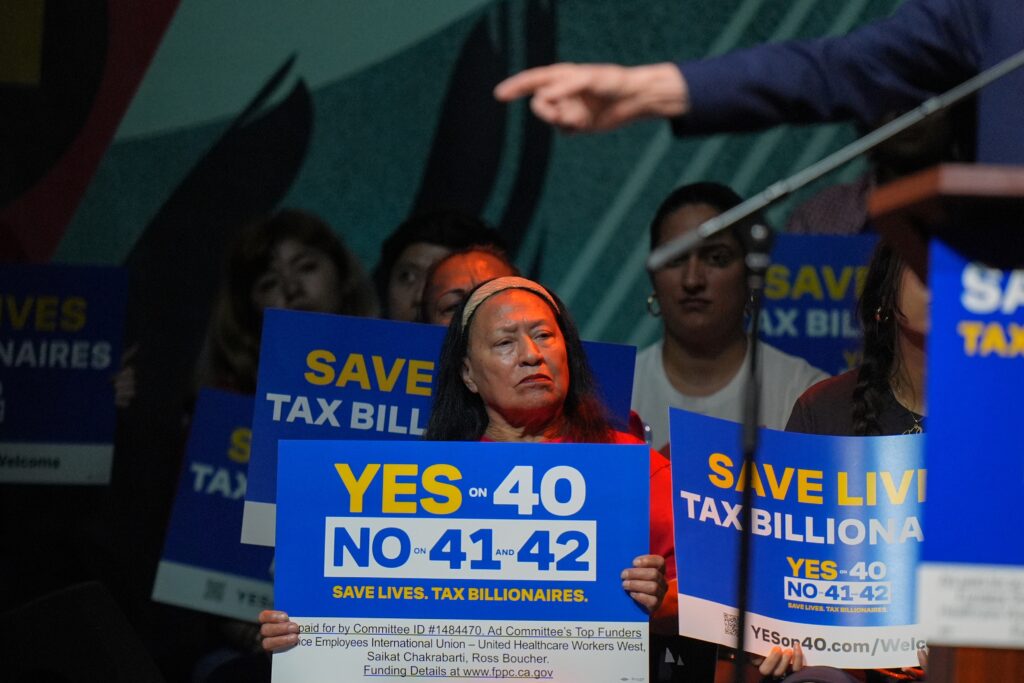
Proposition 40 was launched by David Regan, the president of the health care union SEIU-United Healthcare Workers West, to offset massive funding cuts signed into law by the Trump administration that could knock 2 million residents out of health insurance. It would impose a 5 percent tax on California billionaires’ assets, including their stock portfolios.
The measure would allocate 90 percent of the revenue to Medi-Cal, California’s implementation of the federal Medicaid program, while 10 percent would be steered toward education and food assistance.
Researchers estimate roughly 240 billionaires were living in California as of Jan. 1 and had a combined $2.05 trillion in wealth, far more than in any other state and all but a few nations.
The tax would apply to people with California residency as of that date who have more than $1 billion in wealth. That includes their investments, stocks and businesses but excludes real property as well as most pensions and retirement accounts except for Roth IRAs and other Roth-type arrangements exceeding $10 million.
Wealth tax advocates say it would generate an estimated $100 billion in tax revenue. Researchers at Stanford University’s conservative-leaning Hoover Institution estimate tax revenue at about $30 billion.
A nonpartisan analysis for the California Legislature found that it is hard to predict just how much the state would collect.
Regan, the initiative’s architect, says the money would be a “rounding error” to the state’s billionaires, who he says are fighting it out of spite.
“This has no effect on their lives,” he told the progressive talk radio show “The Majority Report.” “This is a group of people who never have to be accountable to anybody, who never get told ‘no’ by anybody. And here we have regular Californians saying you have to do a little bit to give back to the state that has produced this enormous fortune.”
Opponents say the tax will drive billionaires out of the state and lead to hundreds of millions in tax revenue loss.
Brin has said he worried it was socialism taking root as it did in the country where he was born, the Soviet Union.
“I don’t want California to end up in the same place,” Brin told the New York Times.
The Stanford analysis from economist Joshua D. Rauh estimates this could strip California of as much as $5.8 billion annually in income taxes. The nonpartisan analysis from the legislature estimates annual revenue would probably be reduced by less than $1 billion per year.
Interest groups from many sectors have come out against Prop. 40 based on this concern, including Planned Parenthood, the California Teachers Association, California Medical Association, California Professional Firefighters, as well as numerous construction trade unions, chambers of commerce and advocates for affordable housing.
Wealth tax advocates, including economists Gabriel Zucman and Emmanuel Saez, whose research laid the groundwork for the initiative, say it doesn’t make sense that billionaires would upend their life to leave the state now, when it wouldn’t even help them avoid it.
But some billionaires have already left, including Google co-founders Brin and Larry Page, even as Google itself remains in the Silicon Valley. It’s unclear exactly when they moved, but according to Forbes, Brin was still a resident after Jan. 1, meaning the tax would apply to him.
Mark Zuckerberg, who told the board at Meta he was exploring moving out of state, made a deal to let him sell stocks to pay the tax if it passes while retaining absolutely control of the company.
At least 29 California billionaires, according to an analysis of Secretary of State data and the Forbes billionaire list, are vying to sink the measure in a three-side attack: direct opposition to Prop. 40, and funding two other propositions, 41 and 42, that would nullify the tax if either one of them received more votes.
Proposition 41 would prohibit the state from collecting any tax revenue that was exempt from state spending limits, which the billionaire tax would be.
Proposition 42 would prohibit taxes on “personal property, including the ownership or control of retirement holdings, individually owned assets, and other forms of personal savings.”
The ACLU of Southern California has called both initiatives “deceiving measures” that hide their true aim, of sinking the tax.
So what does $379 million get Prop. 40 opponents? Polling, lobbying politicians, robocalls, mass texts, mailers — and a flood of ads.
The billionaires and other foes of the tax have spent $148 million on ads, compared to a mere $572,000 spent by supporters, out of $35 million raised, a Post analysis of AdImpact data up to Friday shows. (A person in the pro-Prop. 40 campaign said that ad spending will have jumped to about $2 million by Tuesday. The anti-tax numbers will likely have jumped as well.)
With such a vast disparity in spending, the airwaves and streaming services are crammed with ads carrying messages that have little do with billionaires: Prop. 40 will open the door for bureaucrats to tax your wealth no matter how much you make. It will gut the state budget, destroy health care and ruin the innovative spirit of the state.
As McCuan puts it: “The message is: If Prop. 40 passes, health care will end in California, gravity will end, air will end.”
Prop. 42, on the other hand, would stop Sacramento politicians who are threatening to tax your retirement savings (with no mention that its biggest effect would be to nix the billionaire tax.)
One AI-generated advertisement that surfaced on Facebook and Instagram in August shows a massive pink piggy bank with “billionaire tax” sketched into its side resembling a Trojan horse with sneaky bureaucrats hidden inside.
The pig is wheeled down a typical suburban California street by a man with long, disheveled white hair who bears an uncanny resemblance to Bernie Sanders, a prominent supporter of the tax.
“Buried in the 32-page bill, they snuck in a provision that allows them to turn the tax on you,” a narrator bellows before the pig breaks open and agents donned in suits pillage the neighborhood, taking a television from an old lady, a scooter from a kid and a stroller from a mother.
While the measure does empower the California Legislature to lower the threshold for the tax, it requires a two-thirds vote of each legislative chamber. As Los Angeles Times columnist Michael Hiltzik points out, it’s the same requirement for any change to the tax code.
Joel Slemrod, a University of Michigan economics professor who studies tax policy, said he was concerned about the requirement of individuals to disclose their full wealth.
“There’s a privacy issue,” Slemrod said. “Does the government have the right and can we trust the government to have information about the wealth of individuals?”
While opponents say this disclosure will be required for everyone, it is not clear how the state Franchise Tax Board would implement the measure.
The relative wealth and number of billionaires, many of whom have long skirted income taxes, have exploded in recent years and so have their political donations.
A Washington Post-Ipsos poll from last year found a majority of Americans have a negative view of billionaires spending more money on elections, however they are split on whether they think billionaires’ impact on society is negative.
For months, polls showed Californians favored the billionaire tax.
The Public Policy Institute of California found in May that 54 percent of likely voters would vote for it and 45 percent would vote against it. Its polls in September put the measure at 52 percent and 46 percent, respectively.
But the latest poll in mid-October and in late October from Berkeley IGS Poll found that voters had soured significantly on the measure, with voters disfavoring it by a six- and eight-percentage-point lead.
The stakes are high at a time of great income disparities, not just in this state. Policies that start in California have a long history of migrating east.
Scott Clement and Hannah Knowles contributed to this report.
The post California’s mega-rich have outspent foes 250-1 to sink ‘billionaire tax’ appeared first on Washington Post.