Is it safe to say that Gen Z has mastered the art of ironic detachment? Young people speak in absurd riddles and pair acid-soaked jokes with dead-eyed stares.
No current event is too sober for their particular brand of dark humor: not a pandemic, a papal conclave or a deadly war with Iran. If their big siblings served up earnestness in the form of millennial optimism, today’s 20-somethings seem content to joke online that they need lobotomies, and that they will get them at an earring store called Claire’s.
Maybe all the gallows humor reflects a deep cynicism about this political moment. In a recent Harvard Youth Poll, just 9 percent of 18 to 29-year-olds said they believed the country was headed in the right direction.
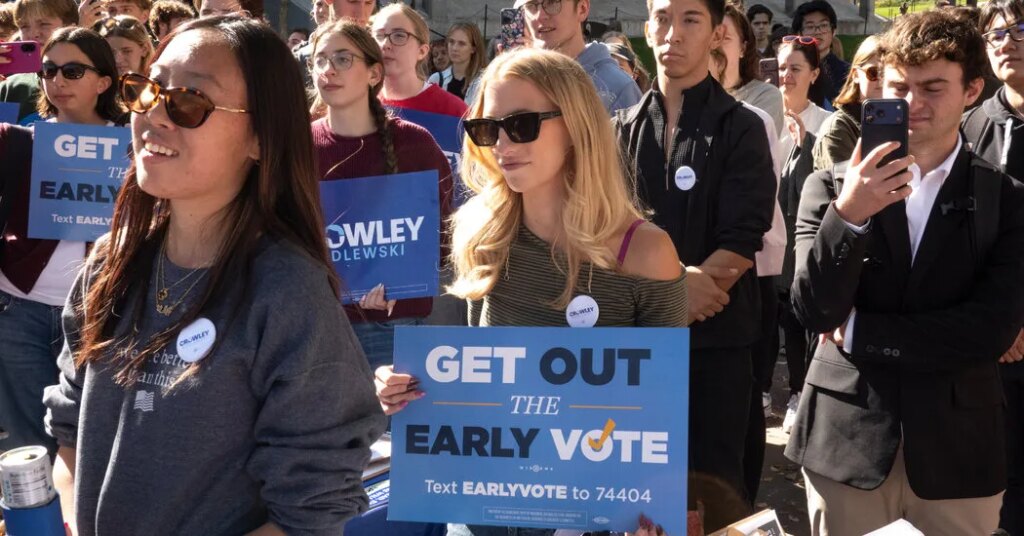
But lately it has seemed as if Gen Z’s apparent apathy might just be the crust atop an ooey-gooey core. When it comes to politics, the generation that calls everyone else “cringe” has been placing a fresh emphasis on sincerity — in deed, if not in TikTok post.
Maddie Block, 29, saw a wave of earnestness sweep through young, progressive New Yorkers who were energized by Zohran Mamdani’s mayoral campaign last year. They decorated T-shirts and knocked doors. They made friends in a city not always known for its friendliness. They took selfies when the candidate — always grinning — swung by on a CitiBike.
“The dark humor, at least in my friend groups, is maybe more of a coping mechanism,” said Block, the daughter of a Republican state senator who has opposed his views in a series of social media videos. “I don’t think that’s the way we actually view our own lives — that’s certainly not how I view politics.”
In New York, the genuine excitement of young people helped propel Mamdani, a democratic socialist, to City Hall at the age of 34. Some of his young supporters alighted on a sense that they had more to offer than quips about the world’s hopelessness. “As much as we might joke about it being doom and gloom, it doesn’t have to be,” Block said.
This sense of optimism is showing up elsewhere on the left, among members of Gen Z alienated by the Democratic Party who have thrown their weight behind candidates aligned with the Democratic Socialists of America. They maintain a distinctly Gen Z sense of humor, showing up to a national D.S.A. summit in sweatshirts that read “Red Hot Socialist Summer,” but their ambitions reflect a sincere belief that electoral politics can make a difference.
Flashes of sincerity are also appearing among young people on the right, said Brilyn Hollyhand, a 20-year-old conservative commentator who has spent the past year visiting high school and college campuses to debate politics with students. “I don’t think the nihilistic label fits, because we’re talking more than we’ve ever talked, whether it’s social media or on campuses,” he said.
Lately he has been going to tailgates at college football games to register voters. He expected to have to convince young, conservative men that the midterms were important, but found that many were already counting down until early voting began. Some were concerned about the rise of the D.S.A.; others had gotten a powerful lesson in civic participation when they turned out for President Trump two years earlier.
“You think your voice doesn’t matter until you see on election night that the guy you voted for won,” Hollyhand said.
It remains to be seen how many members of Gen Z will show up to vote in the midterms, which tend to have lower turnout than presidential elections. The most recent New York Times/Siena University poll suggests that young voters may be shifting back toward Democratic candidates after moving right in 2024.
The stakes for political engagement seem high. In the same poll, more than half of 18-to-29-year-olds surveyed said they feared that the United States was in danger of failing as a nation.
Young people tend to be skeptical of the chipper tone of Obama-era optimism, said Deja Foxx, a 26-year-old activist who ran in the Democratic primary for a congressional seat in an Arizona special election last year. She said she appreciated Gen Z’s unwillingness to cast a “hopeful, inspiration-core gloss” over issues like climate change, A.I. and the affordability crisis.
Gen Z-ers might couch their beliefs in absurd memes or cynical jokes, but that does not mean they are tuning out. Foxx recently visited a group of protesters in Lochiel, Ariz., who had set up an encampment around a cottonwood tree that stood in the path of construction for President Trump’s expanded border wall.
“I think if you asked a lot of them how they felt about electoral politics, like the midterms, those young people might actually roll their eyes at you,” she said, adding, “but these are the most engaged people in our democracy.”
Many young people describe being passionate about candidates — on the left and right — who offer something different than the status quo. Brayden Burgess, a 17-year-old in Rockford, Mich., is not yet old enough to vote in the high-stakes Senate race playing out in his state between Dr. Abdul El-Sayed and former Representative Mike Rogers, but he’s been getting involved in other ways.
He has been attending rallies for Dr. El-Sayed, the progressive who won the Democratic primary, in part because he is excited to support Democrats who are not funded by the American Israel Public Affairs Committee. He has already signed up to work the polls after school on Election Day.
The same teenagers who seem “unserious” online may also be collecting signatures for candidates they support or walking out of school to protest ICE, he said. “They’re on their phones, but they’re also being an activist online, and then it can also translate to being an activist in person,” he said.
Block, the 29-year-old New Yorker, added that it was possible to get fired up about a candidate and to rib them a little bit on social media. She has been following a TikTok creator who posts sketches imagining how Mamdani and El-Sayed might act at the dentist or dress up for Halloween.
“I don’t think that it’s an either-or situation,” she said. “We can make these jokes online, and also go vote.”
The post The New Politics of Sincerity appeared first on New York Times.