For anyone kept awake by the infernal whine of mosquitoes, artificial intelligence may be coming to the rescue — armed with a laser.
A Chinese company has started marketing a $1,000 A.I.-enabled device that tracks mosquitoes in flight and burns their wings off. It uses technology found in self-driving cars to pinpoint its targets, while relying on A.I. to decide when it is safe to fire.
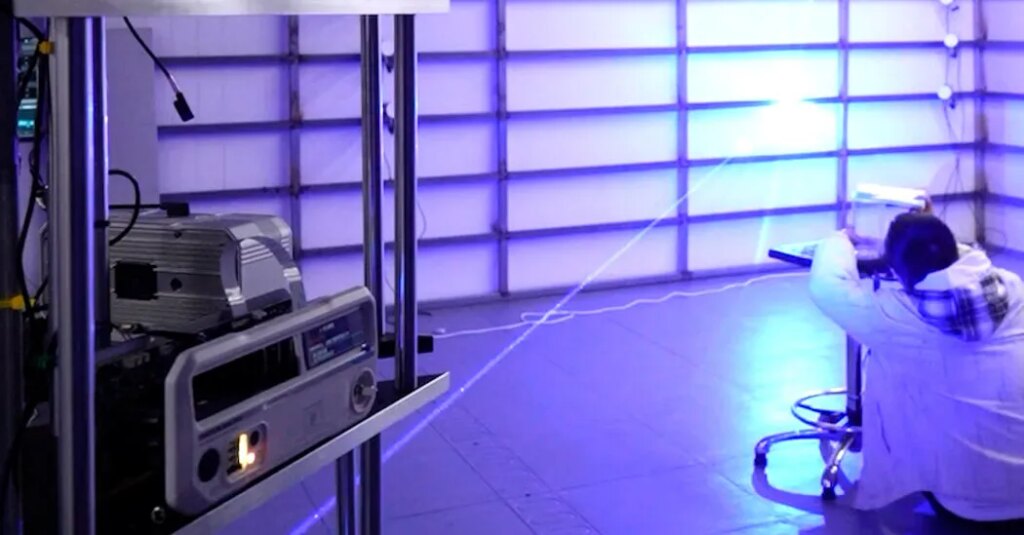
During a recent demonstration at the offices of Photon Matrix, the company behind the device, it appeared remarkably effective. The white, nearly brick-size machine quickly zapped mosquito after mosquito, each bursting into a green or blue flame with a tiny pop.
For anyone who has ever wished mosquitoes a horrible death, this is a strikingly high-tech way to make that wish a reality. The laser delivers a gruesome end, though not a quick one. Mosquitoes whose wings have burned off can take hours or even days to die, lying on the ground and twitching slightly, said Wang Chuan, chief executive and founder of Photon Matrix, based in Changzhou, about 100 miles northwest of Shanghai.
After the demonstration, I examined the fallen mosquitoes. The wings appeared to be gone, but their legs and bodies looked intact. None could fly, even when I waved my hand directly over them.
But there is a potentially dangerous catch. A laser powerful enough to disable a mosquito can also damage the human eye.
The device, the Laser Mosquito Air Defense System, uses a Class 4 laser, the most powerful classification, typically reserved for industrial applications. Such lasers can cause retinal injuries in less than a second, and their sale and use are tightly regulated.
While the United States leads in developing the most advanced A.I. models, the device shows how quickly China is embedding powerful computing in consumer products. The technology also has military potential. It’s not hard to imagine how a system that tracks and shoots down mosquitoes today could be adapted to target drones tomorrow.
Mr. Wang said that the company was seeking regulatory approval in China, Europe and the United States and that he believed Chinese approval was close.
In the United States, manufacturers can begin selling new laser devices after submitting paperwork to the Food and Drug Administration, which does not test the products, said Ken Barat, a former laser safety officer at Lawrence Berkeley National Laboratory who oversaw the drafting of the world’s technical standards for research lasers.
Mr. Barat said Photon Matrix’s multiple safeguards could make the device safe. But he cautioned that a Class 4 laser designed to focus on something as tiny as a mosquito could pack “a lot of energy” into a small space.
Photon Matrix initially tested less powerful Class 3 lasers but found they could not reliably disable mosquitoes, Mr. Wang said. The company chose a Class 4 laser, limiting each burst to one-hundredth of a second — long enough, he said, to burn off the wings while reducing, but not eliminating, the risk of eye damage. The wings, which have little ability to absorb heat, burn off before the mosquito’s body is heavily affected.
To protect people and pets, an A.I.-enabled camera recognizes them and prevents the laser from firing. The system also identifies reflective surfaces that could send beams bouncing in unpredictable directions. An infrared system provides illumination so the camera can operate at night. A separate radar system detects movement by people or pets in the laser’s path, even in total darkness.
Buyers must also pass a 15-question safety test, including questions like which room is least suitable for the device. (The answer: a bathroom, with high humidity, confined space and reflective surfaces.) Only those who answer every question correctly can register a fingerprint to activate the machine.
The mosquito hunting relies on lidar — an acronym for light detection and ranging, a technology widely used in self-driving cars. The device fires 100,000 extremely faint laser pulses a second to map an area in a flat, two-dimensional plane in front of it, tracking moving objects smaller than a pea as they cross that plane.
The idea of shooting mosquitoes out of the air with lasers predates the current A.I. boom. In 2010, Intellectual Ventures, a company founded by a former chief technology officer at Microsoft, unveiled a similar anti-mosquito system but never mass-produced it.
Photon Matrix said it had received 5,000 prepaid orders for the device and had secured a contract manufacturer, with mass production expected to begin within weeks.
Mr. Wang is already planning a next-generation device that would fire even shorter bursts. With a future model, he hopes, the eye’s moisture will absorb the laser energy before it reaches the retina.
Siyi Zhao contributed research.
The post In China, the War on Mosquitoes Has Entered the A.I. Era appeared first on New York Times.