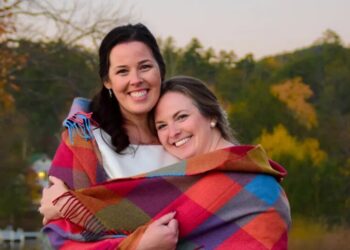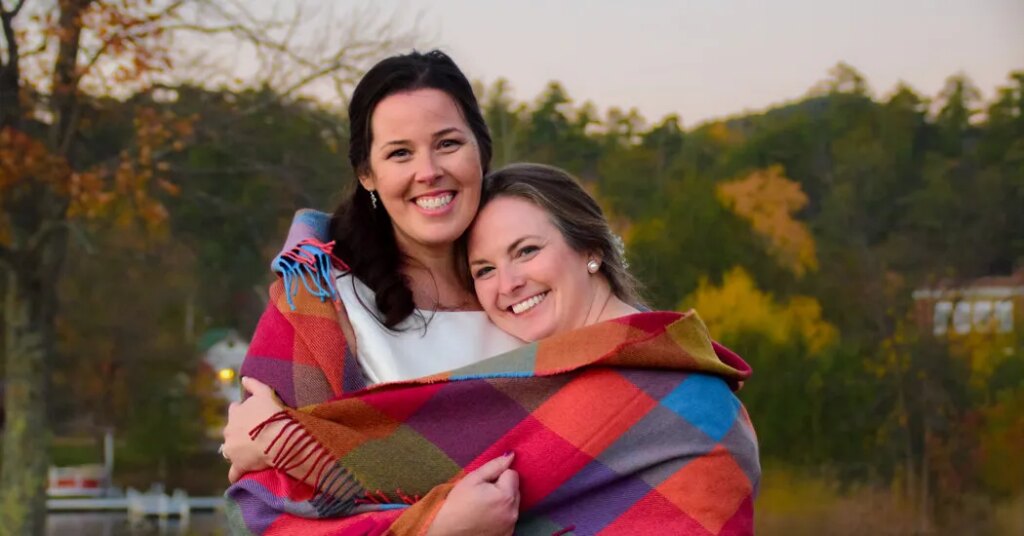
Katharine Ann Moser had been thinking a lot about the specter of deadly disease when she met Jaclyn Marguerite Conklin in June 2020 in Lake Placid, N.Y.
Moser, an occupational therapist, and Conklin, a physical therapist, were wearing masks at the time. Protocol at Elderwood of Uihlein at Lake Placid, a long-term care facility where both had traveled for temporary assignments in the early days of Covid, required it. Neither remembers how they bridged the six-foot distance that separated their desks and their lunch tables that June, but by July, they were meeting twice a week after work for hikes or walks. A romance, especially with another woman, had never occurred to them.
Moser, 45, grew up in an Irish Catholic family in Queens, N.Y., and Waterbury, Conn. She has two brothers and holds two degrees in occupational therapy: a bachelor’s from Elizabethtown College in Pennsylvania and a doctorate from Rocky Mountain University of Health Professions in Utah. In 2005, when she was 23, she took a DNA test that confirmed she carries the gene for Huntington’s disease, an incurable brain disorder that ravages the mind and body.
Two years later, she was the subject of a Pulitzer Prize-winning New York Times article about facing life with a lethal gene. Her decision to take the test deepened an ongoing rift with her mother; Moser’s maternal grandfather also had Huntington’s.
Conklin, 36, grew up on a tree farm in Reading Center, N.Y., the third of Alice and Gary Conklin’s four children. At Nazareth College in New York, where she was a competitive swimmer, she earned a bachelor’s degree in health science and a doctorate in physical therapy.
Like Moser, Conklin had only dated men before September 2021, when they acknowledged on a camping trip in North-South Lake, N.Y., that their friendship was starting to feel romantic. That they had managed to maintain a connection that long seemed like kismet to both: The contracts that brought them to Lake Placid in 2020 lasted only three months. When Conklin was dispatched to Cooperstown, N.Y., that October, Moser took a permanent job at Elderwood.
[Click here to binge read this week’s featured couples.]
But they never lost touch. “Katie was the first person to call me on Christmas” in 2020, Conklin said. The following summer, when Elderwood offered Conklin a new contract, she took it and rented a room from Moser, who had bought a house in nearby Saranac Lake.
For Moser, dating had been challenging since the discovery of her Huntington’s gene. Symptoms, almost guaranteed to surface in her 40s or 50s, were likely to affect her ability to walk, talk and think. “I would tell someone on the third date, because that’s when I felt it could get serious,” said Moser, who has not experienced any symptoms of the disease.
Telling Conklin, when both were still settling into their first jobs at Elderwood, was different. “We were friends,” she said. “I would talk to her about my family and advocacy efforts.”
The 2021 talk that changed both their lives came on the heels of a shift in Moser’s outlook about how to live with her Huntington’s gene. After settling in Saranac Lake, “I really felt that I would just live life and be open to experiences, including love.”
Moser was first to acknowledge her feelings on the camping trip that September. “It was cold that morning, and we were in our tent, and we just got into this conversation as we were waking up,” Moser said. “It was like, ‘I’ve never done this before. Could this be something?’” Conklin had already sensed it could.
Additional work assignments, including one in Washington that Conklin accepted the month after they became romantic partners, kept the two in a long-distance holding pattern until September 2024, when Conklin was offered full-time work in Lake Placid. She is now a physical therapist in the Saranac Lake Central School District.
If their return to living under the same roof that year felt like the stars aligning, so did major news about Huntington’s disease that came out in 2025: preliminary findings into a new brain injection showed potential to slow its progression by 75 percent.
“It was the first time in a long time that I felt like I could have a future,” Moser said. She knew how she wanted to spend it. In October 2025, she proposed to Conklin on a vacation in Montreal.
On Oct. 17, they welcomed 106 guests to Voco Saranac Lake, a local venue, for an outdoor wedding that got hustled inside after a dusting of morning snow and a thermometer that dipped into the 30s. Bethany Rau, a friend who was ordained through the Universal Life Church for the occasion, officiated.
In handwritten vows, Moser promised to keep life interesting as they grow old together. Conklin was more reflective in her vows.
“Katie, more than anything, I admire the way you live,” she said. “You understand something many people spend years trying to learn: Time is precious, the future isn’t promised and joy can be found in the smallest things.”
The post Given a Future She Didn’t Expect appeared first on New York Times.