For centuries during the Stone Age, a series of caves in southern Spain were home to a gruesome habit of cannibalism, confirming perhaps the most literal case of “you are what you eat.”
Starting at least 8,000 years ago, according to a new study, people there consumed their dead in much the same way they ate wildlife and livestock — as another available food source, not out of dire circumstances. “It’s not a war; it’s not a conflict,” said Miguel Botella, a professor emeritus in physical and forensic anthropology at the University of Granada in Spain. “They just ate cadavers after they died.”
Dr. Botella began studying caves in southern Spain in 1972 at a site called Las Majolicas, where he discovered heaps of Neolithic bones. Now, in a recent study published in the Journal of Archaeological Science, he and his team compared three caves in the area, all with signs of cannibalism over occasionally overlapping time periods.
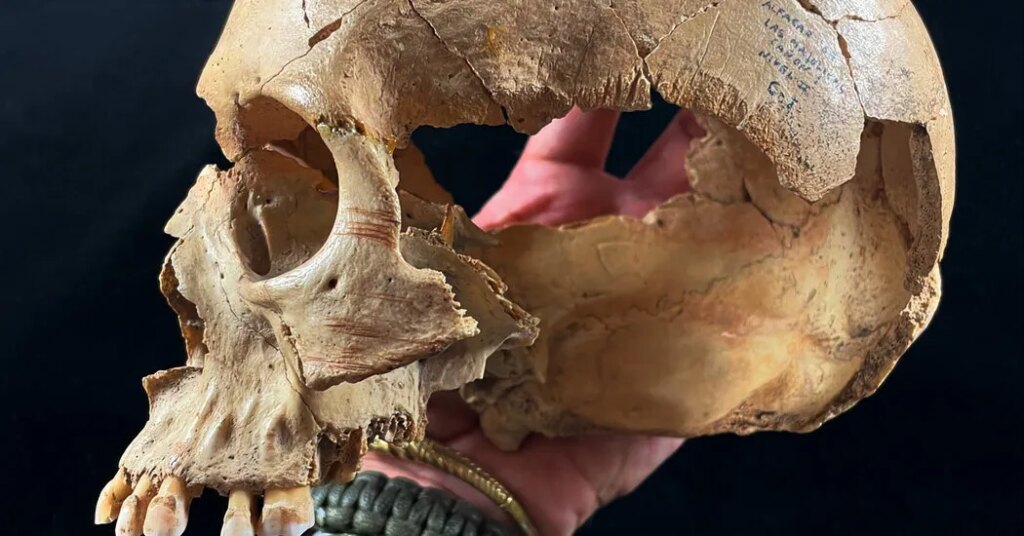
In total, the team analyzed 967 human remains representing at least 60 individuals, dating to distinct periods between 5,300 and 3,760 B.C. The bones bore cut marks consistent with butchering: marks made by defleshing tools, meat removal and chopping. Some bones also appear to have been boiled, based on their whiter color and translucency. Others were smashed, most likely to remove the marrow, Dr. Botella said.
Analyzing the individual caves showed the researchers that cannibalism occurred consistently in the area over centuries, with some technical variations.
In Malalmuerzo, which translates to “Bad Lunch” (a name that is purely coincidental, Dr. Botella said) the remains bore all types of processing marks. There were also children’s bones with human chewing marks, signs of “a very intensive consumption,” said Ana Solari, a physical and forensic anthropologist at Argentina’s National Scientific and Technical Research Council and a coauthor on the study.
At Carigüela, anthropologists have found skull cups, essentially craniums modified to serve as cups, from an adult skull and from a child’s. This cave’s remains, which dated to two distinct periods, also contained other tools made from human bones, such as awls and femur chisels.
In two of the caves, Malalmuerzo and Majolicas, there were roughly equal numbers of women and men and of adults and children. Dr. Botella and Dr. Solari said that the relatively even distribution, when taken with other evidence, suggested that most of the people who were cannibalized were most likely not the victims of violence before death.
The team also proposed that because all the remains were discarded alongside animal bones with similar processing marks, these people probably weren’t hunting others for the express purpose of eating them, either.
Instead, it seems more likely that people in these caves cannibalized one another as funerary practice. That’s in contrast to other communities in Europe at the time, who buried their dead or left them in open-air graves. Starting in the fifth century, some Europeans also started burying their dead collectively in megalithic tombs.
But in these caves in southern Spain, Dr. Botella said that researchers had yet to find evidence of any other kind of funerary practice such as burial or cremation. “The great majority of them, they didn’t kill them,” he said. “They just died; and after they died, they ate them.”
Dr. Botella speculated that the people in these caves may have cannibalized their family members or friends so they would stay in their lives, similar to more recently recorded instances of cannibalism practiced in parts of South America. And although there were not any physical signs of ritual use on the bones, such as ornamentation, this doesn’t rule out that rituals didn’t occur.
Silvia Bello, who has studied cannibalism in ancient humans for some time at the Natural History Museum in London but was not involved in the recent paper, agreed that these particular cases most likely occurred between members of the same group. Though she said the possible blunt-force trauma marks on two individuals revealed the possibility of occasional violence.
Eating one another wasn’t their main preoccupation in life. Dr. Botella said these people were mostly farmers and herders, keeping sheep and goats and cultivating wheat and barley. The caves also aren’t unique: More than a dozen other caves in southern Spain also have evidence of cannibalism, as do others elsewhere in Europe. When taken together, Dr. Botella said this research showed that this type of cannibalism — eating your dead — was most likely a common cultural practice for centuries in the Neolithic.
Dr. Solari added, “They didn’t have the taboos that we have today.”
The post Three Stone Age Caves Reveal Continual Cannibalism appeared first on New York Times.