America has always had oligarchs, but for most of the past century or so, they steered the country in relative quiet. They knew how to support the right politician or use the law to protect their edge. And if a given law proved inconvenient, that’s what the skilled lobbyists and friendly judges were for.
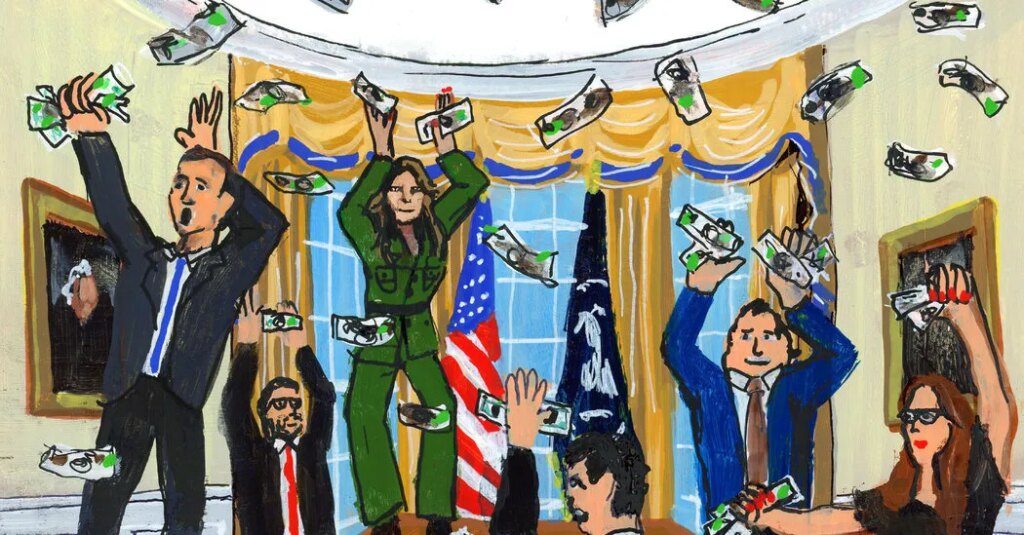
President Trump’s second term has ushered in a starkly different arrangement. Tariffs, prosecutions and regulations are all now subject to one man’s whims. Business leaders are being asked to underwrite government projects, such as the White House ballroom. The government assigns to itself a cut of private businesses. The White House bestows enterprises from oil fields to social media platforms on loyal allies. A coterie of top officials, their children and their gaggle of hangers-on move through the world like princelings. The rule of law can seem situational at best.
It’s a throwback to an old style of governing, centered on a father figure who treats the nation like an extension of his household, and who dispenses resources and favors and jobs like a dad handing out candy to his kids. In an environment like this, fealty to the national patriarch can seem like the surest — in some cases only — way to get ahead.
The scholar of elite privilege Jeffrey Winters, drawing on the work of the great 19th- and early-20th-century sociologist Max Weber, has described the contours of “sultanistic” oligarchies, as in sultans of old, in which even for the very rich, “the head oligarch both can make you or break you.”
When Professor Winters wrote a history of oligarchy back in 2011, he told me, he had Vladimir Putin’s Russia in mind as the paradigm of a modern sultanate. Today, he’s seeing those tendencies closer to home.
Mr. Trump is now worth about $7 billion, thanks in significant measure to crypto deals that sound almost too shady to be true. His son Eric’s net worth at one point jumped tenfold, according to a Forbes estimate. Don Jr.’s venture capital firm has gained access to some of Silicon Valley’s most lucrative opportunities, helping drive returns for its primary investment fund in the neighborhood of 200 percent.
Wealth can still buy political power, just as it did in the oligarchy’s previous iteration. The difference today is that a new gusher of cash has erupted and is flowing in the opposite direction. Political power, or even just proximity to it, is generating wealth to a degree unknown in modern American history.
The Trump family, once ostracized by a large part of the C-suite set, is now front and center, exerting a gravitational pull over ventures of every kind. Crypto. A.I. Rare earths. Quantum computing. Drones. Nuclear power.
It’s not lost on anyone that these Trump investments tend to come with added bonuses. Take the prediction market Kalshi, which counts Don Jr. as an adviser. When New York’s attorney general tried to shut down operations in the state, the elder Trump’s administration threw it a lifeline, ordering the company to keep operating. Or look at Foundation Future Industries, a humanoid robotics firm backed by Eric Trump. It won a $24 million Pentagon contract this spring to continue development of A.I.-powered soldiers. That makes it one in an array of Trump-connected companies whose primary customer is the United States government. You know who’s in charge of that.
The Trumps say they’re simply savvy investors. Their representatives insist they don’t promote their companies to the government and that those companies have received no preferential treatment from the administration. Maybe so. What’s clear is that the Trump brothers don’t have much patience for all the hand-wringing about the blurring of public office and private gain. “We understand what the administration wants to do,” Don Jr. told an investment forum in Riyadh, Saudi Arabia, last year, “because we helped craft some of that messaging.”
In a statement, Alan Garten, the executive vice president of the Trump Organization, firmly rejected the idea that any members had inappropriately benefited, noting that the Trump Organization dates back decades, “and Don and Eric were actively developing projects, pursuing investments and building business relationships for years before their father entered the White House.”
The president’s kids aren’t the only members of Washington’s new princeling class. Jared Kushner’s investment firm recently completed a $55 billion deal with Saudi Arabia’s sovereign wealth fund. Alex and Zach Witkoff, the sons of the White House envoy Steve Witkoff, have benefited from significant deals with the United Arab Emirates’ spymaster via World Liberty Financial, the crypto exchange they and members of the Trump family run together. Brandon and Kyle Lutnick, the U.S. commerce secretary’s children, have overseen record revenue at their family’s financial firm. A consulting firm at which the daughter of the White House chief of staff is a partner has received lucrative contracts from a Russia-aligned Balkan government. Mr. Trump reportedly bristles when people in his orbit try to make money off their proximity to him. “That’s my money!” he’s been repeatedly quoted as saying, with variations that sometimes include an expletive between “my” and “money.”
Mr. Trump’s political opponents denounce this as straight-up corruption. But the rise of the princelings is better understood as part of a new strain of American capitalism, one that turns the entanglements we used to regard as conflicts of interest into core operating principles, and then markets that coziness to retail investors for further gain. This goes beyond the old caricature of influence peddling, where you maneuver your way to some official’s good side. Here, the access is baked right in. The familial and the federal are one and the same. Responding to questions from The Times, the White House principal deputy press secretary Anna Kelly wrote, “President Trump only acts in the best interests of the American public, which is why they overwhelmingly re-elected him to this office, despite years of lies and false accusations against him and his businesses from the fake news media.” She added, “There are no conflicts of interest.”
If Democrats take one or even both houses of Congress in next week’s midterm elections, they’re determined to investigate these deals. Representative Ro Khanna is already involved in an investigation into alleged stock manipulation schemes carried out by a firm based in Trump Tower. Representative Jamie Raskin wants to examine how seemingly overnight Don Jr.’s venture capital outfit went from “investing in total market flops” to being “the hottest firm in the United States.” (That firm’s attorneys, in a letter back to Mr. Raskin, called the description “not merely unkind, it is belied by the public record.”)
There’s a lot to sift through. Even if investigators manage to find every item in this supermarket sweep through the global market, it will still be just the most visible example of how the princelings reordered American business and politics. They have now had years to dig in and fully entwine their business interests with the business of the government. Mr. Trump will eventually leave office, but the consequences will last much, much longer.
This was not always the plan. As recently as late 2024, the Trumps and their allies were making almost the opposite play. They were trying to capitalize on being outsiders.
The left had bullied much of corporate America into accepting its agenda, the argument went. Democratic administrations had jawboned the social networks into treating MAGA views like disinformation. A bank had closed hundreds of Trump-related accounts after they were flagged for money laundering. A judge even found the family business liable for fraud. All that opened up an opportunity. Shut out of the corporate mainstream, in their telling, Trump allies could build what the investor Omeed Malik called the “parallel economy,” one that didn’t much care for Pride Month or carbon capture or vaccine mandates.
Mr. Malik and Don Jr. helped take public the firm that owns PublicSquare, which saw itself as a MAGA answer to Amazon, a place where like-minded businesses could market themselves to red America. Those companies included Garnuu, a tampon brand that touted itself as being for “Girls Only. Period.” and a pet supply firm that refused to “cater to alternative lifestyles.”
“It’s time to invest in companies that don’t hate you,” Don Jr. posted on social media.
The pitch worked — for about a day. PublicSquare’s stock price more than doubled shortly after its I.P.O. Then it tanked. By election night 2024, PublicSquare had fallen 90 percent from its peak value.
Of course by then, Don Jr. and Mr. Malik weren’t outsiders anymore. The “parallel economy” play no longer made sense. The Trumps and their allies were ascendant. The plan had to evolve, a source with direct knowledge of the matter told me — one of 25 I spoke to for this story.
They transitioned to a new strategy, based on their identities as the ultimate insiders. Don Jr., Mr. Malik and Chris Buskirk, a conservative media figure (and a former New York Times contributing Opinion writer), founded a private club in Georgetown and advertised a $500,000 initiation fee. The name wasn’t terribly subtle: Executive Branch.
1789 Capital, the venture firm Mr. Malik had founded with Mr. Buskirk and the far-right megadonor Rebekah Mercer, formally welcomed Don Jr. as a partner right after the election. It went from $150 million under management to more than $1.7 billion by the end of 2025. The cash came, in part, from the family offices of high-net-worth individuals and Middle Eastern sovereign wealth funds.
Mr. Buskirk explicitly tied his projects, including 1789, to the rise of a new ruling class. “You either have an extractive elite — an oligarchy — or you have a productive elite — an aristocracy — in every society,” he told The Washington Post.
Starting in the Biden years, there has been a mounting wave of venture capitalist interest in defense, aerospace and other start-ups to help re-establish America’s manufacturing base. Mr. Malik and Don Jr., longtime advocates of such investments, rode the “patriotic capitalism” wave. As of last summer, 1789 Capital’s portfolio included the high-tech weapons manufacturer Anduril, Elon Musk’s company SpaceX and Axiom Space, which is working on new astronaut suits for NASA. These are minority positions, without board seats or operational control, but even so: As investments, they’re far from anti-woke tampons.
In a 2025 book, Eric Trump complained that during the first Trump term, the family passed up all sorts of lucrative opportunities, yet still found itself “accused endlessly of somehow ‘profiting’ off the presidency.” This time around, there would be no missing out on deals or listening to pious lectures about conflicts of interest. “They created this monster,” Don Jr. told CNBC. Investments in cryptocurrencies and prediction markets, originally portrayed as alternatives to the woke banking and polling industries, were repositioned as pillars of the new economic establishment.
When Peter Navarro, Mr. Trump’s trade adviser, pushed the Pentagon toward a deal with a rare-earth magnets start-up backed by 1789, was he legitimately promoting a national security priority, or was he doing a favor for the president’s son? The whole arrangement erases such distinctions. Now the drone-parts manufacturer Unusual Machines, which counts Don Jr. as an adviser, is in negotiations for a Pentagon loan. That would be a big development for the company, which doesn’t sell to the government directly; its stock rose 65 percent when The Wall Street Journal broke the news. Then it climbed 26 percent when the White House announced new tariffs on the import of foreign drone parts, functionally squeezing Unusual Machines’ rivals.
That’s what we used to call a conflict of interest, but “the entire notion of conflict of interest is based upon a world that I think these guys are questioning,” said the political scientist Jeffrey Kopstein, a scholar who has written presciently on the new Trumpist style of governing. There’s “no distinction between the public and the private.”
The embrace of this kind of state symbiosis is an ironic turn for a crowd that not long ago was raging against political interference in the markets. I asked Allan Evans, the chief executive of Unusual Machines, if he was bothered by the perception that the firm is unfairly benefiting from its coziness with the ruling family. “The narrative doesn’t hurt me,” he answered. “If you believe there’s coziness, wouldn’t you want to invest in our stock? And if you think that ‘oh no, that’s corruption and terrible,’ you’re not going to invest in our stock anyway.”
“From a game theory perspective, I just — I’ve got to let this ride,” Mr. Evans added. “There’s no negative outcome boxes, you know?”
There are about 20 golf courses within a 20-mile radius of Kissimmee, Fla. The Remington Golf Club is not considered one of the better ones. (“Traps were overgrown on many holes. Tee boxes were a bit bare,” wrote one GolfPass reviewer.) It was a primo pick, however, for an idiosyncratic financial play that’s become a Trump world staple: the reverse merger.
The idea sounds simple enough. Find a down-on-its-luck company that’s already listed on a stock market, and smash it together with a start-up in need of quick money. It’s a shortcut to a major cash infusion, without the paperwork of an I.P.O. or the hassles of dealing with venture capital investors. The results can be a little odd.
In February 2025, the holding company that owned the Remington Golf Club and a sister course went public on the Nasdaq stock exchange, with financial underwriting by a company based in Trump Tower. That company was Dominari Securities. The I.P.O. flopped, and when shares were at rock bottom, one of Dominari Holdings’ funds bought up a significant number of them. A few months after that, the golf course company announced it was merging with, of all things, a small firm building drones for the military. Dominari Securities would arrange the financing for that deal, too.
Between the two of them, Don Jr. and Eric Trump own about 11 percent of Dominari Holdings, and they serve on the company’s advisory board. Its president, Kyle Wool, is a frequent booster of the president on the Fox Business channel. When the impending merger was announced (“Trump Sons Back New Drone Company Targeting Pentagon Sales” was the headline in The Journal), the golf course company’s shares shot up 24 percent intraday. The number of shares traded jumped from around 24,000 to over 28 million in a single day. The fact that a Trump-backed company could be selling drones to the Trump administration wasn’t a bug; it was a feature. In fact, that feature seems to have been a selling point to a certain kind of investor.
Mr. Evans, from Unusual Machines, compared the Trump brothers coming on board to when Oprah Winfrey joined Weight Watchers, but it’s more than that. Buying into these companies offers people a chance to affiliate themselves with emerging technology, MAGA celebrities and Trump-adjacent businesses all at the same time. The Financial Times recently noted that a vast majority of companies backed by Dominari and 1789 — neither of which commented in response to questions from The Times — are in sectors aligned with Trump administration priorities.
Brett Velicovich, the president of Powerus, the merged golf course-drone company, told me in the spring that it would compete on merit, not connections. “With the way that the Department of War works, there are multiple layers of oversight,” he said, adding that it “would be virtually impossible for someone to make a call, and all of a sudden: a contract.” In June, Unusual Machines announced a $30 million equity investment in Powerus. In August, one of Powerus’s subsidiaries received the company’s first major Pentagon contract, a funding line worth up to $90 million from the U.S. Air Force. As Pentagon contracts go, that’s a pittance, but it’s a lot of money for a start-up.
Dominari Securities helped engineer lots of other reverse mergers, each more improbable than the last. The company achieved a mash-up of a crypto business with a company that makes sea otter plushies, another of a drone software company with a construction company known for the hundreds of waxing salons it’s built.
Then there’s the tungsten-mining operation in Kazakhstan. The Trump administration had given its preliminary OK to $1.6 billion in financing when it announced a merger with Skyline Builders. That’s a Hong Kong-based engineering company that previously went public with the help of none other than Dominari Securities.
Separately, Trump Media, which runs the Truth Social platform, is combining with a nuclear fusion firm. Seriously. Yes, this seems like some kind of MAGA Mad Lib. But we’re in an age of absurdity on Wall Street. Allbirds, the shoe brand, recently announced it was becoming an A.I. company. The princelings didn’t build this madhouse, but they seem to be making themselves very much at home in it.
These shell-company deals, which have historically been riskier than traditional I.P.O.s, fell out of fashion on Wall Street for a while. They have been making a comeback, though, and these princeling-connected deals are a part of it.
The entrepreneurs joining these deals aren’t necessarily MAGA. Often, their businesses just need the money, and right now the oligarchy is flush. “Unfortunately they are so far-right,” one chief executive told The Journal, speaking of his new partners. But now “we’ve got the capital we need.”
Many of these deals have turned out rather well for Dominari Securities and its American Ventures fund. Take those Kissimmee golf courses. After the fund put in $26 million, its holdings in the mashed-up golf course company are worth around 10 times as much. As for the everyday investors who bought in — well, they didn’t do so great. Powerus, the golf-drones combo, is down almost 70 percent since its merger was announced. Dominari Holdings’ chief executive has rejected any suggestion that his company improperly manipulated share prices, or that shareholder losses were evidence of anything other than normal market fluctuations. “Do stock prices rise and fall?” he asked Bloomberg. “Of course they do.” But that same pattern, of a sharp rise in value followed by a steep decline, played out in one Dominari-arranged merger after another after another.
The Trump administration is by no means the first in which family members leveraged their last name: Joe Biden’s son and Hillary Clinton’s brothers are just three examples. The Trump years have expanded that kind of operation to a global scale. Governments around the world are trying to tell the difference between the big fish and the remora.
In April of 2025, Chase Herro, a self-described “dirtbag of the internet,” Zak Folkman, the former proprietor of Date Hotter Girls, and Zach Witkoff, the son of Mr. Trump’s chief envoy to the Middle East — otherwise known as co-founders of World Liberty Financial — traveled to Lahore, Pakistan. They were received like visiting dignitaries, draped with stoles and flowers in Shalimar Gardens, a UNESCO World Heritage site built in the 17th century. A trumpeter in a dress uniform signaled their entrance. A dancer spun in their honor. A drummer pounded. Fireworks ignited overhead. The whole event — plus a “fireside chat” about the future of finance with Bilal bin Saqib, the head of Pakistan’s crypto council — was filmed and distributed on government social channels.
This was Pakistan’s third attempt, at least, to use Trump-connected businessmen as interlocutors with the new administration. First, according to The Wall Street Journal, a meeting occurred with a hedge fund manager who had once been close with Don Jr., then another with that man’s 20-year-old son (who brought along a Malibu tech exec who boasts of “architecting a new dimension”).
Finally Islamabad turned to the dirtbag, the pickup artist and the princeling. “World Liberty Financial is not a political organization, has no role with the U.S. administration, and has nothing to do with regulatory or foreign policy,” a spokesman wrote to the Times, in response to questions for this article. “It is false to state or imply otherwise.” Still, those three were some of the best connections Pakistan could find to the new Washington.
Months later, the four would reunite in Islamabad, where the younger Witkoff was treated like a cabinet secretary as he signed a memorandum of understanding between his company and the Pakistani government. The country’s prime minister, Shehbaz Sharif, looked on, applauding.
Something similar happened in the gilded halls of Mar-a-Lago in February when the World Liberty Financial trio welcomed a parade of American chief executives and titans of capital for a one-day conference. The head of Goldman Sachs was there. So was the investor who helped bankroll the merger of Warner Brothers and Paramount, as were the heads of the New York and Nasdaq stock exchanges, where all of those reverse-merged, Trump-linked companies were listed. Oh, and Nicki Minaj, too.
According to the conference agenda, everyone was there to discuss the “future of finance and technology.” The subtext, however, was that the future of finance and technology is whatever the Trump family and its business partners say it is. Behind the speakers on the main stage, a giant golden eagle loomed. It didn’t look exactly like the one on the presidential seal, but it didn’t look all that different, either.
The last time American oligarchs were this brazen was at the end of the 19th century. Their power was immense, and they weren’t afraid to show it, whether by openly buying a Senate seat or persuading the president to help them corner the gold market.
“It provoked a backlash,” said Professor Winters, the author of “The Blind Spot: How Oligarchs Dominate Our Democracy.” “That backlash lasted decades.” He ticked off a series of reforms that resulted: the progressive income tax, and its radical idea of asking more from the rich; the Sherman Antitrust Act, which broke up the biggest oligarchs’ biggest source of wealth; the direct election of senators, which undercut the oligarchs’ ability to pick the nation’s most influential legislators; the rise of organized labor. There’s a reason the oligarchy retreated behind the hedgerows for the next century or so.
Around the world right now, there are indications that regimes with sultanistic tendencies are starting to wear out their welcome. Mr. Trump’s Hungarian ally Viktor Orban was ousted after a total of 18 years in power, defeated on a promise to prosecute the open corruption of Mr. Orban and his cronies. Antigovernment protests in Albania are nearing their 10th month after Ivanka Trump breezily mentioned on a podcast how she and her husband had “found” a protected island there and were planning a luxury resort on it.
America is by no means headed for changes of this scale. But it’s become increasingly clear that Americans are grossed out by the magnitude of self-enrichment in and adjacent to the Trump administration. In a late October poll, CNBC found that corruption was now the top issue on midterm voters’ minds. In a recent Gallup poll, 89 percent of all Americans surveyed said government corruption was widespread — a consensus almost unimaginable on any other topic. Investors have lost an estimated $3.8 billion on Mr. Trump’s crypto coin. The initiation fee for Executive Branch, the princelings’ private club in Washington, is now in the low six figures, down from half a million for founding members.
The Trump family’s sprawling business empire has become so unpopular that even members of the mostly fawning Republican Congress are pushing for oversight. In late September, Senator John Curtis of Utah formally asked the Senate Judiciary Committee to take a top-to-bottom look at Don Jr.’s business dealings — the crypto, the defense deals, all of it — in order “to prevent the presidency from becoming a vehicle for private enrichment by those closest to it.”
A few months before that, Representative John Moolenaar, the Republican chairman of the House Select Committee on the Chinese Communist Party, joined Mr. Khanna, the Democratic ranking member, to demand answers from Mr. Wool, the chief executive of Dominari Securities and the president of Dominari Holdings, the interrelated Trump-connected companies at the center of those wild reverse mergers.
Citing reporting by Bloomberg and Securities and Exchange Commission filings, the congressmen accused Dominari and the firm Mr. Wool previously led of being involved in “nearly two dozen” apparently fraudulent deals in which Chinese companies went public and then tanked, leaving investors broke. (In response, Dominari Holdings said in a statement to investors that Chinese deals represented a “fraction” of Dominari Securities’ overall revenue, and that the company was no longer doing I.P.O.s in Hong Kong.) The congressional investigators specifically mentioned the Hong Kong engineering company that, after its reverse merger with the Kazakhstan mining interest, is poised to receive as much as $1.6 billion from the Trump administration.
It didn’t have to be like this. The Trump family and its associates could have spent the duration of the second administration building towers in Tbilisi and private mansions in Saudi Arabia. They would have had their financial revenge, and the outcry would have been far more muted.
The princeling crowd didn’t stop there. It advanced its interest into myriad new arenas, almost as Trump enterprises did when they expanded beyond real estate to casinos, a for-profit university, a third-tier airline, an off-brand pro football team.
All those earlier ventures went bust, taking countless other businesses down with them. The United States Football League folded, thanks to Mr. Trump’s machinations. The revitalization of Atlantic City was a lost cause by the time he started his run of bankruptcies.
Mr. Trump emerged just fine from each disaster — the family is nothing if not resilient. His customers, his contractors, his business partners and his hangers-on, they suffered. There might be a lesson in that history, for anyone willing to look for it.
Noah Shachtman is a contributing Opinion writer who writes frequently about government corruption.
The Times is committed to publishing a diversity of letters to the editor. We’d like to hear what you think about this or any of our articles. Here are some tips. And here’s our email: [email protected].
Follow the New York Times Opinion section on Facebook, Instagram, TikTok, Bluesky, WhatsApp and Threads.
The post How to Get Rich in Trump’s America appeared first on New York Times.