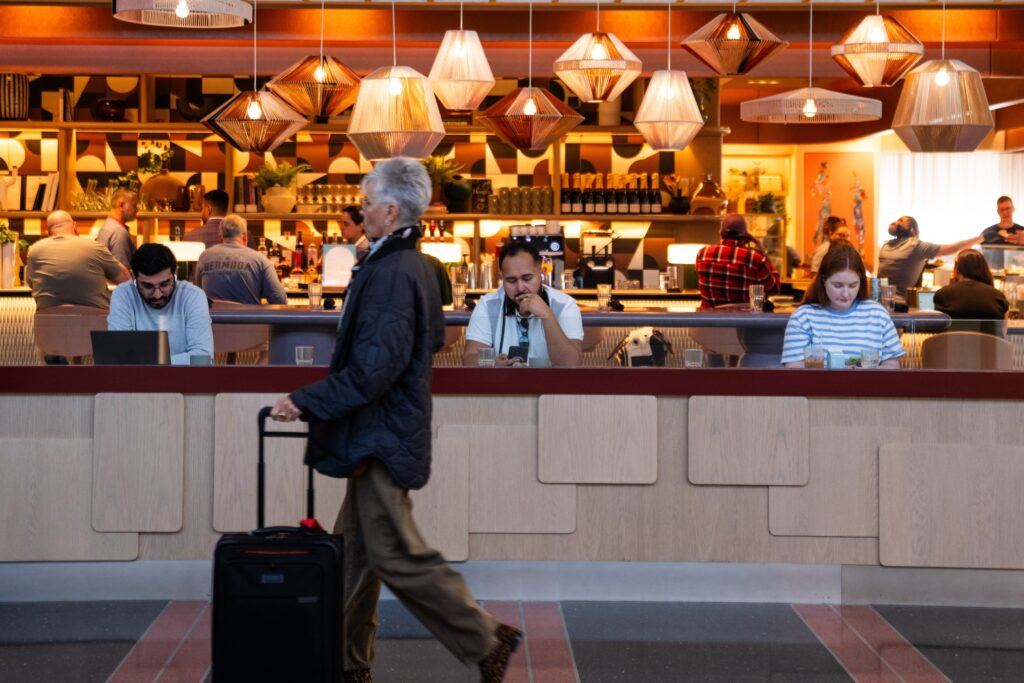
Don’t get Adam Smith started on how hard it is to get crystal-clear ice cubes to the airport for a cocktail called Ben Franklin’s Milk Punch.
“Getting clear ice through security was problematic,” said Smith, the on-site representative for Capital One at the credit card company’s Reagan National Airport lounge.
But, Smith said, the José Andrés Group, which partnered with Capital One for the lounge, was adamant that the cocktail needed the special ice. Otherwise, why even bother? “So you have to jump through hoops to get ice,” Smith said.
The cocktail itself tastes better than it sounds. It’s made with Spanish brandy and uses milk proteins to make the drink smooth and clear. A 2-by-2-inch ice cube, dusted with nutmeg, floats in the glass.
The fancy frozen water crystallizes the lengths airlines and credit card companies are going to — in the D.C. area, around the United States and the world — to compete in the war for the best airport lounge. Upping the ante with massages, bourbons and imported cheeses is necessary to hold on to profitable customers who want perks associated with expensive business class tickets and sky-high credit card fees. All in the service of feeling that they matter — or, at the very least, saving a few bucks on food and having plenty of outlets for phone charging.
Airlines and credit card companies are shelling out millions on lounges. “They’ve really invested in them and turned them into oases in the airport,” said Nick Ewen, editor in chief of travel site the Points Guy. By his measure, the competition heated up about five years ago.
At Capital One’s restaurant-style lounge at Reagan National Airport, there’s someone called a “tapas attendant.” Cured meats are imported from Salamanca, breadsticks from Andalusia and Manchego cheese from Castilla-La Mancha. The carts are also sourced from Spain. On a recent morning, waiters rolled them around the lounge, offering guests strawberry doughnuts. Depending on the time of day, the carts are used to hawk mimosas or gin and tonics.
David Borowik, Capital One’s airport lounge director, said he’s competitive with other lounges but that he’d rather be compared to restaurants in Washington. “This is not something we like to measure in airport terms,” he said.
Airlines say airport lounges are booming because consumers increasingly want premium travel experiences. Even Southwest Airlines, a low-cost carrier, has decided to get in on the action, with lounges set to open at four airports, including Baltimore-Washington International Marshall Airport, beginning in late 2027.
People also want lounge access because they think it signals their worth to other people and reaffirms their own worth to themselves, according to Joseph Nunes, a University of Southern California professor who studies loyalty programs and status.
“Status is a fundamental human motive,” Nunes said, and social media has made people especially status-conscious.
But as more and more people have gained access to airport lounges — a phenomenon that has been facilitated by partnerships between airlines and credit card companies — that air of exclusivity has waned. Passengers regularly complain on social media about hour-long waits to get into lounges and challenges finding seats once inside. Some airlines have responded by imposing restrictions to reduce overcrowding.
On a recent morning at National Airport’s crowded American Express lounge, travelers worked on laptops and iPads as they waited for flights. They wore Moncler vests, toted Goyard bags and picked at slabs of scrambled eggs. Some debated whether it was worth an annual credit card fee of $895.
“It doesn’t really differentiate itself much from sitting in front of the gate,” said Charles Rice, who was waiting for his flight home to Atlanta.
The lounge has a signature scent and a shower, and is decorated with historic photos related to the District. “It’s a place where you can come in and have a great meal and forget that you’re in an airport,” said Rosy Parra, who oversees lounges for American Express.
Airport lounges are on the verge of becoming mainstream, if they haven’t already, according to Silvia Bellezza, an associate professor at Columbia Business School who studies how consumers signal their status through luxury goods.
“Everyone wants to emulate the people at the top,” Bellezza said. “Once too many people emulate them, the behavior and the signal loses its value because the people at the top see that it is not diagnostic of status anymore, and so they move to something else. There’s this perpetual game.”
Still, some travelers said it’s not about peacocking. “It’s usually just a quieter place to be, more comfortable place to be, with better WiFi,” said Andrew Cashin, who was waiting in the American Express lounge before flying back to Boston. “It’s an escape from the crowds,” said 23-year-old Jakob Sandberg, who made it into the Etihad Airways-Chase Sapphire lounge at Washington Dulles International Airport because his parents have the required credit card.
But airlines and credit card companies don’t seem to think the lounge boom is going to plateau anytime soon. American Airlines lounges saw nearly 10 million visits in 2016 and are expecting to see around 18 million this year, according to spokeswoman Kelsey Wells. In the coming months, American Airlines is set to unveil a renovated lounge at National, while United Airlines is set to open one of its biggest lounges in the country at Dulles.
“We see club and lounge usage growing at a faster rate than the airline itself at times,” said Aaron McMillan, United’s managing director of hospitality programs.
In 1939, American Airlines opened the world’s first airport lounge at LaGuardia Airport in New York. A couple of years later, the airline opened its second lounge at National, just outside D.C. in Northern Virginia. Back then, airport lounges were invitation-only.
“These were places that were highly exclusive enclaves,” said Kevin James, a professor at the University of Guelph who studies airport lounges. “When you were invited to be a member, it was a real sign of cachet.”
When the American Airlines lounge opened at National, Virginia was a dry state, so chief executive C.R. Smith personally furnished the lounge with his own liquor, according to airport historian Janet Bednarek. Sometimes, members without a plane ticket went to the lounge just for a drink, she said.
At one of American Airlines’s three lounges at National, signature cocktails included an Old Bay Bloody Mary and an Orange Crush. Around lunchtime one day in late September, guests took advantage of the fact that most drinks — including liquor and champagne — are complimentary.
“They don’t have to go out in gen pop,” said Wells, the spokeswoman, referring to the people waiting for their flights at gates and bars where cocktails cost upward of $15.
The waffle station had closed for the day, but guests helped themselves to a charcuterie spread and a buffet featuring hot honey pork and vanilla pumpkin pudding.
Paul Verner took advantage of the $79 day pass. His flight from Cincinnati to Boston was canceled and then he was rerouted through D.C., so he said he planned to spend the day eating, drinking beer and watching football. “I’ll get my money’s worth,” he said.
The days of cookie-cutter lounges have gone the way of the dodo. Airlines say they’re now obsessed with cultivating a sense of place in their lounges through design and food. The D.C. views do that more than anything else for American Airlines.
The lounge has views of Washington National Cathedral, the U.S. Capitol and the Washington Monument. (At the American Express lounge, people with a Centurion Card — which requires a $10,000 initiation fee, plus an annual $5,000 fee — have access to a private area in the back, with a view of the road in front of the airport where Ubers drop off travelers on the sidewalk. Elsewhere, there’s a view of the tarmac.)
Execution varies. At Dulles, the local nod in the Etihad Airways-Chase Sapphire lounge is largely limited to photos of matchboxes from classic haunts like Clyde’s and Le Diplomate. For its Dulles lounge, Capital One collaborated with Will Patton, the mixologist behind the Dupont Circle bar Press Club.
But there’s always another tier. Some airlines offer higher-end lounges for their most premium travelers. The Delta One lounge in Seattle features an izakaya dumpling bar. At Air France’s La Première lounge in Paris, travelers can order a three-course meal from a menu by Alain Ducasse before being driven in a Porsche Cayenne to the plane.
Soon, travelers will have an alternative at Dulles, which announced earlier this week that it’s moving forward with a VIP terminal for commercial passengers, who will have access to a VIP entrance and parking, private security screening, and suites, lounges and other amenities that are separate from the masses. A spokesperson for daa International, the Irish company developing the facility, said it hasn’t decided yet on how much access will cost.
To Nunes, the looming VIP terminal highlights the ability to monetize convenience. Unlike standard lounges, access to a VIP terminal isn’t about rich people signaling to poorer people that they’re above them, Nunes said. “This is for high-net-worth individuals who care more about convenience, and signaling to other high-net-worth individuals they are one of them,” he said.
The VIP terminal concept isn’t totally unheard of. At Dulles, private jet passengers have had access to a lounge for years. But about a decade ago, interior designer Michelle Acevedo designed an even more exclusive lounge at the airport for Jet Linx. The private jet company wanted the lounge to feel bespoke, Acevedo said.
“They wanted it to feel concierge,” she said, “where their customers could come in and not even sit with, and I quote, ‘the riffraff of these other private jet passengers.’”
The post The airport lounge arms race is on appeared first on Washington Post.