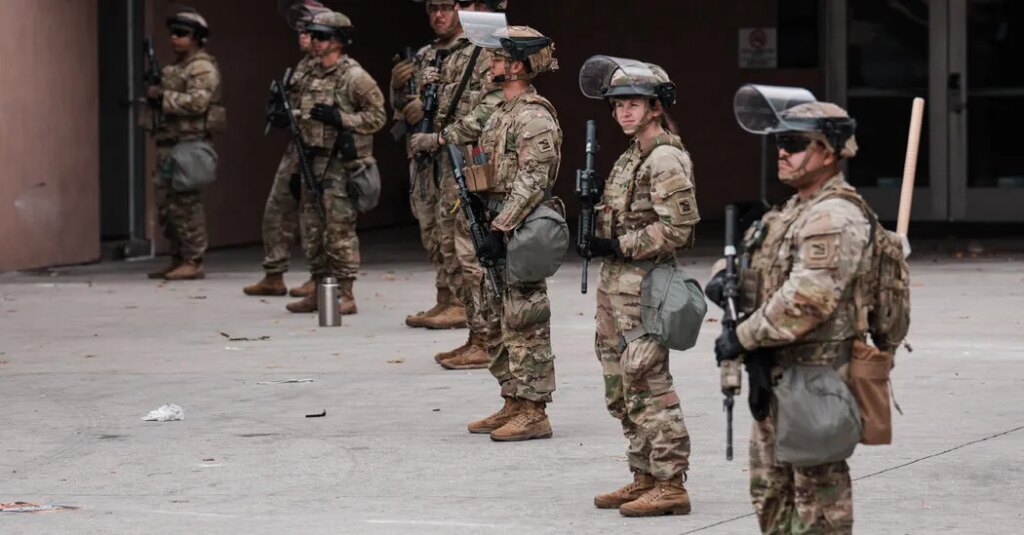
President Trump violated federal law by seizing control of the California National Guard last year and deploying troops to the streets of Los Angeles during immigration protests, a federal appeals court ruled on Friday.
With the midterm election less than two weeks away, the ruling could provide an extra layer of legal assurance on the limits a president faces in using the military on American soil.
Mr. Trump’s top military adviser has said there are no plans to deploy troops to polling stations for the midterm elections. But Mr. Trump has said in the past that he regretted not ordering the National Guard to seize voting machines after the 2020 election. And in recent months, he has taken unusual steps to disrupt voting procedures in several states.
“To the extent people were concerned that he could try to federalize Guards, try to send them to polling places, I think this clearly says no, you can’t,” said Erwin Chemerinsky, the dean of the law school at the University of California, Berkeley.
Friday’s decision by the Ninth Circuit Court of Appeals applies the reasoning the Supreme Court used when it ruled that Mr. Trump did not have the power to send National Guard troops into Chicago last year.
Though the ruling was largely predictable, it amounts to another procedural win for Gov. Gavin Newsom of California. The state has been in a protracted fight with the Trump administration over the immigration protests and troop deployments that rocked Los Angeles when Mr. Trump took command of troops over the governor’s objections.
“California fought back against this potential power grab, and in doing so created essential legal precedent that not only protects Californians but all Americans,” Governor Newsom said in a statement.
The case centers on whether a president may take control of a state’s National Guard under a particular section of law that Mr. Trump invoked in his order last year.
In the past, presidents have used the Insurrection Act to federalize National Guard troops during times of unrest. But amid last year’s protests over the Trump administration’s deportation agenda, Mr. Trump cited a different law when he called up the National Guard.
The ruling by Judges Eric D. Miller, who was appointed by Mr. Trump, and Jennifer Sung, a Biden appointee, said the president had exceeded the authority allowed under that law.
To call in the National Guard, the Supreme Court had already ruled, the president must show that he is unable with the help of the regular military to execute federal laws. The Trump administration did not prove that in this case, the judges wrote.
In addition, the judges wrote, the circumstances in Los Angeles did not amount to a “rebellion or danger of rebellion” that would permit a president to federalize a state’s National Guard.
Though some demonstrators used the protests “as an excuse for violence and destruction,” the court wrote, the events were mostly peaceful and sufficiently under control by local law enforcement.
Mr. Trump’s order to federalize the National Guard “exceeded the President’s statutory authority and encroached on Congress’s” power, the ruling said, and was therefore unconstitutional.
Judge Mark J. Bennett, who was appointed by Mr. Trump, dissented, arguing that the ruling was premature. He wrote that the case should have been sent to trial in a lower court for a full airing of the effects of the Supreme Court’s decision.
“With the benefit of that process, we could have addressed these difficult issues in turn,” Judge Bennett wrote.
The post Court Says Trump Violated Law in Los Angeles National Guard Deployment appeared first on New York Times.