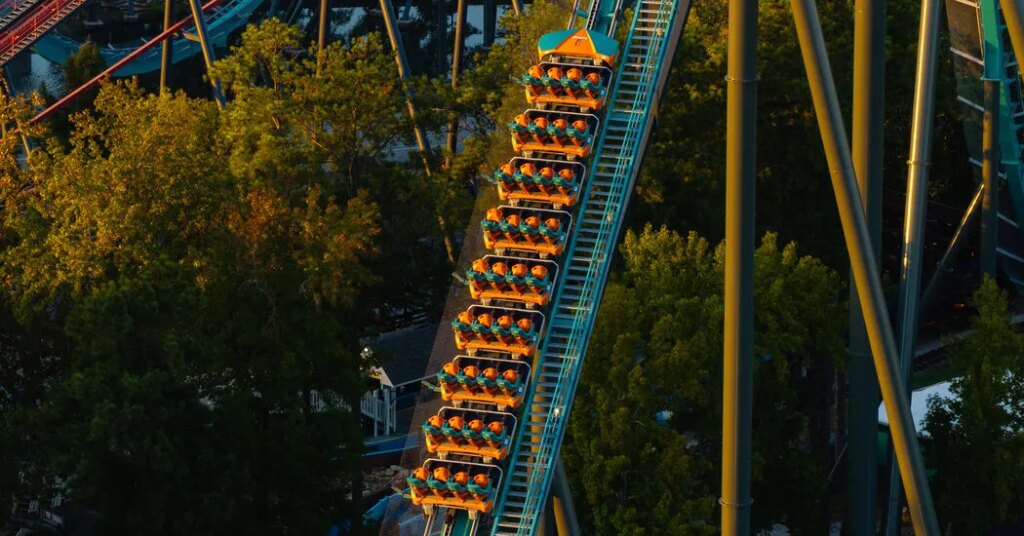
Six Flags will add seatbelts to select roller coasters across its parks, the company said on Friday, weeks after the death of a man who fell from a ride at one of its properties.
The announcement came as Six Flags contended with recent lawsuits over safety concerns.
John Reilly, the president of Six Flags Entertainment Corporation, said in a statement on Friday that the company’s parks hired independent engineers and inspectors to conduct safety reviews of all rides and attractions as the additional safety measures were put in place.
“We are committed to carefully evaluating their findings and taking appropriate action to further strengthen our standards and culture of safety,” Mr. Reilly said in the statement.
Earlier this month, Hassan Jihad Ibn Kariem, 42, was thrown from his seat and declared dead after riding Goliath at Six Flags Over Georgia in Austell, Ga., the state’s tallest roller coaster. That ride is temporarily closed and will receive seatbelts when it reopens.
Goliath was previously equipped with the commonly used lap-bar “clamshell” restraints, which swing down to lock above the riders’ laps.
State authorities, as well as the Cobb County Police Department, are investigating the death, but there is no single federal agency responsible for enforcing safety standards for rides like Goliath, which had passed its most recent state inspection on March 16.
The other attractions that will receive the safety additions are Nitro at Six Flags Great Adventure in Jackson, N.J., and Raging Bull at Six Flags Great America in Gurnee, Ill., which is north of Chicago, a spokeswoman for the company said in an email on Saturday.
Aside from Goliath, eight rides at five parks in Illinois, North Carolina, New Jersey, Ohio and Ontario, Canada, are temporarily closed, the company said.
Ride safety at Six Flags parks has come under intense scrutiny over the past several weeks, even before Mr. Kariem’s death.
In September, three people sued the amusement park company and the ride’s manufacturer after suffering what they said were catastrophic brain injuries from riding the X2 coaster at Six Flags Magic Mountain in Southern California. The lawsuits accuse Six Flags and a manufacturer of X2’s parts of operating a defectively designed ride and failing to adequately warn passengers about the risk of serious brain injuries.
That month, Six Flags Magic Mountain said the X2 would permanently close.
Before those lawsuits, Mr. Reilly said during an August call with analysts that the company incurred higher repair and maintenance expenses at certain parks as it reduced downtime, adding, “We will not compromise on safety.”
In its second-quarter financial filings, released in August, Six Flags reported that its net revenue was $865 million, a decrease of $65 million from the same time last year. Attendance for the quarter was just above 13 million visits, a decrease from more than 14 million for the same period in 2025.
There are currently more than 220 coasters operating across all Six Flags parks, Mr. Reilly said on Friday.
“We will continue to communicate about our progress and hold ourselves accountable to our commitments to you,” he said.
The post Six Flags Will Add Seatbelts to Some Roller Coasters After Rider’s Death appeared first on New York Times.