Benjamin Netanyahu looks thinner and paler these days. Gone is the swagger of previous political campaigns. But he remains tireless, traipsing among shopping centers and television studios, trying to persuade a weary and polarized country to return him to office for up to another four years in Israeli elections on Tuesday.
At 77, he is already Israel’s longest-serving prime minister. If he is to extend that tenure, he has to sell the deeply divided electorate on the new, more hawkish version of himself — and of Israel.
Mr. Netanyahu’s career will forever be defined by the Oct. 7, 2023, Hamas-led attacks on southern Israel, the deadliest day for Jews since the Holocaust. He long had a reputation for being risk averse and avoiding military confrontations, even as he cultivated an image as Israel’s Mr. Security. But that image, as well as Israel’s confidence in its own defense, was badly damaged that day.
So Mr. Netanyahu, known by friends and foes as Bibi, reinvented himself. Instead of sticking to Israel’s previous security doctrine centered on short wars of defense, he has waged Israel’s longest war on multiple fronts — against Hamas in Gaza, Hezbollah militants in Lebanon, the Houthi militia in Yemen and, together with the United States, Iran.
He has doubled down on Israel’s occupation of the West Bank, allowing Jewish settlements to proliferate and settler violence against Palestinians to escalate, further aggravating Israel’s international isolation.
“He understood that if he wanted to survive, not only politically but as a historic figure, he had to change,” said Mazal Mualem, an Israeli political commentator and Netanyahu biographer. “He killed off the old Bibi and delivered a new one into the world,” she added.
After the Oct. 7 attacks, Mr. Netanyahu promised total victory over Hamas and other enemies. While Israel’s military campaign has left those adversaries battered, the wars have been inconclusive. Now, he says there is more to be done, and that he is the one to do it. “We must complete the elimination of the Iranian regime,” he said on Tuesday.
It is unclear whether he will get the chance. Days before what many Israelis view as the most fateful election in the country’s history, Mr. Netanyahu and his Likud party are in a tight race against an opposition led by Gadi Eisenkot, a centrist and former military chief. Opinion polls show the opposition slightly ahead but lacking enough seats to guarantee a governing coalition.
Mr. Netanyahu may have lost some of his luster, but he is a master politician who has maintained a loyal base of supporters and cultivated strong political alliances, meaning that he cannot be counted out.
A Question of Responsibility
As prime minister for most of the past 17 years, in addition to a three-year term in the 1990s, Mr. Netanyahu has evolved along with the Israel he has largely shaped.
He returned to power in late 2022 after a brief hiatus. Shunned by other mainstream parties because he faces corruption charges, Mr. Netanyahu formed a governing coalition with the participation of far-right extremists who had been considered beyond the pale by most Israeli politicians.
At the time, he told Israel’s Parliament that the country was in its “golden age” after “the quietest and safest security decade in our history.” Even as he repeated a pledge to block Iran from developing a nuclear weapon, he trumpeted his aim to “widen the circle of peace” with the goal of ending the Arab-Israeli conflict.
Instead, on the morning of Oct. 7, 2023, thousands of gunmen surged across the border from Gaza, overrunning Israeli communities, army bases and a music festival, killing about 1,200 people, according to the Israeli authorities, and taking 251 hostages.
Mr. Netanyahu has not taken personal responsibility for government failures that preceded the attacks, including his policy aimed at fostering quiet in Hamas-run Gaza rather than confronting the militant group, or the military and intelligence lapses that left Israel vulnerable. He has blocked an independent state inquiry into what went wrong.
Mr. Netanyahu says that his security chiefs chose not to wake him on Oct. 7.
But Mr. Netanyahu and Israeli security leaders repeatedly downplayed signs that Gaza militants were gearing up for an assault, including reports of heightened Hamas activity from female military spotters and the acquisition of a Hamas battle plan.
A New Doctrine
Israel’s war against Hamas killed more than 74,000 Palestinians, according to Gaza health officials, prompting accusations of war crimes against Mr. Netanyahu from rights groups and foreign governments.
Critics and former Israeli officials also say he prolonged the war in Gaza, which Israel launched in response to the Oct. 7 attacks, and delayed deals for the release of hostages — to keep his far-right coalition partners on board and remain in power. The prime minister’s office did not respond to a request for comment.
The wars have also overstretched the military and taken a toll on many Israelis, who have performed repeated tours as reserve soldiers. At the same time, Mr. Netanyahu has extended the exemption of ultra-Orthodox Jewish men from mandatory military service, bending to the demands of his ultra-Orthodox coalition partners who say religious study is a higher priority.
Israel’s conduct in the Gaza war has also left the country increasingly isolated and facing international boycotts and embargoes. Although Mr. Netanyahu, who spent part of his childhood in Pennsylvania, prides himself on speaking “American,” support for Israel in the United States is at an unprecedented low, said Daniel B. Shapiro, a former U.S. ambassador to Israel.
“There’s no way you could reverse that without a change in leadership, in the face of Israel,” he added.
Mr. Netanyahu’s vision of an Israeli Sparta — an insular, self-sufficient, militaristic society — which he offered at an economic conference in 2025, has been deeply unsettling for many Israelis, who have traditionally enjoyed economic and other ties overseas.
In the past, Mr. Netanyahu was loath to preside over an open-ended war. “I am not eager for unnecessary wars,” he said in 2018 amid tensions along the Gaza border, adding that he was working to ease the economic crisis in the enclave to prevent an escalation in violence.
For a quarter-century, mostly under Mr. Netanyahu, Israel lived largely within its border fences after withdrawing from southern Lebanon in 2000 and from Gaza in 2005.
Now, saying it is acting to protect Israeli border communities, Israel is again occupying swaths of territory in Lebanon and Gaza, and expanded the area it occupies in Syria. Military policies of containment have been set aside. On Sunday, Mr. Netanyahu published his updated national security doctrine, putting a priority on pre-empting threats.
After Israel killed Hezbollah’s longtime leader in Lebanon, in 2024, Mr. Netanyahu summed up his philosophy by invoking a Talmudic teaching on pre-emptive action. “If someone rises up to kill you,” he said, “kill him first.”
‘King of Israel’
On the campaign trail, Mr. Netanyahu continues to sound an alert about what he deems threats external and internal, stoking fear of Israel’s Arab citizens and questioning the legitimacy of the political parties that represent them.
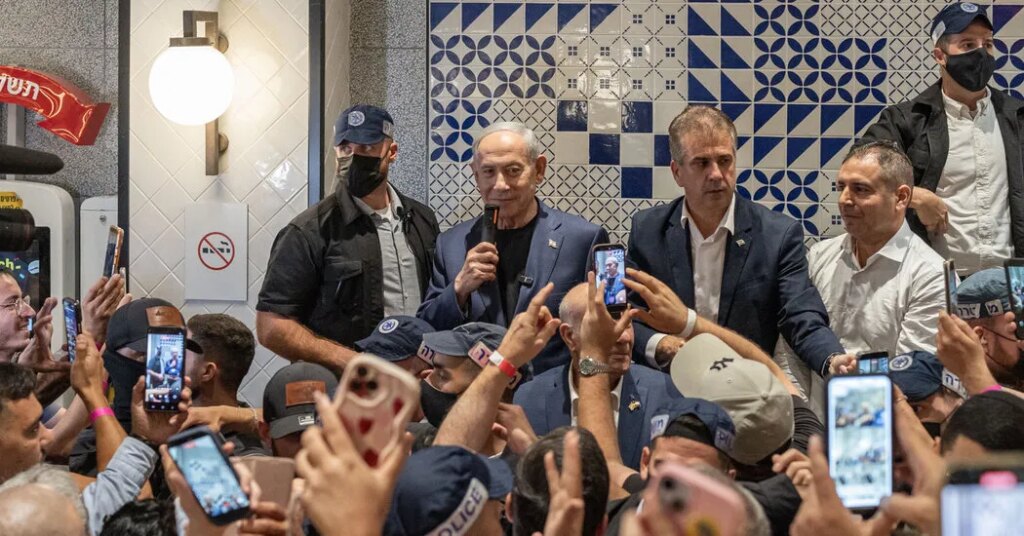
On a recent weeknight, security officers ushered Mr. Netanyahu into a grimy food court at a shopping mall in Holon, a Tel Aviv suburb. About 200 people were waiting for him.
“Bibi, King of Israel!” the crowd chanted, repeating a common refrain.
Struggling to be heard over an inadequate sound system, Mr. Netanyahu delivered a stump speech of barely 90 seconds.
“Do you want Mansour Abbas?” he asked, referring to the leader of an Arab political party that could play kingmaker in a close election.
“No!” the crowd cried.
“Well go out and vote Likud!” he exhorted, before being whisked away.
“I love him,” said Shimon Karni, 48, who was in the crowd. “I’m proud of what he’s done for Israel and the Jewish people,” he said. “May he be our prime minister till he’s 120.”
Mr. Netanyahu’s supporters call him a unique leader.
“The prime minister is a proud Israeli patriot who believes with every fiber of his being that he is the only leader capable of dealing with the challenges facing Israel,” said Ofer Golan, a former adviser to Mr. Netanyahu. “And I believe he is right.”
A Personal War
Since the last election, Mr. Netanyahu and his allies have also begun to target what they call enemies in the deep state, including Israel’s attorney general and top judges.
This transformation of Mr. Netanyahu began long before the Oct. 7 attacks, analysts say, dating it to 2019, when he was indicted on charges of bribery, fraud and breach of trust in three separate but related corruption cases. On trial since 2020, he has denied any wrongdoing and accused the deep state of trying to oust him through a judicial putsch after failing at the ballot box.
Mr. Netanyahu once pointed to Israel’s democratic institutions as a beacon in the Middle East. After he was indicted, “he perceived the legal apparatus as a direct foe,” said Yohanan Plesner, the president of the Israel Democracy Institute, a nonpartisan research group.
In January 2023, Mr. Netanyahu’s justice minister, Yariv Levin, announced a plan for a sweeping judicial overhaul. Mr. Netanyahu said it was necessary to rein in what he called an overactive judiciary, restore the balance between the branches of government and give more power to elected officials.
Opponents of the plan said the proposed measures would remove checks on government power and lead to a dictatorship of the majority. Mass protests erupted across the country. Some Israelis feared a civil war. Israel’s security chiefs said they warned repeatedly that the protests and social schism weakened Israel in the eyes of its enemies and would lead to war.
Mr. Netanyahu’s critics say he became engrossed in his personal troubles and surrounded himself with a shrinking coterie of loyalists.
“He was of course a man of many capabilities, but more important, he had a detailed strategic vision,” said Ehud Yaari, an Israel-based fellow of the Washington Institute for Near East Policy. His aims included developing relations with African nations and expanding agreements with Arab Gulf states.
“But instead of focusing on the big goals, he began his personal war,” Mr. Yaari said. “It was a different Netanyahu, with different priorities. His attention drifted elsewhere.”
Preserving the Coalition
For years, Mr. Netanyahu pursued formal relations with moderate Arab Gulf states to bypass Palestinians or pressure them into greater territorial compromise. After the Abraham Accords of 2020 normalized Israel’s relations with Morocco, Bahrain and the United Arab Emirates, the big prize was to be Saudi Arabia.
But Mr. Netanyahu’s far-right partners prevented him from proposing an eventual pathway to Palestinian statehood as the Saudi government demanded. In the past, he had paid lip service, at least, to the idea of a demilitarized Palestinian state.
“To preserve his coalition, he gave up on that too,” said Gayil Talshir, a political scientist at the Hebrew University of Jerusalem.
Instead, he has proceeded in lock step with members of his government seeking to eventually annex the West Bank. His policies there, together with his failure to tackle mounting violence by Israeli settlers against Palestinians, contributed to the recent imposition of sanctions by several countries once among Israel’s staunchest allies.
“We all wonder where his head is at, where his personal value system is,” said Shalom Lipner, another former aide to several Israeli leaders, including Mr. Netanyahu. He added, “We’ve seen him shift to be able to stay in the chair.”
The post Netanyahu Is Up for Re-election After Years of War. How Will Voters See Him? appeared first on New York Times.