PARIS ― Hundreds of thousands of people marched around France on Saturday, as authorities deployed massive security measures to avoid a repeat of last weekend, when protests over rising living costs spiraled into riots.
More than 70,000 police officers fanned out around Paris, Marseille, Bordeaux and other cities after last week’s riots left streets littered with torched cars and shattered storefronts.
The mayhem prompted scrutiny of the country’s leaders for failing to contain the violence and looting in France’s worst unrest in years.
As demonstrators returned to the streets under the eye of drones and helicopters, Saturday marked a test for the vigor of a month-long protest movement that began with student grievances but ballooned into a catchall display of frustration with the rising cost of living.
“We’re all fed up,” read one sign as protesters gathered in Paris. Another said this was the “anger of the youth,” and in the city of Rennes, a placard read: “We are the Republic.”
Protesters said they hoped, after the turmoil, to return the spotlight to their economic and social grievances and assert their right to protest.
Some cities banned any demonstrations in their downtown districts on Saturday. Stores and restaurants in Paris boarded up their facades or shuttered their doors ahead of the afternoon marches. The Louvre, the Musée d’Orsay and other cultural institutions closed for the day.
Even with the bouts of tension and rain, around 110,000 people came out in Paris, officials said, roughly the same as last week. The Interior Ministry estimated that 400,000 people marched around France, however, while the influential CGT labor union put the number at around 800,000.
In a visit to police early Saturday, Interior Minister Laurent Nunez instructed officers in the French capital to be “ultra, ultra responsive” and “absolutely uncompromising” with attempts to stir up disorder. “It’s going to be a long day,” he said.
Authorities have imposed curfews in parts of Paris and other cities all week, but allowed some demonstrations led by unions on Saturday along specific routes.
The tactics are far more restrictive than usual in France, where the constitution protects the right to protest. Government officials and French President Emmanuel Macron said the measures were necessary to maintain order and to protect businesses.
Tensions spiked further after a shooting on Friday that Macron described as a “racist terrorist attack” in the French town of Trappes, west of Paris.
Officials said a gunman suspected of acting out of racist and Islamophobic hatred had opened fire with an automatic weapon from a car, killing one person and wounding five others, including a 12-year-old girl who was shot multiple times.
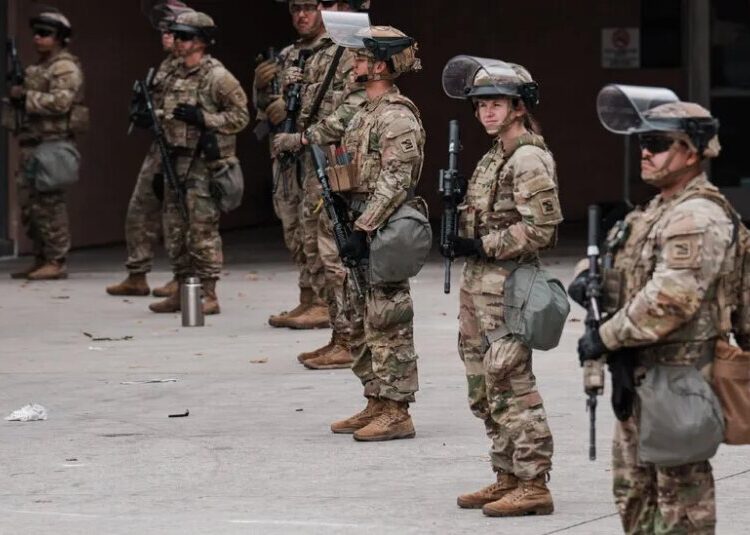
The interior minister said Saturday evening that “the marches went smoothly,” noting that the day was “not over yet.” A unit of military troops was also deployed to guard public buildings.
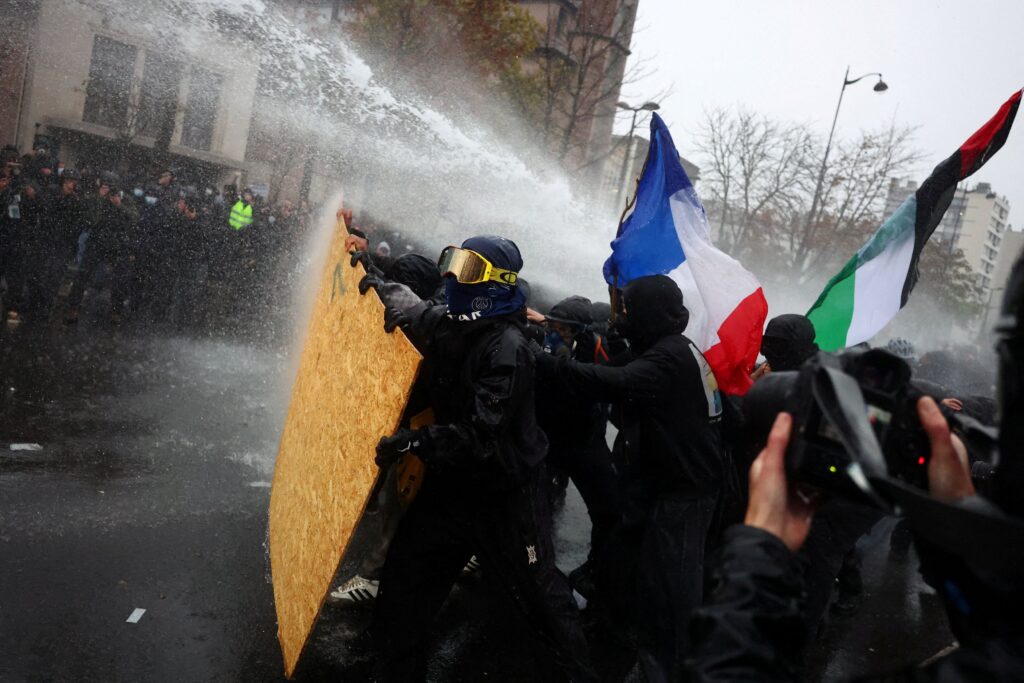
After a day of largely peaceful marches, some cat-and-mouse clashes broke out in Paris and Marseille as police sought to disperse the protests around sundown. Riot police unleashed tear gas and water cannons as groups of young men lit small fireworks.
In Lyon and Nice, police fired tear gas at crowds that turned up in defiance of the protest bans.
France’s simmering troubles are coming to a head months before a pivotal presidential election next spring, with far-right leader Marine Le Pen leading in the polls.
One flash point this weekend is the French town of Orléans, south of Paris, where Le Pen’s party is holding a two-day convention and she is set to formally launch her campaign for the presidency. Up to 20,000 are estimated to have come out Saturday to rally against Le Pen’s hard-right National Rally in what organizers called a stand “against racism and fascism.”
Several left-wing politicians joined the demonstration in Orléans on Saturday, as well as union leaders and the mayor of Trappes, the site of Friday’s attack.
A range of concerns, from energy prices to housing and education, has sent protests rippling through other European nations in recent days including Belgium and Portugal, though on a smaller scale. On Saturday, Italian authorities deployed soldiers in Milan, while crowds gathered in Rome and Florence.
After last weekend’s rioting in France, government officials acknowledged security lapses, blaming what they say are radicalized “ultraleft” groups for stirring up trouble and looters for seizing on the chaos to ransack stores.
The CGT union, which has called for the country to strike on Nov. 5 over rising prices and budget cuts, said Saturday’s “message was clear,” calling on the government to respond to protest demands.
“No ban on demonstrations will stop the mobilization,” it said. “The anger is immense, the determination even greater.”
The post French protests draw hundreds of thousands under tight security and rain appeared first on Washington Post.