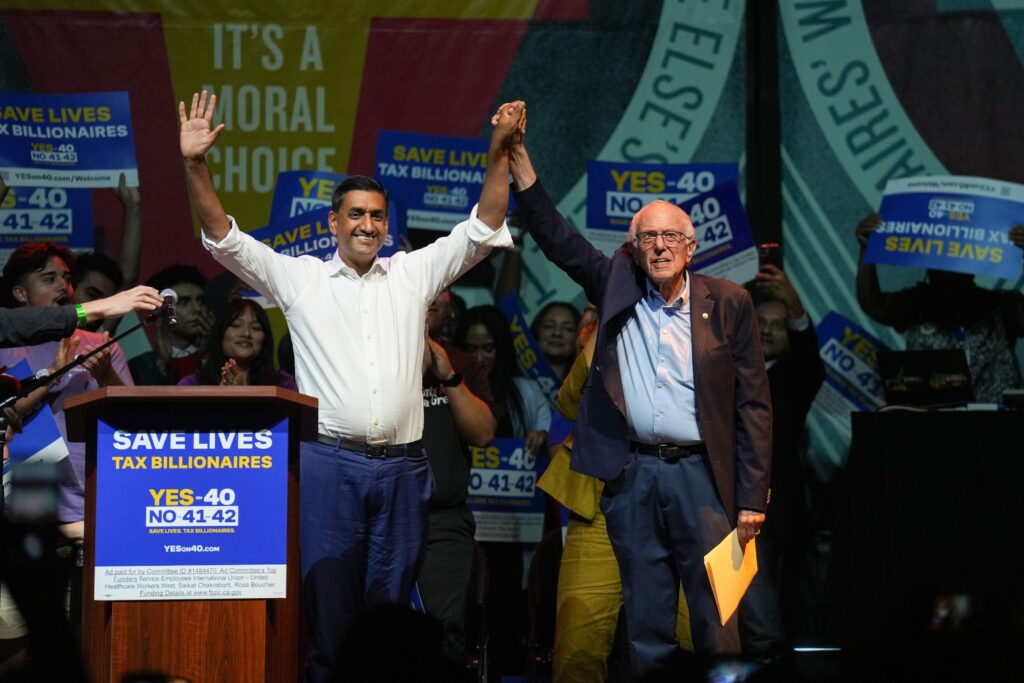
ORLANDO — Rep. Ro Khanna (D-California), a self-proclaimed “progressive capitalist” weighing a 2028 presidential bid, took his message here to the kind of people who could propel his ambitions.
He joined Angie Nixon, Florida’s progressive Senate Democratic candidate, to campaign at a town hall at the University of Central Florida. The event was part of Khanna’s four-stop college tour as he seeks to energize young voters and make inroads with them.
Khanna has been taking stepslike these to raise his national profile ahead of a possible campaign for the Democratic presidential nomination. He has been positioning himself to be one of the most appealing candidates to the party’s left wing.
But while Khanna shares progressive goals such as taxing the wealthy and strengthening labor unions, he diverges from other progressives, including Sen. Bernie Sanders (I-Vermont) and Rep. Alexandria Ocasio-Cortez (D-New York), who have electrified young voters with a focus on restricting corporate power. Khanna, who represents a Silicon Valley district, offers an economic vision for government to help expand technology and manufacturing, including in communities that have missed out on the tech boom.
That approach presents a tension at the heart of his pitch. As Khanna criticizes wealthy executives’ political influence, he also wants government to partner with them to spur investment and create jobs. The question is whether young voters will see that as a way to make powerful companies work for ordinary people, or whether it will fail to resonate with a coalition that is skeptical of big tech and capitalism itself.
Some young adults are wary of the “progressive capitalist” label. Carter Barnes, an 18-year-old political science major at UCF, said the two ideas are at odds.
“It’s a little bit of an oxymoron,” Barnes said. “I’m hesitant when somebody calls themselves a progressive capitalist because they will always serve capitalistic interests.”
A September NBC News poll found that 47 percent of registered voters ages 18 to 29 had a negative outlook on capitalism, underscoring the challenge Khanna faces in pitching an economic vision that combines progressive policies with a role for private industry.
Khanna discussed little of his broader economic agenda during his speech or the subsequent question-and-answer session with UCF students and Nixon. But he took on other issues that resonate with young voters.
Khanna’s speech ranged from condemning Israel’s actions in Gaza to highlighting his work with Rep. Thomas Massie (R-Kentucky) to force the release of the Epstein files. His remarks drew repeated rounds of applause, and when Trump voters in the crowd tried to talk over him during a question-and-answer portion, some attendees jumped to his defense.
A dozen students interviewed after the event offered mixed views of his economic agenda, though most reacted positively to his appearance.
Mohammed Al Najjar, a 22-year-old legal studies major at UCF who said he had listened to Khanna on podcasts, praised his willingness to work across party lines.
“I love that he does cross the aisle in a lot of situations to create some sort of bridge and remind people it’s not a left versus right issue,” Al Najjar said.
Al Najjar said he sees room for a blend of capitalist and socialist principles in the American economy, a view that aligns with Khanna’s effort to marry private-sector growth with an expanded social safety net.
“Capitalism and socialism both have a place in America,” Al Najjar said. “You have to have some sort of combination.”
Alberto Medina, a spokesperson for Tufts University’s Center for Information and Research on Civic Learning and Engagement, said economic issues remain central to young voters, particularly the costs of housing, groceries and health care.
For Khanna, “the real challenge is going to be making that case to young people that these economic policies are going to change their economic circumstances and improve their lives in a concrete way,” Medina said.
A key part of Khanna’s economic vision is spreading the benefits of the technology boom beyond Silicon Valley. He wants major technology companies to establish tech hubs and create jobs in rural communities and underserved areas. His proposal envisions the government using tax incentives to encourage companies to invest and hire in these communities.
Khanna argues that incentives alone would not be enough. His approach would also impose penalties on companies that move jobs overseas, alongside requirements that employers pay a living wage and remain neutral in union organizing.
“If Donald Trump can bully you to build his ballrooms, the next president should make these business leaders invest in America, in the Black South, in abandoned factory towns, in rural America,” Khanna told The Washington Post.
But asking young voters to trust corporations to help deliver economic opportunity could be a challenge.
Melchizedek El, 21, said he was open to the idea of expanding technology investment into rural communities, provided residents had a say in how those projects were developed. He raised concerns about companies using land and water in ways that could harm local farms.
Khanna’s domestic manufacturing agenda follows a similar approach, using investment to rebuild American industrial capacity. Factories in the United States have long been a concern for climate activists because of their greenhouse gas emissions and reliance on fossil fuels. Khanna said he wants to prioritize cleaner production.
He has pointed to modern steelmaking technologies, including hydrogen-based steel, as alternatives to traditional blast furnaces which typically rely on coal and produce significant emissions. He argues that expanding domestic manufacturing can create well-paying jobs while allowing the U.S. to set higher standards for industrial emissions than countries such as China.
Josh Ingalls Tanner, a 19-year-old hospitality major at UCF, questioned whether expanding domestic manufacturing would make economic sense if producing goods in the U.S. costs more than making them overseas. A higher price tag for U.S. goods due to production costs, he argued, could make it hard for U.S. manufacturers to compete.
“It’s not necessarily in touch with reality,” Tanner said. “It’s not an automatically good thing.”
All of the students interviewed by The Post said they would consider supporting Khanna for president.
Khanna told The Post that he plans to decide by the end of the year whether to pursue the Democratic nomination, though he may not publicly announce his decision until later. He said his choice largely depends on whether he has the support of his family. He’s also weighing if the political climate is too “toxic.”
The decision also comes down to whether he believes he can make a difference at a moment where he said people feel stuck in the economy and are looking for a path forward.
“They’re looking for someone who has a clear understanding of the modern economy,” Khanna said.
The post Ro Khanna, eyeing the White House, tries to sell capitalism to the left appeared first on Washington Post.