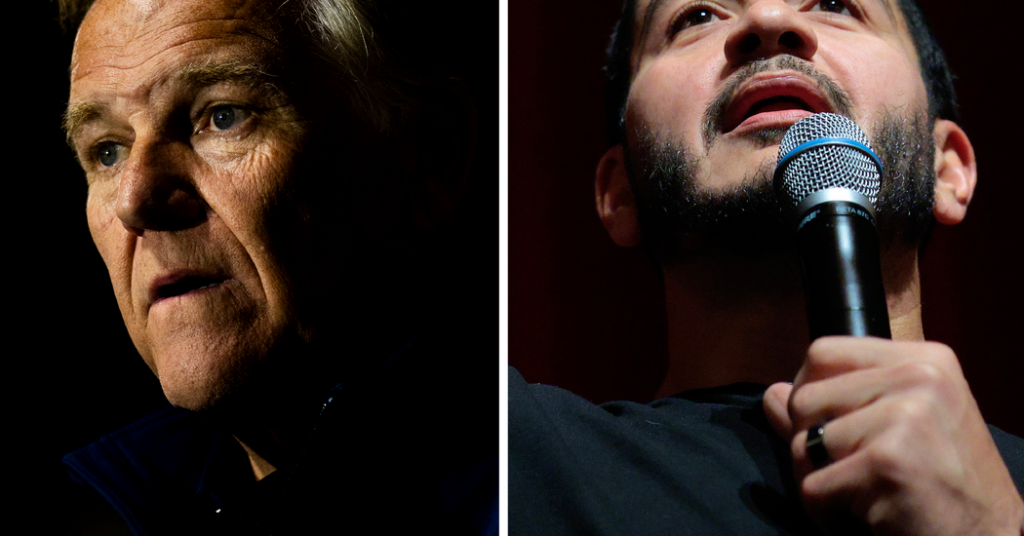
Mike Rogers snickered as his surrogate smeared his opponent.
At a recent campaign stop at a winery an hour outside Detroit, Senator John Kennedy of Louisiana told a scrum of reporters that Abdul El-Sayed, the Democratic nominee for Senate in Michigan and a Muslim, sleeps in an Osama “bin Laden jersey.”
Mr. Rogers, 63, swallowed a sip of his water and smiled. He is a former Army officer, F.B.I. agent and representative who headed the House Intelligence Committee until his term expired in 2015 after he opted not to run for re-election. Even Democrats considered him levelheaded and cooperative — “a voice,” as one lawmaker put it, “for moderation and consensus building.”
Now, though, Mr. Rogers is running to be the first Republican senator from Michigan in a quarter century — and running in a political era fundamentally different from the one in which he came of age. As the United States lurches toward Election Day, this race has come to embody the spiraling toxicity of the country’s politics.
While any of a handful of other competitive Senate contests could help determine the new balance of power in Washington, none comes close to matching the mounting racial and religious menace and meanness in Michigan. President Trump has taken to calling Dr. El-Sayed, a former public health official, a “jihadist.” When Dave Portnoy, a provocative internet celebrity, called Dr. El-Sayed a “terrorist,” Mr. Rogers was quick to respond. Mr. Portnoy, he said on social media, “is exactly right.”
Roxie Richner, a spokeswoman for Dr. El-Sayed, called the attacks on him “heinous.” He is “as Michigan as it gets,” she said.
Abby Ronson, a spokeswoman for Mr. Rogers, said Dr. El-Sayed was the one “spewing hate.” She cited his response to a Hezbollah-inspired attack on a Michigan synagogue that critics deemed insufficient and insen bc xsitive and for which he subsequently apologized. She also mentioned a comment in which he said when his opponents go low, “we take them to the mud and choke them out.”
Allies of Dr. El-Sayed dismiss any notion of equivalence. Ravi Mangla, a spokesman for the Working Families Party, which has endorsed Dr. El-Sayed, called the discourse from Mr. Rogers and his supporters “deeply racist and Islamophobic.”
Back at the winery in Highland Township, Mich., in a barn that had a dirt floor and smelled like horses, speakers rallied a crowd of more than 900 people wearing cowboy boots and MAGA hats. Many questioned Dr. El-Sayed’s patriotism.
“He’s a citizen, but that does not make him an American,” said David Beamer, the father of Todd Beamer, the leader of the passengers who thwarted the terrorists who hijacked Flight 93 on Sept. 11, 2001. “He’s not an American.”
“We believe in this country,” said Kristi Rogers, Mr. Rogers’s wife. “Our opponent does not.”
“We will save this country if we win this election,” Mr. Rogers said to rising hollers and applause. “The whole country is watching!”
‘Get him out of here!’
As the ugly rhetoric at Mr. Rogers’s campaign events has escalated, so, too, has a palpable sense of peril at those of Dr. El-Sayed.
One recent evening in Western Michigan, a group of far-right activists crashed a campaign stop in rural Oceana County, thrusting wooden crosses into the air and chanting that Dr. El-Sayed needed to be “deported.”
“This is our country!” Jake Lang, an influencer and provocateur who was pardoned by Mr. Trump after going to prison for his role in the Jan. 6 Capitol riot, bellowed into a bullhorn. “We will not be Islamified!” (Mr. Rogers has called Mr. Lang a divisive, violence-promoting “fringe extremist.”)
“Go home, dirty Arabs!” another man yelled.
The next afternoon in nearby Muskegon, in a downtown theater before a crowd of 1,400, Dr. El-Sayed stood on the stage in front of a Michigan flag and an American flag and between two bodyguards.
“Now, look, I’m not supposed to run for office,” he said.
“I’ve got the wrong name,” he added. “Apparently, I pray the wrong way.”
A burly man got up out of his seat near the front of the room. He was wearing hightops, sweatpants and a baggy white shirt with the image of a red Templar cross from the Crusades. He advanced toward Dr. El-Sayed.
The bodyguards moved toward him.
A campaign staffer confronted him.
“Let him talk,” Dr. El-Sayed said.
“The problem is,” the man said loudly, “his book says something different than my book.”
Dr. El-Sayed, 41, is the son of Egyptian immigrants and his first language was Arabic. He grew up mainly north of Detroit, raised mostly by his father and stepmother.
In the Democratic primary, Dr. El-Sayed campaigned with Hasan Piker, the incendiary anti-Israel streamer who recently told Axios that the United States “pound for pound” was responsible for more terror than Al Qaeda. Dr. El-Sayed has distanced himself from Mr. Piker but has not fully disavowed him.
At a debate earlier this month Mr. Rogers sought to tie Dr. El-Sayed and his family to Hamas, Hezbollah, Al Qaeda and the Muslim Brotherhood, part of a broader effort to make insinuations of such associations a central issue in the stretch run of this race. Afterward, Dr. El-Sayed was asked why he didn’t dispute those claims. “This is about trying to point to somebody whose name is different,” he said. “I’m just not going to dignify it.”
Since then, though, Dr. El-Sayed has pushed back, disavowing the Muslim Brotherhood during a town hall event over the weekend and in an exchange with a reporter from Newsmax.
In Muskegon, at the theater, Dr. El-Sayed talked to the man with the cross on his shirt.
“I’m grateful that you’re here,” Dr. El-Sayed told him. “Do you follow canon law?”
“Vaguely,” the man said.
“I would recommend as a Christian that you go read canon law,” Dr. El-Sayed said, “because it is supposed to pattern your life choices as a Christian. Here’s the thing about it: Because of the U.S. Constitution, you have the right to live according to canon law — and also because of the U.S. Constitution, you don’t get to enforce canon law on anyone else. You pray as you choose to pray, I pray as I choose to pray.”
The rest of the answer was all but drowned out by a deafening ovation. The man began to point and wave his hands. The cheers turned to jeers.
“Get him out of here!” people shouted.
“U.S.A.! U.S.A.!” Dr. El-Sayed said, and the crowd followed. “U.S.A.! U.S.A.!”
Three police officers approached the man and led him up the aisle and toward the door, and he turned amid the ruckus and his thumbs up switched to middle fingers.
‘They will make the right decision’
In speeches, Mr. Rogers calls himself a “proud son of Michigan and a product of the American dream.”
He grew up as one of five brothers in rural Brighton Township and helped pay for college by making Chryslers on car lines. He was in the Army in California. He worked for the F.B.I. in Chicago.
He was a state senator in the late 1990s before running for Congress in 2000. He won, by 88 votes, on an anti-negativity platform. “I’m not asking you to vote against my opponent,” he said in an ad. “I’m asking you to vote for me.”
He represented his mid-Michigan district for seven terms and became the Intelligence chair. He was a mainstay on political television shows after the rise of the Tea Party helped Republicans reclaim control of the House in 2010.
But he tired of the intensifying polarization and “brand identity politicians” doing the “celebrity thing,” he said at the time. In his last speech in Congress, he appealed to colleagues and citizens to “find the better part of our angels.”
He signed with Cumulus Media and Westwood One to do talk-radio commentary. In contrast to Rush Limbaugh or Sean Hannity, Mr. Rogers hoped there was space for “a more productive, you-might-actually-learn-something kind of talk radio,” he said at the time.
“I’m a bit of a canary in a coal mine,” he added. “I am hoping I don’t choke on the fumes at the bottom of the shaft.”
He was a national security commentator for CNN. He joined corporate boards to advise technology and cybersecurity firms.
He founded Americans for Peace, Prosperity and Security, putting on foreign policy forums featuring 2016 Republican presidential candidates like Lindsey Graham and Marco Rubio.
In 2020, Mr. Rogers warned that it was “exceptionally dangerous” that Mr. Trump was refusing to acknowledge that he had lost the presidential election. And in the aftermath of Jan. 6, he said it was “damn right” that Mr. Trump “had responsibility.”
In 2022 and 2023, Mr. Rogers explored the possibility of a presidential run of his own. “Trump’s time has passed,” he said in The Washington Post. “Angry and scary is not a way to win elections,” he said in New Hampshire.
Two years ago, though, Mr. Trump urged Mr. Rogers to run for the Senate. He lost by just 19,000 votes to Elissa Slotkin, the centrist former C.I.A. analyst and official for the Department of Defense.
This year, against a very different political opponent in a very different political environment, Mr. Rogers is working to put together a fragile and complicated coalition. He needs the MAGA base, Republicans who have soured on the president and small but sufficient slices of voters who typically pick Democrats — including Jewish and Black voters.
On the campaign trail, Mr. Kennedy, the senator from Louisiana, summed up the Michigan race in simple — if vulgar — terms.
“Mike Rogers pisses excellence,” Mr. Kennedy told reporters outside a factory he and Mr. Rogers toured. Dr. El-Sayed, he said, is part of “the Hamas wing of the Democratic Party.”
Mr. Rogers was asked if Mr. Trump’s continuing use of Dr. El-Sayed’s middle name — Mohamed — is a dog whistle “gone too far.”
“I can’t pick the guy’s middle name,” Mr. Rogers said. “It’s his legal middle name. My argument is maybe — his middle name — we should change it to ‘that big government socialist.’”
Ms. Ronson, the spokeswoman for Mr. Rogers, said that his campaign would not use such loaded language. “But we’re also not going to speak for the rest of the Republican Party, and we’re also not going to speak for the president.”
At the barn at the winery in Highland Township, after his speech, Mr. Rogers huddled with half a dozen Black women. They hugged him and posed for pictures. Together they bowed their heads and prayed.
Why, they were asked, were they voting for Mr. Rogers?
“If you’re going to hold office in America,” said Valeria Berry of Detroit, “you need to be an American.”
The post The Michigan Senate Race Keeps Getting Nastier appeared first on New York Times.