The rapid rise of artificial intelligence has stoked fears that powerful computers might someday replace humans, leaving millions of Americans out of work and without a steady income.
It’s a doomsday scenario, one that could potentially overwhelm the government’s ability to care for the swelling ranks of the unemployed. And the mere risk has caught the attention of Congress, where lawmakers are starting to explore ways to bolster the nation’s economic safety net before it is too late.
In recent months, Democrats and Republicans have unfurled a series of bills that aim to offset the potential job losses posed by the advent of A.I. The ideas may differ in scope and cost, but together they reflect a widening trepidation in Washington that the government has fallen behind in preparing for vast technological change.
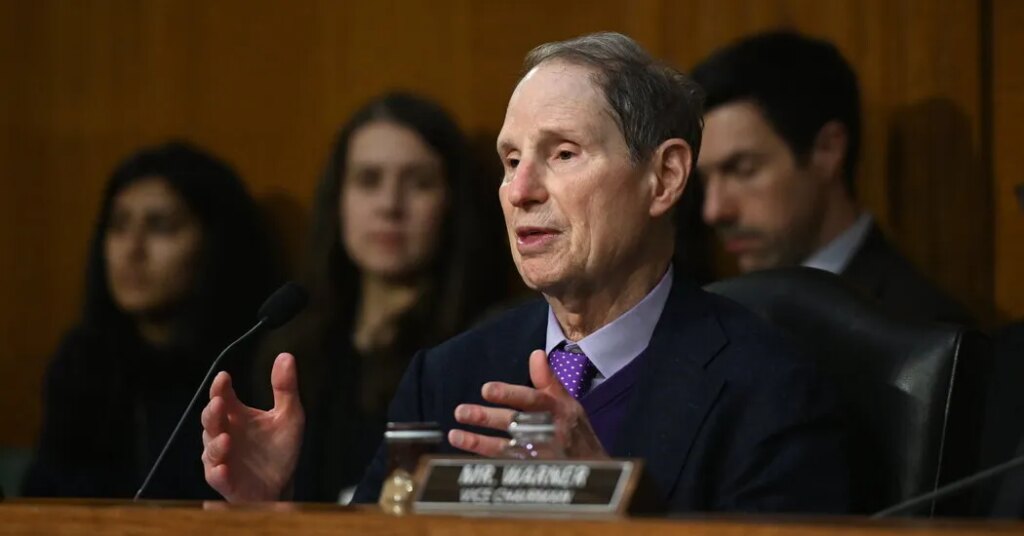
The latest proposal is set to arrive this week: a bill from Democrats including Senator Ron Wyden of Oregon, who leads his party on the chamber’s chief tax-writing committee, that would greatly expand the nation’s unemployment insurance program.
Existing jobless benefits cover a fraction of out-of-work Americans’ wages, generally for up to 26 weeks. Under Mr. Wyden’s bill, Congress would provide additional aid in times of high unemployment. Plus, there would be up to 26 weeks of further assistance to help those displaced by technology to learn new skills.
The bill includes other upgrades to a key federal safety-net program whose strains were obvious — and largely unresolved — amid the pandemic. With A.I., Mr. Wyden said, there is growing urgency to address those deficiencies, as the nation readies for “one of the biggest economic impacts on the economy in American history.”
“I think it would be malpractice to not get ready, because we’re in a position now where many citizens feel the looming fear of A.I. job losses,” he said. “And Congress has a responsibility to help the country get ready.”
The arrival of A.I. represents a seminal political test for the nation’s capital, where policymakers racked by division are slow to act except in times of crisis. The dynamic offers a contrast with the breakneck pace of development in Silicon Valley, where many believe that A.I. could auger swift and tectonic economic disruptions.
Speaking at a global conference this month, a co-founder of Anthropic projected that U.S. output could rise by almost 50 percent by 2030. But that same company’s chief executive, Dario Amodei, has coupled rosy growth forecasts with more dire warnings that A.I. could upend millions of workers’ lives.
For now, economists see no evidence that A.I. has altered the labor market on a grand scale. But there are still some emerging “A.I.-related hiring headwinds,” according to a report this week from Goldman Sachs, which found it has contributed to slower-than-expected job growth recently in some industries sensitive to technological change.
Martha Gimbel, the executive director of the Yale Budget Lab, emphasized that the signs do not yet suggest that A.I. is having a macroeconomic effect. But she also stressed that the work to measure those changes in real time was both “historically unusual” and difficult.
“In the middle of the Industrial Revolution, people weren’t trying to guess whether the weavers had been displaced yet,” she said.
The uncertainty has started to gain attention in Washington, where Democrats and Republicans have found common cause around the basic idea that the government should find better ways to measure the effects of A.I.
One of those bills, written by Senators Josh Hawley, Republican of Missouri, and Mark Warner, Democrat of Virginia, would require more robust reporting from companies about A.I.-related layoffs.
“I actually believe over a longer haul, five years plus, A.I. will probably create whole new categories of jobs,” Mr. Warner said. “But what does that do for the interim? And we don’t have good data yet.”
Despite bipartisan support, the bill and other, similar measures have stalled on Capitol Hill, where Republicans have largely followed President Trump in adopting a hands-off approach to artificial intelligence.
Bret Swanson, a technology expert at the conservative-leaning Heritage Foundation, said the reticence might stem from the fact that Republicans did not want to do anything to “disrupt these huge investments into A.I., which are sustaining what may otherwise be a rocky economy.”
That, Mr. Swanson continued, has affected even the debate over the implications for workers, which could “draw attention to the downsides” of A.I. in the eyes of a skeptical nation.
Mr. Trump’s top aides have dismissed any suggestion that A.I. could cause mass layoffs. In contrast, many Democrats still see wide-scale unemployment as a growing threat, and in response, party leaders have pursued measures meant to help Americans affected by technological change.
The roster of bills includes an attempt by Senator Mark Kelly, Democrat of Arizona, to tax tech giants’ profits for a new federal trust. That would help fund benefits and training for displaced workers. Another, by lawmakers including Representative Greg Casar, Democrat of Texas, would tax tech companies and channel the proceeds to job-creating infrastructure investments.
But those efforts to boost the federal safety net face an even tougher political climb, given long-simmering disputes between the parties about the role of government and the provision of federal benefits. The result is a sort of stasis on Capitol Hill, despite a “high level of anxiety” on both sides of the aisle over job losses, according to Gina Raimondo, the leader of Raise Us, a nonprofit focused on A.I. policy.
“My great worry, actually, is that they’ll do what Congress often does, which is wait until it’s too late,” added Ms. Raimondo, whose group is backed by tech companies. She formerly served as commerce secretary under President Joseph R. Biden Jr.
There is also the thornier political question of who, exactly, should pay for it.
A handful of tech giants, including Anthropic and OpenAI, have publicly supported ideas that would set aside some of their expected new riches for Americans, especially those displaced by artificial intelligence. This week, Anthropic announced it would set aside a portion of its stock for a “public benefit fund,” and Elon Musk, the founder of SpaceX, followed by promising to give away shares to “every kid in America.”
Otherwise, most tech companies have steered clear of endorsing specific bills in Congress targeting tech wealth. In the meantime, these companies and their executives have committed millions of dollars toward trying to elect tech-friendly lawmakers in the midterm elections, despite growing voter resentment.
Mr. Wyden said he believed that backlash was “starting to open some eyes” in Silicon Valley. But he acknowledged that A.I. companies had not endorsed his new legislation, called the Stability and Opportunity for Workers Act. The measure is backed by other Democrats, including Michael Bennet of Colorado, Elizabeth Warren of Massachusetts and Chuck Schumer of New York.
If adopted, the bill would raise the minimum level of unemployment benefits, which vary by state but on average cover less than half of workers’ past wages, according to program advocates. It would also expand the pool of people eligible to receive aid.
For the moment, his proposal does not have an official cost estimate, and Mr. Wyden did not include a provision to pay for the benefits, which currently are funded by employer payroll taxes. In other legislation, he has called for taxing tech giants and their data centers as a way to ensure that “big companies play a role” in offsetting their burden.
Still, Mr. Wyden added of the new legislative push: “There’s a lot of work to do.”
The post Fearing Mass A.I. Layoffs, Some in Congress Eye Ways to Aid Workers appeared first on New York Times.