Over the past year, President Trump and his allies have offered a series of explanations for why the nation needs a 250-foot-tall triumphal arch: It will mark 250 years of American independence. It will befit Washington’s place among Western capitals. It will honor the nation’s veterans. It will serve the military, the president added last month, as a platform for snipers.
But as the mega project planned for Memorial Circle heads to a final vote by the National Capital Planning Commission Nov. 5, the Trump administration has circled around one argument crucial to the project’s legal defense: The arch will at long last bring to life, officials say, a proposal that has languished on hallowed land for a century.
“It is a national embarrassment that policymakers have neglected for more than 100 years to build a congressionally authorized monument on this circle,” Mark Paoletta, an administration lawyer and the new chair of the planning commission, wrote this month in an essay in The Federalist that offers a kind of closing argument for the project. Construction could start as soon as Nov. 5, once the commission votes, the government has said in court.
This framing ties the legal rationale for the arch to a historical one. And it rebuts critics who say the monument is a vanity project of the president; on the contrary, this history implies, the whole thing isn’t even his idea. Expanding on his essay, Mr. Paoletta told The New York Times it was a “betrayal” of historical plans for Memorial Circle that the entrance to Arlington National Cemetery today is a “pathetic empty grass traffic circle.”
The fight over the project isn’t just about whether something should go there; even some of the president’s critics agree the grass is underwhelming. The issue is whether a law passed in 1925 empowers Mr. Trump to make his arch the answer when Congress has since said only it can authorize new monuments in the capital.
The administration argues that Congress effectively authorized the arch a century ago. That’s because it says the project fulfills the “historic design intent” of a never-built proposal from the 1920s by the Arlington Memorial Bridge Commission.
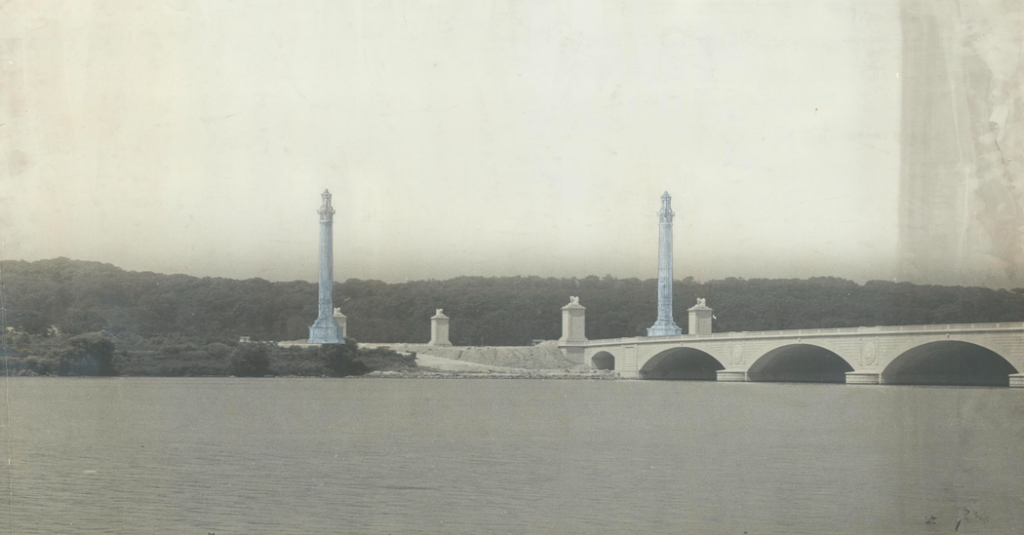
That proposal: a pair of slender and widely spaced columns at the western end of a new bridge spanning the Potomac River.
Architectural historians and design professionals have balked at the claim that a 250-foot arch could follow from those columns, or that they have represented an unfilled legacy for the last 100 years.
“The idea that this proposal is somehow justified by what happened in the 1920s and ’30s with the proposals for the bridge — not to be blunt about it, but it just doesn’t pass the laugh test,” David Maloney, the District of Columbia’s state historic preservation officer, told the National Park Service in a recorded meeting in September.
History, critics say, has become a pretext for the president’s desires.
Mr. Paoletta’s retort: “The fact that his vision accorded with the view of the Arlington Memorial Bridge Commission just demonstrates his tremendous eye as a builder.”
Vince Haley, the director of the White House Domestic Policy Council, said in a statement, “The Triumphal Arch in Memorial Circle will fulfill a century-long American vision to create one of the most iconic landmarks not only in Washington, D.C., but throughout the world.”
Basing this strategy on history, however, has created some incongruities.
The administration has declined to consider designs resembling those original columns. It has struggled to explain how plans to commemorate the nation’s 250th anniversary derive from the 1920s. And it has insisted the arch can’t be located anywhere else — perhaps the cleanest resolution that would give Mr. Trump his arch while preserving other historic sites — because of its inseparable link to the Memorial Bridge plan.
Two stately columns
When Mr. Trump began talking publicly about the arch last fall, he said he wanted a monument “like the one in Paris.” But bigger. The world’s most powerful nation, he reasoned, should have the biggest arch of all. He did not mention the 1924 Memorial Bridge Commission report or its plans for a pair of 166-foot columns at the bridge’s western end.
In February, a group of veterans sued over the project, arguing that the administration lacked congressional approval. The government responded in March, introducing the idea of the 1920s-era authorization.
The bridge commission intended “two stately columns” that would be “surmounted by statues,” government lawyers quoted from the original report. Congress in 1925 authorized construction of the commission’s plans, giving the group discretion to revise them. The government said that even though the bridge was completed without the columns, “neither the underlying congressional authorization to build the columns — nor the discretion to modify column design — have expired.”
Mr. Trump, in other words, can still pick up those 166-foot columns a century later…
What began as a legal defense became embedded in the design of the arch and how officials described it. The first detailed plans were released ahead of an April Commission of Fine Arts meeting, specifying an arch that was 166 feet tall — a homage to the earlier columns — with the statues on top bringing the total height to 250 feet.
Interior Secretary Doug Burgum introduced the project at the meeting by telling the story of the Memorial Bridge Commission, and he invoked it again last month in announcing the start of what he called excavation work. In official documents, the Park Service has said the project is “grounded in the historic design intent” for the bridge and so must be located there, even if building it will detract from dozens of historic sites.
In a tense meeting with preservationists in September, a Park Service official, Tammy Stidham, defended the project when pressed on whether the commission in 1924 had in mind the nation’s 250th anniversary, or a triumphal arch.
“It did not contemplate what we are contemplating now,” she said. “But I think the intention is that what is contemplated now fulfills what was originally intended.”
Negative space
When it introduced this history in the arch lawsuit, the government left out a key phrase from the 1924 report. The commission described two stately columns “framing in but not interfering with the view of the Lincoln Memorial from the direction of the Lee Mansion.”
The commission explicitly did not want anything to interrupt the sightline from Robert E. Lee’s home in Arlington National Cemetery looking east across the bridge toward the Lincoln Memorial. Views between the two were integral to the whole composition, designed to evoke reconciliation between the North and the South. The original columns, also symbolizing North and South, were to bound that view, not block it.
Today, a central objection to the arch is precisely that it would interfere with this view, as renderings by Mr. Trump’s architect acknowledge:
What the commission clearly had in mind, said Neil Flanagan, an architect and public historian in Washington, was “negative space” — a clearing designed to enhance what could be seen through it.
“In fact,” Mr. Flanagan said, “sculpting the negative space at the center of the corridor is the purpose of almost every major design decision described in the report.”
The historical record also suggests not that the commission wasn’t able to complete the columns, but that officials chose not to.
Frederick Law Olmsted Jr., who sat on the planning commission, thought the plaza was too architecturally elaborate. Adolph Weinman, a sculptor on the arts commission, thought the columns might look like smokestacks. The bridge commission itself worried about how expensive it was all becoming. And there were concerns, shared by President Herbert Hoover, that the columns would interfere with flights to a nearby airport roughly where the Pentagon is now.
Facing these objections, the commission decided in December 1931 not to build the columns (they had evolved to 181 feet tall, suggesting no special meaning in the 166-foot number).
The architect William Mitchell Kendall and the arts commission went on to try several lower-profile alternatives — pools, pavilions, fountains — none of which panned out.
In this history, the columns look less like unfinished business than a discarded idea.
The 1925 law also authorized a “10-year program” of expenses and construction, “in a total sum not to exceed $14,750,000.” Those details imply that Congress intended to authorize a one-time project for the bridge, not a continuing invitation for development, said the Georgetown law professor David Super.
Mr. Paoletta argued the original budget doesn’t apply to the arch today because the arch would be funded primarily by outside gifts, not taxpayer dollars. And he pointed to another element of the bridge that wasn’t finished until years later, when the Arts of War and Arts of Peace equestrian statues were installed in 1951.
The dedication of those statues, an official history of the bridge noted years later, “brought work on the Memorial Bridge to a conclusion.”
Larry Buchanan contributed production, and Kirsten Noyes contributed research.
The post Does Congress Need to Approve the Arch? Trump Says It Did 100 Years Ago. appeared first on New York Times.