Nine years ago, Paul and Sarah Bookbinder were asked if they could take in two abandoned and injured raccoons. Paul, a veterinarian who focused on cats and dogs, was willing — but there was one problem: He knew nothing about treating raccoons.
The Bookbinders agreed to keep the baby raccoons, known as kits, in their bicycle shed while they searched for a licensed wildlife rehabilitator. They expected the arrangement to be temporary. Instead, they quickly became attached to the kits, whom they named Stanley and Laurel.
“There’s an intelligence behind their eyes that, once you connect to that intelligence, it’s not like any other animal,” Sarah said. “It takes your breath away.”
The couple said they couldn’t find a wildlife rehabilitator with room to treat the raccoons, and the kits died a few days later. They cried and buried Stanley and Laurel in their backyard.
The Bookbinders decided that would never happen again.
The couple bought a 53-acre property in Earlville, New York, where they opened a raccoon rehabilitation center in 2018. They sold their house the following year to live there.
In the years since, they’ve poured nearly all of their time and savings into rehabilitating hundreds of abandoned and injured animals and releasing them into the wild.
They estimate they’ve helped more than 800 raccoons so far. The couple have even engraved pictures of raccoons onto their wedding rings.
The job, at times, still includes heartbreak. Some of the raccoons succumb to injuries or illnesses soon after coming to the center, but the Bookbinders said many raccoons wouldn’t survive without their care.
“We always tell each other that we’re not the ones that matter. The raccoons are the ones that matter,” Paul said. “And if we have to suffer in order to help them, then as long as we’re physically and mentally capable of doing it, we’re going to keep doing it.”
While the Bookbinders said Stanley and Laurel inspired the turning point of their lives, their interest in raccoons might have begun as children. Sarah drew a picture of a raccoon for her dad when she was around 8 years old with the caption: “All [raccoons] are cute.”
During a childhood camping trip in Upstate New York, Paul and his family were roasting marshmallows when a raccoon approached them. They gave the raccoon a few marshmallows, and about five minutes later, it returned with other raccoons for more. While Paul later learned that feeding raccoons can be dangerous for people and animals, he was impressed at the time by the raccoon’s generosity.
Neither Sarah, 54, nor Paul, 66, thought much about raccoons in the following decades until they met Stanley and Laurel. After the raccoons died, the Bookbinders began building the Charles N. Gordon Wildlife Rehabilitation Center, which is named after Paul’s late uncle who the couple said left them a small inheritance that helped kick-start the facility.
Since then, Sarah said she has woken up every morning wondering, “What can I do today to make it better to be a raccoon?” The Bookbinders said they have sacrificed vacations, family gatherings and countless hours of sleep to focus on the raccoons.
“My mother has resigned herself to the fact that her grandchildren are mostly raccoons,” Sarah said.
The spring, when raccoons give birth, is the busiest season. Wildlife officials, veterinarians, friends and strangers across the state bring them abandoned kits, often because their mothers or they have been shot, hit by cars or are sick. The Bookbinders keep a net and gloves in their car in case they come across sick or injured kits who have been abandoned.
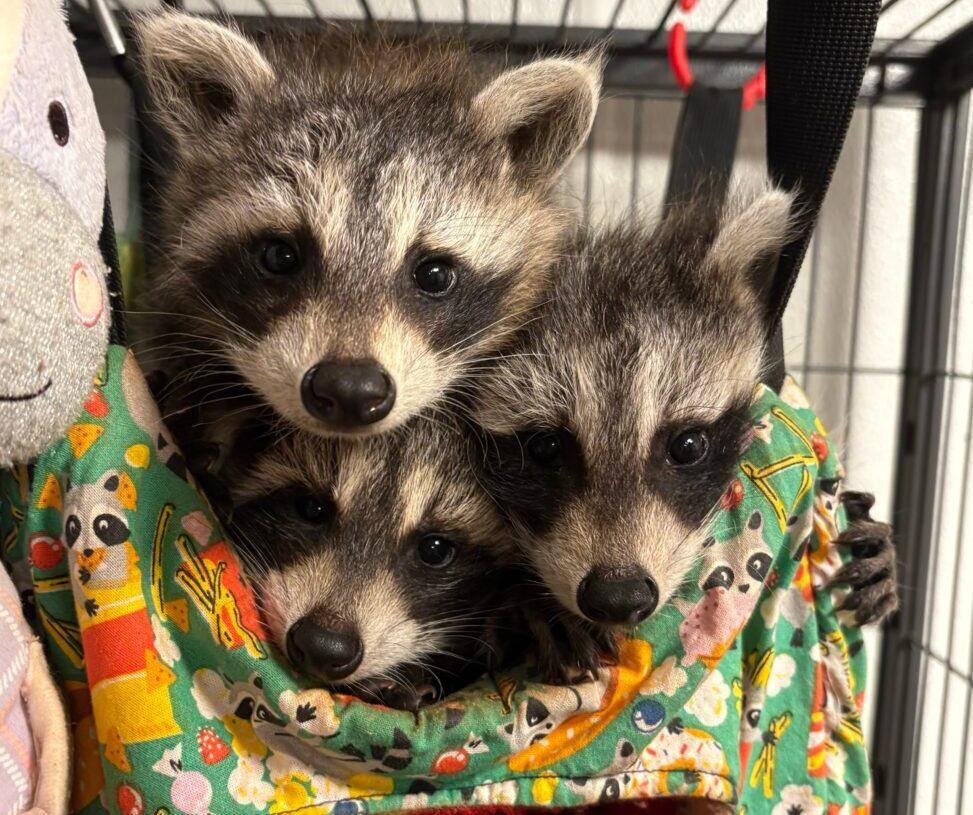
Sarah bottle feeds kits formula designed for the animals; they eat between two and eight times a day. Nothing prepared Sarah for her first spring. She went through more than 200 bottles daily.
“The first minute I bottle fed a baby raccoon,” Sarah said, “I understood what my hands were for.”
When the raccoons are around 3 months old, Sarah moves them to sheds full of natural foods, including nuts, eggs, worms and crickets that are buried under dirt for the raccoons to forage. There are also hammocks, ladders and tire swings that the raccoons use for climbing.
Sarah tries to avoid interacting with them and doesn’t want people to speak around them so they can learn to survive in the wild without relying on people.
There are signs when the raccoons are ready to be released: They hide from people, growl at them and try to escape. Typically this occurs in the late summer or early fall.
The Bookbinders said they become emotional during every release but know the raccoons have ample space to explore: The center borders about 600 acres of state forest.
“It’s like your kid going off to college,” Sarah said, “except that you’re never going to see them again.”
An even harder part of the job, the Bookbinders said, is caring for raccoons who die before they’re released.
Paul said he performed surgery on a raccoon whose jaw was broken beyond repair in 2023. The raccoon would have starved to death because he couldn’t eat, said Paul, who broke into tears in the surgery room when he realized he needed to euthanize the raccoon.
In addition to rehabilitating raccoons, the Bookbinders keep about two dozen raccoons who they think won’t survive in the wild due to injuries. The residents include Peanut, who has a vestibular condition that prevents him from climbing down, and Tribble, who was born with legs so short she can’t climb. The Bookbinders take her for strolls in a baby stroller.
Some injured raccoons who the Bookbinders thought would join that group have pleasantly surprised the couple.
There was one raccoon who dragged her chin as she walked because she couldn’t use her forelegs. A few days after she arrived, Sarah found the raccoon in a heating duct, meaning she had used her forelegs to climb — a sign she could recover.
The raccoon, named Cosette, gradually gained strength until she was released about eight months later.
After releasing raccoons, the Bookbinders engrave each one’s name — including the raccoons who died in care — on a rock that’s placed in a garden among irises and lilacs.
“We’re actually in the process of redoing the rock garden because we ran out of room,” Sarah said. “We never thought it would be this big.”
On Thursday, the Bookbinders plan to release their final group of the year. Rocks for all six of the raccoons — Malbec, Merlot, Ginger, Kim Chee, Syrah and Wasabi — will be added to the garden, in hopes they are never forgotten.
The post This couple opened a rehab for raccoons. They’ve saved 800 so far. appeared first on Washington Post.